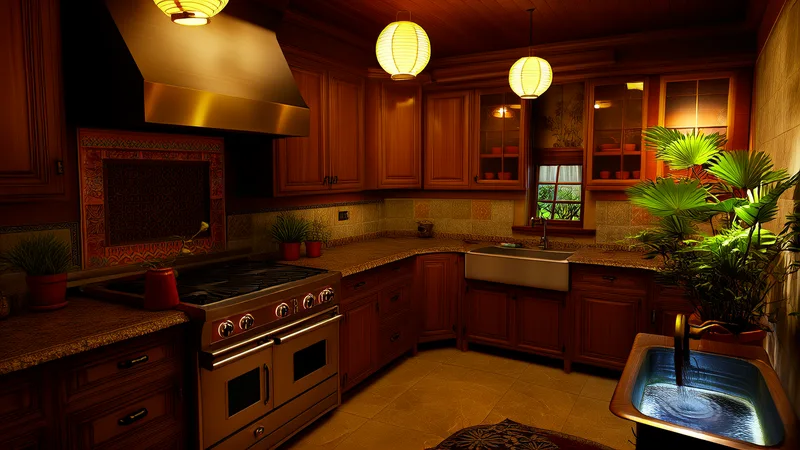
Why Is the Kitchen So Important in Feng Shui?
The kitchen has traditionally been one of the most important areas of a Chinese home. Before modern supply chains and convenience food, the ability to cook was literally a matter of family survival. Food, cooking, fire, and household wellbeing were historically inseparable.
In the Five Elements theory of Chinese philosophy, the stove is strongly associated with Fire, while water fixtures such as sinks are associated with Water. This is why traditional feng shui pays such careful attention to their relationship. The kitchen represents nourishment, prosperity, and the family's capacity to thrive — and the stove, as the source of cooked food, became the most symbolically significant element within it.
Even in modern homes where food can be ordered or bought prepared, the cultural weight of the kitchen in feng shui remains. It represents the household's relationship with abundance and sustenance.
The Feng Shui Meaning of the Stove
The stove represents fire and, symbolically, food and nourishment. Because food is fundamental to family life, traditional feng shui often treats the stove as an important indicator of household prosperity. The condition, cleanliness, and position of the stove are therefore given attention that might seem excessive to those unfamiliar with the tradition.
A well-maintained, clean, fully-functioning stove is considered auspicious — it symbolizes that the household is nourished and that the fire of the home is strong and controlled. A broken, dirty, or poorly positioned stove carries the opposite symbolism.
Avoid Direct Conflict Between Stove and Sink
One of the most recognizable feng shui kitchen concepts is the Water-Fire conflict. The sink represents Water. The stove represents Fire. Placing them directly opposite each other creates what traditional feng shui calls a clash of opposing elements.
From a practical perspective, there are also real reasons to separate them. Cooking near a sink area can create unnecessary splashing, steam condensation on hot surfaces, and inconvenient workflow. Keeping enough separation between the stove and sink is more functional regardless of feng shui beliefs.
If your kitchen layout places them directly opposite and renovation is impossible, some feng shui practitioners recommend placing a wooden element between them — such as a wooden chopping board, a small wooden cabinet, or a plant — to symbolically mediate between the two conflicting elements. Wood feeds Fire and absorbs Water, so it acts as a bridge.
Where Should the Stove Be Positioned?
Traditional feng shui has several recommendations for stove positioning beyond simply avoiding direct sink alignment. The stove should ideally:
- Have stable support and not feel cramped or difficult to access safely
- Not directly face the main entrance of the kitchen or the home
- Not sit immediately beside the sink (Water-Fire adjacency is also cautioned, not only direct opposition)
- Not be placed in an awkward traffic path where people walk behind the cook
- Have adequate ventilation above it — the exhaust hood should function properly
- Ideally allow the cook to see the kitchen door while working
The last point relates to the broader feng shui principle of the command position: wherever possible, a person should be able to see the main entry point of a room without turning their back to it. A cook who cannot see who is entering the kitchen may feel subconsciously unsettled.
Should the Kitchen Face the Front Door?
Traditional feng shui often considers a stove or kitchen that is directly visible from the main entrance undesirable. The symbolic explanation is that wealth and beneficial energy entering the home encounter the strong Fire element of the kitchen immediately, before circulating through the rest of the house.
Simple solutions that do not require major renovation include:
- A decorative screen or room divider
- A kitchen island that creates visual separation
- A partial wall or cabinets that shield the stove view
- Curtains or a beaded partition at the kitchen entrance
- Arranging the kitchen layout so the stove is not the first thing visible from the front door
Kitchen Cleanliness: The Most Important Rule
If there is one feng shui kitchen rule that applies universally and practically, it is this: keep the kitchen clean. A dirty kitchen creates odors, attracts pests, increases hygiene problems, and creates an unpleasant environment that affects the entire household's quality of life.
Traditional feng shui agrees. A neglected kitchen — regardless of how well it was laid out — is considered inauspicious because it represents a household that does not tend to its center of nourishment. The symbolic significance of food and cooking means that the kitchen's condition reflects the household's overall relationship with prosperity and care.
Areas that deserve regular attention:
- The stove surface and burners
- The exhaust hood and filters
- The sink and drain
- Countertops and preparation surfaces
- The refrigerator — interior and exterior
- Floor and baseboards near cooking areas
- Storage inside cabinets, especially near the stove
Can the Kitchen Suppress or Enhance Feng Shui?
Interestingly, traditional feng shui does not treat the kitchen as purely positive or purely negative. Because the kitchen represents strong Fire energy, classical feng shui approaches sometimes use it strategically within a floor plan. A kitchen placed in a sector of the home that carries inauspicious energy can, in some traditional frameworks, use the active Fire element to suppress or neutralize that unfavorable energy.
This is an example of why feng shui cannot always be reduced to simple rules like "this room is good" or "this room is bad." The relationship between all spaces matters, and the kitchen's position in the overall floor plan requires consideration of the whole home — not just the kitchen itself in isolation.
Should the Kitchen and Dining Room Be Separated?
Modern homes increasingly combine kitchen, dining, and living areas in open-plan layouts. Traditional feng shui may have preferred some degree of separation between food preparation and dining — the kitchen involves heat, steam, cooking smells, and active movement, while the dining area is ideally calmer and more focused on the experience of eating together.
Complete separation is rarely practical in contemporary apartments and houses, but a visual transition can be enough:
- Different flooring materials in kitchen and dining zones
- A kitchen island that creates a natural boundary
- Different ceiling heights or lighting levels
- A half-wall or breakfast bar
- Strategic furniture placement
- Decorative screens used as visual dividers
Ventilation and the Kitchen
Proper ventilation in the kitchen is both a traditional feng shui concern and a modern health necessity. Traditional feng shui emphasizes that cooking smoke, steam, and odors should not accumulate and circulate through the home. An effective exhaust hood that actually vents air outside — rather than simply recirculating it — is one of the most useful kitchen improvements available.
Modern building science supports this equally strongly: cooking produces particulate matter, moisture, and volatile organic compounds that affect indoor air quality. A kitchen with inadequate ventilation creates health problems over time, regardless of its feng shui layout.
The Modern Kitchen Feng Shui Summary
The best modern interpretation of kitchen feng shui comes down to a simple set of practical priorities:
- Fire safe: stove properly maintained and not in a dangerous traffic path
- Water controlled: sink and drainage in good working order
- Elements balanced: stove and sink not in direct conflict
- Food clean: kitchen kept clean, organized, and free of pests
- Ventilation effective: cooking fumes removed properly
- Workspace uncluttered: countertops clear for preparation
- Cook positioned well: able to see the kitchen entrance while working
A kitchen that is clean, well-ventilated, and logically organized is good feng shui — whether you measure that by traditional Chinese philosophy or modern principles of functional kitchen design.