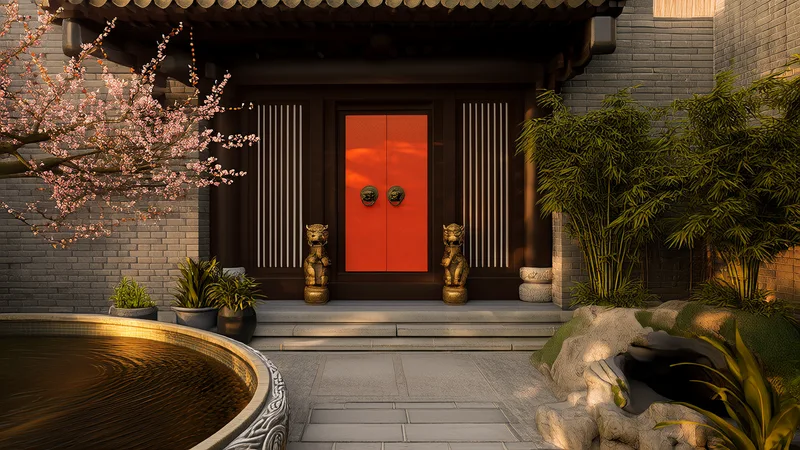
Why Is the Front Door So Important in Feng Shui?
In traditional Chinese feng shui, the front door is often called the "mouth of qi" (气口). It is the main entrance through which people, air, light, and symbolic energy enter the home. Every visitor, every breeze, every beam of morning sunlight comes through this opening — and traditional feng shui treats this as the most influential point of any home's energy design.
This gives the front door and its surrounding entryway exceptional importance. The direction the door faces, what stands in front of it, its color, its condition, what surrounds it, and whether the path leading to it is clear and welcoming — all of these factors receive close attention in feng shui practice.
Even without any belief in metaphysical qi, the front door matters greatly. It is the first impression your home makes on visitors and on yourself every day. A welcoming, clean, well-lit entrance sets an entirely different psychological tone than a cluttered, dark, difficult entryway.
Is a Large Tree Directly in Front of the Door Bad Feng Shui?
Not necessarily — but positioning matters significantly. Traditional feng shui sometimes considers a large tree directly blocking the front entrance a form of Ding Xin Sha (顶心煞), meaning the tree symbolically blocks incoming qi from reaching the door.
There are also several practical concerns with a very large tree immediately in front of an entrance:
- Root systems can damage the path, steps, or foundation over time
- Fallen branches create safety and maintenance issues
- The tree reduces natural daylight reaching the entrance area
- Dense foliage can make the approach feel dark and enclosed
- Pests attracted to the tree may enter the home more easily
- Reduced visibility affects both aesthetics and security
Trees placed to the side of an entrance, however, are generally not considered problematic — and a healthy, well-maintained tree can make a home feel more welcoming and grounded. The issue is specifically a large tree in the direct line of approach to the door.
What About Vines Growing Around the Entrance?
Traditional feng shui is often cautious about excessive vines growing around or near entrances. Because vines wrap and entangle structures, they are sometimes symbolically associated with:
- Complicated relationships
- Entanglements and delays
- Persistent, creeping problems
- Slow progress in personal or professional matters
This is a traditional symbolic interpretation rather than a proven causal relationship. However, from a purely practical standpoint, unchecked vines can also damage exterior walls, block gutters, obscure windows, and make the entrance feel overgrown and neglected rather than welcoming.
Controlled climbing plants — properly maintained and kept away from windows, door frames, and gutters — are a different matter and can make an entrance genuinely attractive.
What Makes a Good Feng Shui Front Door?
A good feng shui entrance follows one simple overriding principle: clean, bright, easy to approach, and proportionate to the house. Everything else is secondary to these four qualities.
Practical aspects of a welcoming entrance include:
- A clean, unobstructed path leading to the door
- Good lighting, especially for evening hours
- A door that opens easily and closes securely
- No trash, broken objects, or excessive clutter at or near the entrance
- A doorbell or knocker in working order
- House numbers that are visible and clearly readable
- Appropriate plants or flowers that are well-maintained
- A welcome mat that is clean and in good condition
Traditional feng shui adds that the entrance should feel proportionate to the home — neither overwhelmingly grand nor so modest that it is difficult to find.
Should Two Doors Face Each Other?
When two interior doors directly face each other, traditional feng shui may describe this as a door clash — the qi from one space collides directly with qi from another. This is particularly discussed in the context of a bedroom door facing a bathroom door, or a front door facing another room's doorway.
Practical solutions are usually straightforward:
- Change one door's swing direction where possible
- Add a screen or partition between the two doorways
- Rearrange furniture to break the direct visual line
- Keep one door habitually closed to reduce the direct alignment effect
See the related article on door-to-door feng shui for a more detailed discussion.
Should the Front Door Face the Back Door? The Through-Flow Problem
When you open the front door and can immediately see through the entire home to a back door or large rear window, traditional feng shui considers this a significant layout problem called Chuan Tang Sha (穿堂煞) — the through-flow sha.
The traditional idea: qi enters through the front and escapes immediately through the opposite opening, without having the opportunity to circulate and settle throughout the home. This is associated with difficulty retaining wealth and stability.
Modern architectural thinking offers a parallel observation: a direct visual and physical corridor straight through the home reduces privacy, limits furniture placement options, and can make the home feel like a passageway rather than a comfortable living space.
Traditional feng shui solutions include:
- A decorative screen or room divider
- Indoor plants placed to break the direct visual line
- A console table or bookcase creating a visual stop point
- Curtains on the rear window or door
- A partial partition or hallway furniture arrangement
The goal is not to completely block the space, but to create a more gradual transition through the home so that movement and energy slow and spread rather than rushing straight through.
Does Front Door Color Affect Fortune in Feng Shui?
Traditional feng shui sometimes selects front door colors according to compass direction, Five Elements associations, house orientation, and the homeowner's personal system. For example:
- South-facing door: red, orange, or strong warm tones associated with Fire
- North-facing door: dark blue or black associated with Water
- East-facing door: green or teal associated with Wood
- West-facing door: white or metallic tones associated with Metal
However, there is no universally correct "lucky" front door color that works equally for every home and every person. The most important things are to choose a color that suits the home's overall design, to keep the door in good condition, and — if following a traditional feng shui system — to apply that system consistently rather than mixing incompatible rules from different schools.
Front Door Feng Shui for Apartment Buildings
In apartment buildings, the concept of the front door becomes layered. There is the building's main entrance, the entrance to your floor, and the entrance to your individual apartment.
Traditional feng shui generally applies the same principles at the apartment entrance level: keep it clean and bright, avoid clutter outside the door, maintain good lighting in the corridor, and ensure the door itself opens and closes properly. What you can control matters more than what you cannot.
If the building's common entrance or corridor has problems — poor lighting, clutter, or a layout that feels uncomfortable — focus on what you can improve at your own apartment door rather than worrying about elements outside your control.
Front Door Feng Shui Checklist
- Path to the front door is clear and easy to navigate
- Door opens easily, closes securely, and is in good repair
- Entryway is well-lit, including in the evening
- No large tree blocking the direct approach
- No excessive vines or overgrowth on or around the door
- Entryway is clean — no trash, broken items, or clutter
- House numbers are visible
- Front door is not directly aligned with the back door or large rear window
- No direct clash with an opposite interior door
- Door color suits the home's design and, if applicable, your feng shui system
The best feng shui front door is one that is welcoming, easy to approach, clean, and well-maintained. No amount of symbolic objects can compensate for a dark, cluttered, broken, or difficult-to-find entrance.