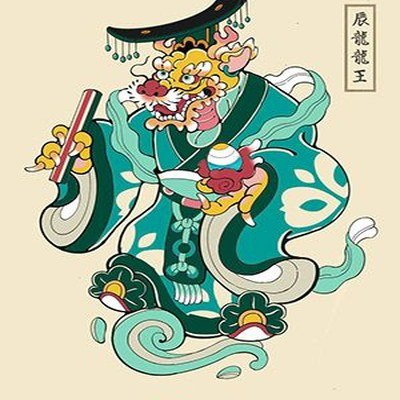
Chinese Zodiac · Sign 5 of 12
Legendary, ambitious, and born to make history
Lóng · Chen (辰) · Earth · Yang
The Dragon is the only mythological creature in the Chinese zodiac — and it acts like it. More Dragon babies are born in Dragon years than any other zodiac year, because Chinese families actively plan for it. This is the most auspicious sign, the most powerful energy, and the most demanding of destinies. Dragon people carry a weight of expectation — from others, and more intensely, from themselves. The Dragon cannot do things halfway; it cannot pretend to care about something it doesn't; and it cannot accept a life it considers small. This is its greatest strength and its deepest vulnerability.
Every strength in the Dragon archetype carries a shadow — the same quality turned one degree too far. These are editorial interpretations, not clinical assessments.
The Dragon archetype is often driven by a desire to embody an inspiring ideal. They want to matter, to spark something in others, and to feel that their existence made a difference.
Each Dragon carries a secondary element modifier from the 60-year GanZhi cycle. Your birth year determines which type of Dragon you are.
| Element | Birth Years | Key Personality Modifier |
|---|---|---|
| Wood | 1964, 2024 | Creative, idealistic, and growth-oriented. More flexible than other Dragon types. |
| Fire | 1916, 1976 | Passionate, charismatic, and driven. The most intense expression of Dragon energy. |
| Earth | 1928, 1988 | Stable, practical, and dependable. Grounded and methodical among Dragons. |
| 1940, 2000 | Principled, determined, and structured. The most disciplined type of Dragon. | |
| Water | 1952, 2012 | Intuitive, adaptable, and socially fluid. The most perceptive Dragon variant. |
The Dragon in love is generous, loyal, and demanding — it gives completely and expects the same in return. Partners who match the Dragon's intensity and can hold their own in debate will thrive; those who need reassurance or prefer easy harmony will struggle. The Rat brings quick intelligence that the Dragon respects and the playfulness that balances its seriousness. The Monkey partnership is dynamic and stimulating — both signs operate on high frequency and push each other to grow. The Rooster is the Dragon's secret friend: where the Dragon creates vision, the Rooster executes it with precision.
Dragons do not work for other people well — or rather, they do so only until they have learned what they came to learn. Then they lead. Entrepreneurship, politics, creative direction, executive leadership, and any field where the Dragon can build something significant from vision draws them powerfully. Financial relationship with money tends toward the dramatic: great peaks are possible, as are spectacular crashes. The Dragon is not naturally cautious with money but benefits enormously from financial advisors who provide guardrails.
Earth element governs the stomach and digestive system. Dragons often neglect physical health while absorbed in projects — skipping meals, losing sleep, driving through exhaustion. The Dragon body is resilient but not invincible. High blood pressure and stress-related conditions are the primary risks. The Dragon needs physical outlets for its immense energy: competitive sports, outdoor challenges, anything that matches the Dragon's need for struggle and achievement.
These are traditional associations from Chinese cosmology and cultural metaphor — not medical claims or health advice.
2026 is notably positive for Dragon professionally — the Fire Horse year amplifies Dragon ambition and executive presence. New ventures launched in the first half of 2026 carry strong momentum. Relationship matters need attention: Dragon focus on career can create distance. Financial gains are real but should be partially consolidated rather than entirely reinvested.
All fortune readings are traditional cultural perspectives for entertainment. Not a substitute for professional advice.
Notable Dragons
The Dragon holds a unique position in Chinese mythology that is the inverse of its role in Western culture. In China, the Dragon is not a monster to be slain but the highest symbol of imperial power, cosmic order, and divine blessing. The Emperor was "the True Dragon Son of Heaven." Rain, rivers, seas, and all water — source of life — were governed by Dragon Kings. The Dragon in the zodiac is not placed by the Jade Emperor's race so much as honored there: even in the race, the Dragon paused to bring rain to a drought-stricken village before continuing, arriving fifth instead of first. Its generosity cost it a higher rank but confirmed its character.
The same energy expresses differently depending on circumstance. Most people move between all three — the question is which state you spend the most time in, and what moves you between them.
May inspire simply by entering the room. During a crisis, they might step up, paint a bold vision, and move others with conviction while still checking in with the team. They use their fire to energize, not to scorch.
May become domineering and impatient, interrupting others and insisting their way is the only way. In a meeting, they might override the quieter voices, then wonder why the team resists. They often overextend, chasing glory until they burn out.
When constrained by micromanagement or rigid systems, they may shut down creatively. They might become cynical, withdrawn, or silently bitter, watching from the sidelines while criticizing others. They often fear that without grand achievements, they are ordinary and worthless.
The Dragon archetype is here to learn that legacy is not the same as recognition. They may spend years building things that demand to be noticed — and discover, if they pause long enough, that the things they built for others outlast the ones they built to prove something. The question they may eventually face: who am I when no one is watching?
Interactive · Self-Reflection
7 scenarios. No right answers. Your pattern reveals which of the three Dragon states you currently spend the most time in.
Chinese folk tradition holds that each of the 12 zodiac animals is missing one thing. The biological observation and what it might mirror in human nature.
In thousands of years of Chinese art — paintings, sculptures, carvings — the Dragon appears without visible ears. The character 聋 (deaf) is written with 龙 (dragon) over 耳 (ear), a folk connection preserved in writing.
The Dragon archetype may be attuned to its own vision with such intensity that external signals are secondary. The Dragon hears what it decides to hear. This is a strength until it becomes the reason no one bothers to warn them.
The human nature reflection is a ChineseFortuneTools editorial interpretation — not a claim of classical or scientific origin.
A Question for You
"If no one ever applauded, would your ambition still feel like yours?"
Classical Chinese philosophy has observed the patterns behind the Dragon archetype for centuries. These quotes resonate with the Dragon's nature.
"To learn and practice what is learned in due time—is this not a joy? To have friends come from afar—is this not delightful? To remain unruffled when others do not recognize your merits—is this not the mark of a gentleman?"
"Learning without thinking leads to confusion; thinking without learning leads to peril."
"The noble mind is aware of righteousness; the small mind is aware of profit."
These Chinese idiom stories illuminate the same human patterns that define the Dragon archetype — told over thousands of years because they refuse to stop being true.
Origin: Warring States (Lüshi Chunqiu)
A man of the state of Chu, crossing the Yangtze by boat, lets his precious sword slip overboard. Calmly he takes a knife and carves a notch on the gunwale right where the sword sank, saying, 'I'll use this mark to retrieve it.' The boat sails on; when it lands and he dives under the notch, he finds nothing. He never realizes that the boat has moved, and that a fixed mark cannot track a moving boat.
Origin: Western Han (Xin Xu)
Lord Ye had decorated his entire estate with dragons—embroidered on robes, carved into beams, painted on walls, and woven into curtains. When the real Dragon of the sky, flattered and honest, descended to visit him and leaned into his window, Lord Ye's face turned white and he bolted in terror. The dragon realized that this man only loved the image, not the reality, and flew away, leaving the coward trembling among his fakes.
Origin: Warring States Period (Liezi)
An old man named Yu Gong, whose home was blocked by two towering mountains, resolved to level them with nothing but hand tools and his family's labor. Mocked by a wise neighbor called Zhi Sou, Yu Gong insisted that though he would die, his sons, grandsons, and their descendants would continue the work without end. Touched by his unshakable faith, the Heavenly Emperor sent two divine beings to carry the mountains away on their backs. The tale celebrates how relentless perseverance, passed through generations, can overcome what seems impossible.
15 — Reflection
"If no one ever applauded, would your ambition still feel like yours?"
This question belongs to the Dragon archetype — not as a verdict, but as an invitation. Your zodiac doesn't define you. It gives you a story to explore.
Recent Years of the Dragon: 1988, 2000, 2012, 2024. The next Year of the Dragon begins February 2036. Element variants: 1988 Earth Dragon, 2000 Metal Dragon, 2012 Water Dragon, 2024 Wood Dragon.
Find your sign by birth date using our LiChun-accurate algorithm.
Your complete Year, Month, Day & Hour pillars chart.
Find auspicious dates for weddings, moving, business, and more.
How the Yin Fire Goat year (丁未) affects Dragon — career, love, wealth & health outlook.