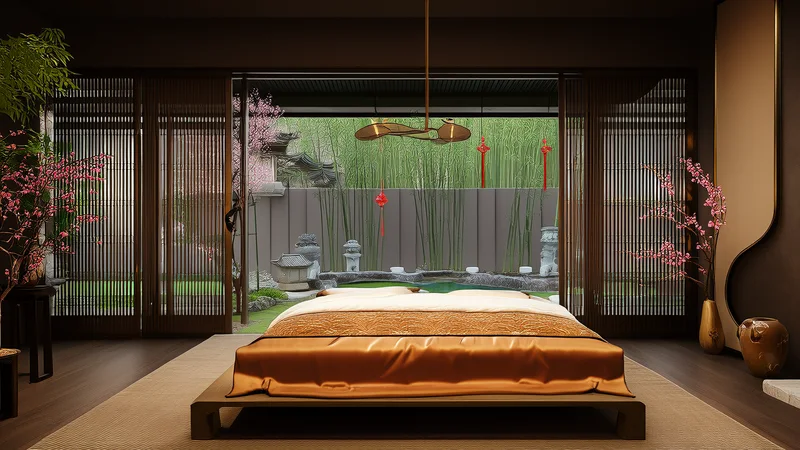
Why Is Bedroom Feng Shui So Important?
We spend roughly one-third of our lives sleeping. The bedroom is therefore one of the most important rooms in any home from a traditional Chinese feng shui perspective.
The bedroom is fundamentally different from the living room. The living room is a social space where family members gather and guests are welcomed. The bedroom, by contrast, is a place for sleep, privacy, and recovery. Traditional Chinese feng shui therefore pays particular attention to the position of the bed, doors, windows, and mirrors — every element that could affect whether the space feels truly restful.
Whether or not you believe in the metaphysical aspects of qi energy, many feng shui bedroom recommendations share a common practical goal: create an environment that makes your brain feel safe enough to rest.
The Command Position: The Most Important Feng Shui Bed Rule
The classic feng shui recommendation for bed placement is known as the command position. This arrangement has three key features:
- You can see the bedroom door from the bed without being directly in line with it
- The headboard rests solidly against a wall
- There is comfortable space on both sides of the bed
The command position creates a psychological balance between awareness and security. You remain aware of the room's entrance — a deeply ingrained survival instinct — while your back is protected by the wall behind you.
Traditional feng shui describes the solid wall as a "mountain" of support. Modern interior design reaches similar conclusions: people generally feel more secure when they cannot be approached from behind while sleeping.
Should Your Bed Face the Door?
One of the most famous feng shui rules is to avoid placing the bed directly in line with the bedroom door. This arrangement is sometimes called the "coffin position" in popular feng shui discussions because of its resemblance to the traditional way a coffin may be carried through a doorway.
However, the terminology and interpretations vary among different feng shui schools, and this expression is cultural and symbolic rather than scientific. The practical concerns are more straightforward:
- Noise from outside the room can disturb sleep
- Light from the hallway enters directly toward the sleeper
- Privacy is reduced — anyone opening the door sees the bed immediately
- The sleeper may feel psychologically exposed and less able to relax
If your bedroom layout makes it impossible to move the bed entirely out of door alignment, there are practical remedies. A solid headboard, blackout curtains on the doorway, a privacy screen, or a piece of furniture placed between the door and bed can all help reduce the feeling of exposure.
Is It Bad Feng Shui to Have a Mirror Facing Your Bed?
Mirrors are among the most frequently discussed topics in bedroom feng shui. Traditional feng shui generally considers a mirror directly facing the bed unfavorable.
The traditional explanation involves the reflective nature of mirrors and the belief that they disturb the peaceful qi of the bedroom by creating excessive movement and reflection of energy.
There is also a much simpler modern explanation. Imagine waking up suddenly in the middle of the night and seeing a human-like reflection in a dark mirror. It can be surprisingly unsettling — even frightening — for some people. Additionally, mirrors can reflect ambient light and movement, which may disturb sensitive sleepers.
If a mirror bothers you while sleeping, consider moving it to a wall that does not directly face the bed, or cover it with a curtain at night. You do not need to remove a mirror from the bedroom entirely — simply repositioning it is often sufficient.
Should You Put Your Bed Under a Window?
Traditional feng shui generally prefers a solid wall behind the head of the bed rather than a window. A window creates an opening that symbolically weakens the feeling of support and protection.
From a practical perspective, a window behind the headboard can cause several real problems:
- Noise from outside (traffic, neighbors, birds)
- Morning light exposure that disrupts sleep
- Temperature changes — drafts in winter, heat in summer
- Reduced privacy if the window faces other buildings or a street
- Condensation that could damage the bed frame or headboard
If your bedroom layout makes a window unavoidable behind the bed, blackout curtains, thermal insulation, and double glazing can reduce many of these practical problems. However, if you have a choice of wall, the solid wall is almost always the better option.
Avoid Heavy Beams or Objects Directly Above the Bed
Traditional feng shui considers a heavy ceiling beam directly above the bed unfavorable. The symbolism is easy to understand: something heavy appears to be pressing downward on the person sleeping below.
Modern interior design reaches a similar conclusion from a safety and psychological perspective. Heavy objects hanging or mounted directly above where someone sleeps can create a subconscious feeling of unease, even when there is no actual danger.
If your bedroom has a beam above the bed and structural modification is not possible, consider these alternatives:
- Install a false ceiling to visually conceal the beam
- Use lighting to draw attention away from the beam
- Add a fabric canopy over the bed to create a visual buffer
- Move the bed to a different position in the room
Best Feng Shui Bedroom Colors
The bedroom should ideally be the least visually stimulating room in your home. Color plays a major role in achieving this.
Traditional feng shui often connects colors with the Five Elements system. However, the most universally applicable principle is simply that bedrooms benefit from softer, calmer tones that support relaxation.
Good bedroom color choices include:
- Warm white or cream
- Beige and natural earth tones
- Soft gray
- Pale sage or muted green
- Light blue or dusty blue
- Soft lavender (used carefully)
Colors to avoid in a bedroom include extremely bright red, vivid orange, neon yellow, and intense colors that create visual stimulation. These may feel energizing during the day but can make it harder to wind down at night.
Bedroom Size: Does Bigger Mean Better Feng Shui?
Traditional Chinese home design generally gives the living room a more public role and the bedroom a more private one. The living room is traditionally expected to have enough space for family gatherings and guests — the bedroom does not need to compete.
A bedroom that is disproportionately large can actually feel less intimate and harder to make feel cozy. Traditional feng shui sometimes describes this as the room "overwhelming" its occupants.
The more important principle is that each room should be proportional to its purpose and to the number of people who use it regularly. A bedroom that feels just right — neither cramped nor cavernous — is often the best feng shui outcome.
How to Keep the Bedroom Calm
The bedroom should be a retreat from the stimulation of daily life. Traditional feng shui recommends reducing several types of visual and environmental noise:
- Excessive decoration that creates visual clutter
- Bright screens (televisions, tablets, phones) left on at night
- Large amounts of clutter on surfaces and under the bed
- Unnecessary mirrors, especially those facing the bed
- Loud electronic devices or charging stations close to the sleeping area
- Work equipment that creates a psychological association between the bedroom and stress
The bedroom should feel different from the office, living room, and kitchen. The more clearly it signals "rest" to your brain, the easier it will be to actually rest there.
Space Around the Bed
Traditional feng shui recommends leaving enough space around the bed for comfortable movement. A bed that is squeezed into a corner or trapped between large pieces of furniture can feel constrained and make the room difficult to navigate.
Whenever possible, aim for these practical arrangements:
- Access from both sides of the bed (particularly important for couples)
- Enough floor space to walk without bumping into furniture
- Drawers and wardrobe doors that can open fully without hitting the bed
- Clear pathways to both the door and windows
Bedroom Feng Shui for Single Women
Traditional feng shui sometimes includes specific recommendations for unmarried women, such as avoiding certain plants or using symbolic objects to manage "peach blossom" energy — a traditional concept related to romantic relationships.
These ideas belong to Chinese folk feng shui rather than universally accepted feng shui principles. A more useful modern approach is simply: make the bedroom represent the life you actually want.
Keep it clean, comfortable, well-lit during the day, and free from objects or imagery that create unwanted associations or emotional clutter. A calm, organized, pleasant bedroom supports wellbeing regardless of your relationship status.
Bedroom Feng Shui Checklist
Use this checklist to evaluate your bedroom's feng shui at a glance:
- Headboard against a solid wall — not a window
- Bed visible from but not directly aligned with the door
- No heavy beam directly above the bed
- No mirror directly facing the sleeping area
- Comfortable space on both sides of the bed
- Soft, calming color palette
- Good ventilation without direct drafts
- Appropriate curtains or blinds for light control
- Minimal clutter on surfaces and floor
- Bedroom feels calm and distinct from work or activity spaces
If most of these are in place, you have already incorporated the core principles of good bedroom feng shui — whether you think of it in traditional Chinese terms or simply as smart, intentional interior design.