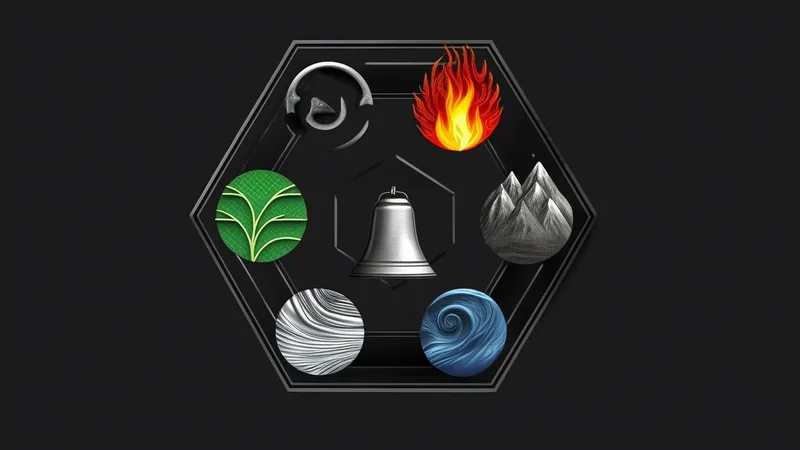
If you study any Feng Shui system seriously — whether Form School, Compass School, Flying Stars, or Ba Zhai — you will encounter the Five Elements (五行, Wu Xing) at every turn.
They are the backbone of traditional Chinese cosmological thinking, and understanding them deeply will make every other aspect of Feng Shui suddenly make sense.
What Are the Five Elements?
The Five Elements are: Wood (木), Fire (火), Earth (土), Metal (金), Water (水).
One of the most important things to understand right away: these are not five physical substances like the Western classical elements.
Wu Xing is better translated as five phases or five modes of transformation. Each "element" represents a pattern of movement, a quality of energy, or a phase in a continuous cycle.
Think of them not as things, but as verbs. Wood is expanding and growing. Fire is rising and transforming. Earth is stabilizing and centering. Metal is contracting and refining. Water is descending and flowing.
This understanding unlocks everything else. When Feng Shui places a Wood element in the East, it is not saying "put a tree in the East corner." It is saying that the East naturally resonates with the energy pattern called "Wood."
The Five Elements: Full Reference Table
| Element | Direction | Season | Colors | Shape | Material |
|---|---|---|---|---|---|
| 🌿 Wood | East, Southeast | Spring | Green, blue-green | Tall, columnar | Wood, bamboo, plants |
| 🔥 Fire | South | Summer | Red, orange, purple | Triangular, pointed | Candles, lights, sun |
| 🏔️ Earth | Center, NE, SW | Late summer | Yellow, beige, brown | Square, flat | Ceramic, stone, clay |
| ⚙️ Metal | West, Northwest | Autumn | White, silver, gold | Round, circular | Metal, coins, bells |
| 💧 Water | North | Winter | Black, dark blue | Wavy, irregular | Water, glass, mirrors |
The Generating Cycle (生, Sheng)
The most fundamental cycle of the Five Elements is the generating cycle, where each element produces or "gives birth to" the next:
In Feng Shui practice, the generating cycle is used to strengthen an area. If the North sector (Water) of your home feels weak, you can add Metal (which generates Water) to support it.
The Controlling Cycle (克, Ke)
The controlling cycle shows how each element restrains another:
- Water controls Fire — water extinguishes fire
- Fire controls Metal — fire melts metal
- Metal controls Wood — metal cuts wood
- Wood controls Earth — tree roots break up earth
- Earth controls Water — earth absorbs or dams water
The controlling cycle is used to reduce excess energy. If a sector has too much Fire energy (can feel agitating or overactive), introducing Water element objects or colors can calm it.
The Weakening Cycle
A lesser-known but equally important cycle: an element can also be weakened by what it generates. A parent who gives everything to a child is depleted.
- Wood is weakened by generating too much Fire
- Fire is weakened by generating too much Earth
- Earth is weakened by generating too much Metal
- Metal is weakened by generating too much Water
- Water is weakened by generating too much Wood
This is sometimes used in Feng Shui to gently drain an excessive element without directly attacking it with the controlling element (which can be too harsh).
Five Elements and Feng Shui Directions
One of the most practical applications of the Five Elements is their directional map. This is used in most Feng Shui systems:
| Direction | Element | Life Area (Ba Gua) |
|---|---|---|
| North | Water 💧 | Career & life path |
| Northeast | Earth 🏔️ | Knowledge & self-cultivation |
| East | Wood 🌿 | Family & health |
| Southeast | Wood 🌿 | Wealth & abundance |
| South | Fire 🔥 | Fame & reputation |
| Southwest | Earth 🏔️ | Love & relationships |
| West | Metal ⚙️ | Children & creativity |
| Northwest | Metal ⚙️ | Helpful people & travel |
| Center | Earth 🏔️ | Overall health & balance |
Wood Element: Growth and Expansion
Wood energy represents upward growth, flexibility, and expansion. In the human body it is associated with the liver and gallbladder. In the yearly cycle it corresponds to spring.
To strengthen Wood energy: add green and blue-green colors, living plants, tall vertical shapes, wooden furniture, and bamboo. A water feature will nourish Wood (Water generates Wood).
To weaken excessive Wood: introduce Metal (which cuts Wood) or Fire (which drains Wood by consuming it).
Fire Element: Transformation and Illumination
Fire energy rises, transforms, and illuminates. It represents passion, activity, fame, and social energy. In the body it is associated with the heart and small intestine. Its season is summer.
To strengthen Fire energy: use red, orange, and purple colors; add lighting, candles, and pointed or triangular shapes. Wood generates Fire, so wooden elements support this sector.
To weaken excessive Fire: Water (which controls Fire) is the direct remedy. Dark blues and blacks can calm this sector.
Earth Element: Stability and Nourishment
Earth energy is centering, stabilizing, and nourishing. It corresponds to the period between seasons (especially late summer) and to the center of the Feng Shui map. In the body it governs the stomach and spleen.
To strengthen Earth energy: use yellow, beige, and brown tones; introduce ceramics, stone, and square or flat shapes. Fire generates Earth, so warm lighting supports this sector.
To weaken excessive Earth: Wood (roots break earth) provides the controlling influence.
Metal Element: Clarity and Refinement
Metal energy is contracting, clarifying, and refining. It corresponds to autumn, the West and Northwest, and the lungs and large intestine in the body. Metal carries an energy of precision, focus, and completion.
To strengthen Metal energy: use white, silver, and gold; introduce metal objects, coins, wind chimes, and round or circular shapes. Earth generates Metal.
To weaken excessive Metal: Fire (which melts metal) is the direct control.
Water Element: Flow and Wisdom
Water energy flows downward and inward. It corresponds to winter, the North direction, and the kidneys and bladder in the body. Water represents wisdom, depth, introspection, and career energy.
To strengthen Water energy: use dark blues and blacks; add water features, mirrors, glass, and wavy or irregular shapes. Metal generates Water.
To weaken excessive Water: Earth (which dams water) is the direct control.
How Feng Shui Practitioners Use the Five Elements
A Feng Shui assessment typically begins by mapping the Five Elements across the home using compass readings. Then the practitioner looks for imbalances:
- Which sectors feel stagnant, cold, or dead?
- Which sectors feel overly active, agitating, or harsh?
- Are there clashing elements in key areas (like Fire-Water opposition in a sector)?
- Are there missing elements in important life areas?
Once imbalances are identified, remedies use either the generating cycle (to boost a weak element) or the controlling cycle (to reduce an excess element).
Five Elements in Objects and Colors
You don't need to make major renovations to introduce Five Element energy. Colors, materials, and shapes all carry elemental associations:
- Plants and green textiles — Wood
- Candles, lamps, and red accents — Fire
- Ceramic pots, stone sculptures, yellow cushions — Earth
- Metal frames, wind chimes, white decor — Metal
- Aquariums, fountains, dark rugs, mirrors — Water
Five Elements and Period 9 (2024–2043)
Traditional Feng Shui also uses the Five Elements across time cycles. The current period — Period 9 (2024–2043) — is governed by the Fire element. In Period 9, Fire-associated directions (South), colors (red, purple), and qualities (visibility, fame, social connection) are considered especially active.
This is why many Feng Shui practitioners advise increasing Fire and Wood elements in homes during this period, while being cautious about Water-dominated interiors (Water controls Fire).