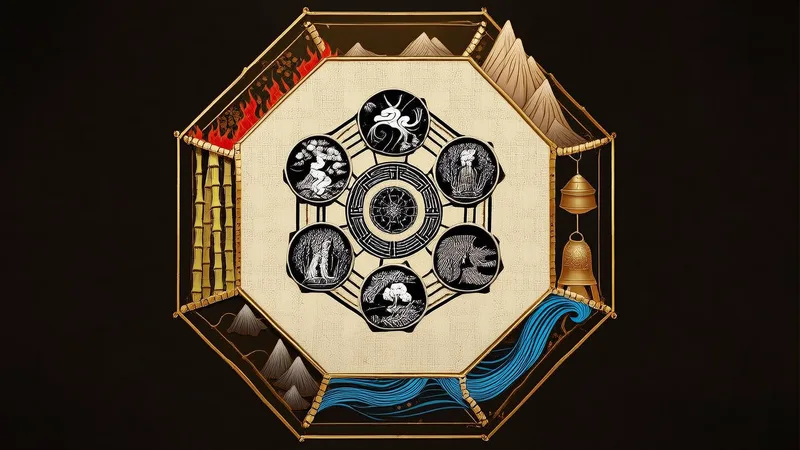
The Bagua (八卦) — literally "Eight Trigrams" — is one of the most fundamental symbolic systems in Chinese culture. It appears in Feng Shui, the Yijing (Book of Changes), traditional medicine, philosophy, and martial arts.
In Feng Shui specifically, the Bagua serves as a map that overlays the compass directions with life areas, elements, and energetic qualities. Understanding it is essential to understanding almost any Feng Shui system.
What Is a Trigram?
A trigram is a symbol made of three horizontal lines. Each line is either:
- Unbroken (—) — Yang
- Broken (- -) — Yin
Three lines × 2 possibilities (Yin or Yang) = 8 possible combinations = the Eight Trigrams.
Each trigram has a name, a natural image, a direction, an element, a family member association, and a life area. These associations form the Bagua system.
The Eight Trigrams: Complete Reference
| Trigram | Symbol | Chinese | Image | Direction (LH) | Element | Life Area |
|---|---|---|---|---|---|---|
| Qian | ☰ | 乾 | Heaven | Northwest | Metal | Helpful people, travel |
| Kun | ☷ | 坤 | Earth | Southwest | Earth | Love, relationships |
| Zhen | ☳ | 震 | Thunder | East | Wood | Family, health |
| Xun | ☴ | 巽 | Wind | Southeast | Wood | Wealth, abundance |
| Kan | ☵ | 坎 | Water | North | Water | Career, life path |
| Li | ☲ | 离 | Fire | South | Fire | Fame, reputation |
| Gen | ☶ | 艮 | Mountain | Northeast | Earth | Knowledge, self-cultivation |
| Dui | ☱ | 兑 | Lake | West | Metal | Children, creativity |
The Bagua Home Map (Later Heaven Arrangement)
The Later Heaven Bagua (后天八卦) is the arrangement used in almost all practical Feng Shui. When overlaid on a home plan using compass directions, the nine sectors correspond to life areas:
Later Heaven Bagua — compass-based layout (South at top, as in traditional Chinese maps)
Earlier Heaven vs. Later Heaven Bagua
Earlier Heaven Bagua (先天八卦)
Attributed to the legendary Fu Xi, this arrangement shows the eight trigrams in perfect symbolic symmetry: Heaven (Qian ☰) in the South, Earth (Kun ☷) in the North, Fire (Li ☲) in the East, Water (Kan ☵) in the West. Each trigram faces its exact opposite across the circle.
Earlier Heaven Bagua is used primarily in theoretical and ceremonial contexts: temple gate designs, protective talismans, and some divination practices. You often see it on traditional Feng Shui mirrors placed above doorways.
Later Heaven Bagua (后天八卦)
Attributed to King Wen of Zhou, the Later Heaven arrangement distributes the trigrams based on their natural seasonal and directional associations. This is the arrangement used in all practical Feng Shui: Ba Zhai, Flying Stars, and directional analysis. When you see a Bagua map with life areas, it is always the Later Heaven arrangement.
The Nine Life Areas
In practical Feng Shui, the nine sectors of the home (eight directions + center) correspond to life areas:
- North (Water / Kan ☵) — Career, life path, wisdom, and opportunities
- Northeast (Earth / Gen ☶) — Self-knowledge, education, inner cultivation
- East (Wood / Zhen ☳) — Family relationships, health, ancestors
- Southeast (Wood / Xun ☴) — Wealth, financial abundance, material flow
- South (Fire / Li ☲) — Fame, reputation, recognition, social visibility
- Southwest (Earth / Kun ☷) — Love, marriage, partnership, romance
- West (Metal / Dui ☱) — Children, creativity, joy, completion
- Northwest (Metal / Qian ☰) — Helpful people, mentors, travel, benefactors
- Center (Earth) — Overall health, balance, integration
How to Overlay the Bagua on Your Home
Traditional Compass Method
In traditional Chinese Feng Shui, you use a compass to determine your home's facing direction (the direction the main entrance faces outward). Based on this reading, you establish the directional map and overlay the Bagua accordingly. A South-facing home (front door faces South) has the Li/Fame sector at the front and Kan/Career at the back.
The BTB/Western Method (Non-Traditional)
In the Western New Age approach, the Bagua is always placed with the "Knowledge, Career, Mentors" row at the bottom aligned with the main entrance wall, regardless of compass direction. Traditional practitioners do not endorse this method, but it is widely taught in Western Feng Shui books.
What the Bagua Reveals About Your Home
Once you overlay the Bagua, you can identify whether important life areas are supported or challenged by your home's layout:
- Missing sectors — if your home has an L-shape or irregular layout, some Bagua sectors may be "missing." Traditional Feng Shui provides remedies for this.
- Important room placement — where your bedroom, home office, and main door fall in the Bagua affects which life areas receive the most energy.
- Element alignment — checking whether the element of each sector matches or clashes with the room's decor, materials, and function.
Bagua and the Kua Number
Your personal Kua number (from Ba Zhai / Eight Mansions Feng Shui) is derived from the Bagua. Each Kua number corresponds to one of the eight trigrams, giving you personal lucky directions aligned with your trigram's energy. Calculate your Kua number here.