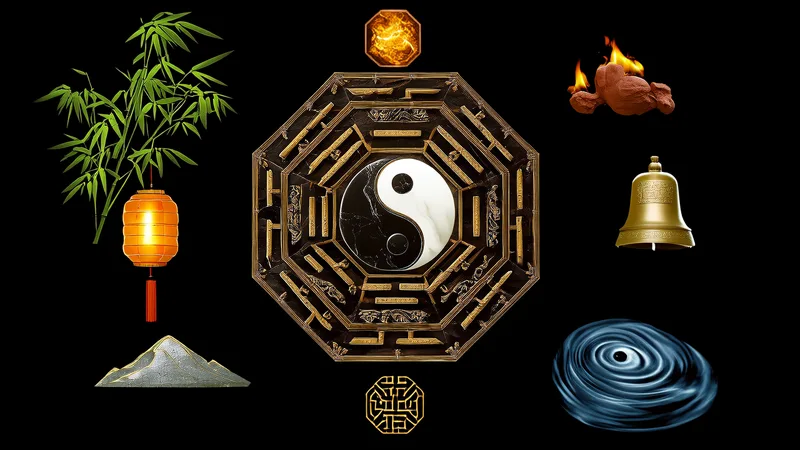
Yin-Yang (阴阳) is not just a symbol you see on t-shirts. It is the foundational philosophical concept behind traditional Chinese medicine, the Yijing (Book of Changes), and of course, Feng Shui.
Without understanding Yin and Yang, Feng Shui becomes a disconnected collection of rules. With it, the rules start making sense on their own.
What Do Yin and Yang Actually Mean?
The words "Yin" (阴) and "Yang" (阳) originally referred to the shaded and sunny sides of a hill. Yin is the shaded slope — cool, dark, and moist. Yang is the sunlit slope — warm, bright, and dry.
From this simple observation, Chinese philosophy developed one of its most profound ideas: all phenomena exist in complementary pairs, constantly transforming into each other.
☀️ Yang Qualities
- Light, brightness
- Activity, movement
- Heat, warmth
- Expansion, outward
- Hard, solid
- Day, summer
- Heaven, sky
- Masculine principle
🌙 Yin Qualities
- Darkness, shadow
- Stillness, rest
- Coolness, moisture
- Contraction, inward
- Soft, fluid
- Night, winter
- Earth, ground
- Feminine principle
The critical insight: neither Yin nor Yang is inherently "good" or "bad." The traditional ideal is not pure Yang or pure Yin — it is dynamic balance, appropriate to the time and place.
Three Core Principles of Yin-Yang
1. Opposition and Complementarity
Yin and Yang are opposite but inseparable. You cannot have light without darkness. You cannot have movement without stillness. Each defines the other, and each contains the seed of the other (represented by the dot in the Yin-Yang symbol).
2. Constant Transformation
Yin and Yang are not fixed states. Day becomes night. Summer becomes winter. Activity leads to fatigue, which leads to rest, which restores energy for activity. Everything is in constant flux between the two poles.
3. Mutual Rooting
Each contains the other. At the extreme of Yang is the seed of Yin — at the height of summer comes the first cooling that signals autumn. A room that is extremely Yang (very bright, very active) starts to feel exhausting, pushing back toward the need for rest.
Yin and Yang in Feng Shui Practice
Every space assessment in Feng Shui begins with a Yin-Yang analysis. The practitioner asks: Is this space too Yin or too Yang? What type of activity happens here? What does the occupant need?
Bedrooms: More Yin
Bedrooms are for rest, sleep, and intimacy — all Yin activities. A bedroom should therefore lean toward Yin qualities: softer lighting, muted colors, quieter materials, lower ceiling visual weight, and less active energy. Extremely bright lighting, mirrors facing the bed, and strong primary colors all create excessive Yang in a space meant for Yin recovery.
Living Rooms: Balanced to Yang-Leaning
The living room is where social activity, conversation, and family life happen. It benefits from more Yang energy: good natural light, open space, warm and active colors, comfortable but upright seating. However, if the living room also serves as a space for evening relaxation, keeping some Yin balance prevents the space from feeling overstimulating.
Offices and Study Rooms: Yang with Yin Focus
Offices need Yang energy for productivity (good light, organized space, upright desk position) but also Yin-like focus (not too many visual distractions, a sense of containment and support at the back). The ideal study environment is Yang enough to keep you alert, Yin enough to enable deep concentration.
Kitchens: Predominantly Yang
Kitchens involve fire, heat, and active transformation — inherently Yang. Traditional Feng Shui considers the kitchen one of the most important Yang spaces in the home. Good ventilation (moving qi), strong lighting, and organized storage all support healthy Yang kitchen energy.
Bathrooms: Inherently Yin
Bathrooms are naturally more Yin — associated with water, drainage, and downward-moving energy. Traditional Feng Shui recommends keeping bathroom doors closed and drains covered to prevent Yin energy from spreading through the home.
Yin Houses and Yang Houses
Traditional Chinese Feng Shui distinguishes between:
- Yin houses (阴宅) — burial sites and ancestral tombs. Much of classical Feng Shui (especially the Zangshu/Book of Burial attributed to Guo Pu) was concerned with selecting auspicious burial sites.
- Yang houses (阳宅) — homes and buildings for the living. Modern Feng Shui primarily deals with Yang houses.
This distinction is largely unknown to Western audiences but is fundamental to understanding why classical Feng Shui texts often discuss burial landscapes rather than interior design.
Yin-Yang Imbalance Signs in Your Home
Signs of Too Much Yin
- Chronically dark rooms even during the day
- Damp or musty smells
- Clutter creating stagnant energy
- Residents feel depressed, lethargic, or unmotivated
- Overly quiet, isolated space with no social energy
Signs of Too Much Yang
- Extreme brightness causing glare and visual fatigue
- Constant noise or activity with no quiet refuge
- Aggressive color saturation throughout the home
- Residents feel anxious, irritable, or unable to rest
- Sharp, angular furniture creating harsh energy flows
Practical Yin-Yang Adjustments
To increase Yang energy:
- Open curtains and blinds for more natural light
- Add warm-toned lamps in dark corners
- Use brighter, warmer paint colors
- Introduce living plants (active growing energy)
- Play music or increase ambient sound
- Declutter to allow qi to circulate
To increase Yin energy:
- Use softer, sheer curtains to diffuse direct light
- Choose muted, cool, or deep tones for walls
- Introduce soft textiles — thick rugs, heavy curtains, cushions
- Reduce harsh overhead lighting; use floor lamps instead
- Add water elements (small fountain, aquarium) for calming Yin sound
- Create enclosed, cozy reading nooks or retreat corners
Yin-Yang and the Feng Shui Compass
In Compass School Feng Shui, Yin-Yang also applies to directions, time periods, and even to the type of qi assigned to different sectors. South-facing homes are traditionally considered more Yang (sunlit, active, social energy at the front). North-facing homes lean more Yin. This directional Yin-Yang assignment forms part of the foundation for systems like Eight Mansions (Ba Zhai) and Flying Stars (Xuan Kong Fei Xing).