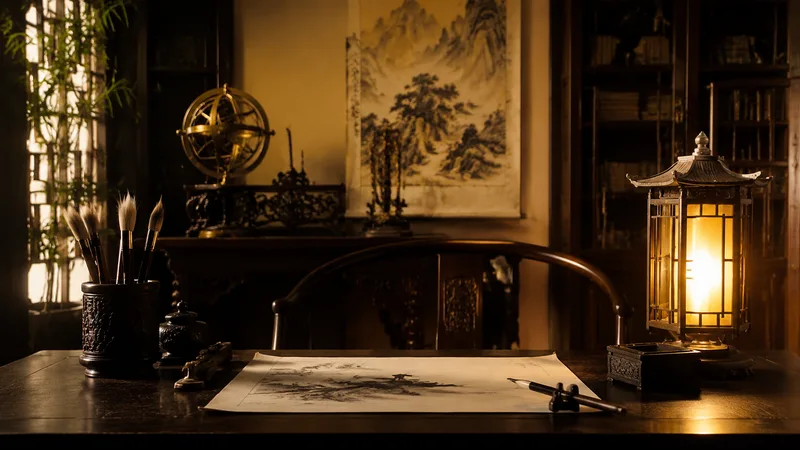
In traditional Chinese culture, academic success was not only about studying hard. The environment in which learning happened was believed to matter deeply — and at the center of that belief was a concept called the Wenchang position (文昌位).
Wenchang (文昌) is one of the most revered stars in traditional Chinese astrology and culture. The name combines the characters for "culture" or "writing" (文) and "prosperous" or "flourishing" (昌). Together, they describe a star associated with scholarly achievement, intellectual development, the arts, literary talent, and success through education.
Understanding the Wenchang position offers a fascinating window into traditional Chinese attitudes toward learning — and some genuinely useful principles for creating a better study environment.
The Wenchang Star in Chinese Tradition
The Wenchang Star has been venerated in Chinese culture for over two thousand years. Temples dedicated to Wenchang — the deity associated with this star — were found throughout China, particularly near examination halls during the imperial period.
In traditional Chinese society, the imperial examination system (keju) determined social mobility. Young men who passed the highest levels of the examination could become officials, achieve wealth and status, and bring honor to their families for generations. The stakes were extraordinarily high.
In this context, Wenchang worship was not merely superstition. It was part of a comprehensive cultural infrastructure that treated academic achievement as one of the highest human pursuits. Students prayed at Wenchang temples before examinations, and families arranged their homes according to Wenchang principles to give their children every possible advantage.
The Wood Element and the Wenchang Position
In the Five Elements system (Wood, Fire, Earth, Metal, Water), the Wenchang position is traditionally associated with the Wood element.
Wood represents:
- Growth and upward movement
- Vitality and expansion
- The energy of spring and new beginnings
- Flexibility within strength
- Natural, organic development
These qualities map beautifully onto the nature of learning itself. True education is not rigid memorization — it is growth, expansion, and the development of something living and flexible within the mind. The Wood element captures this quality.
This elemental association has direct practical implications. Wooden furniture, bookshelves, and study desks are traditionally considered particularly appropriate for the Wenchang area. Natural wood creates a warm, grounded atmosphere associated with scholarly focus.
The Calligraphy Brush and the Number Four
One of the most culturally rich elements of the Wenchang tradition involves the calligraphy brush. In traditional Chinese scholarship, the brush was not simply a writing implement — it was the instrument of civilization, culture, and intellectual achievement. The great examination essays that determined careers were written with a brush. Imperial decrees were issued with a brush. Poetry, history, and philosophy were preserved with a brush.
Traditional feng shui sometimes recommends placing four calligraphy brushes in the Wenchang area. The number four carries a special association with Wenchang in traditional Chinese numerology — the Fourth Star in the Nine Stars system is sometimes called the Wenchang Star.
Beyond the feng shui symbolism, displaying calligraphy brushes in a study serves another purpose: it connects the student with a long tradition of Chinese scholarly culture. A modern student using a laptop to complete assignments sits in a room that also honors the brush, the inkstone, and the thousands of years of learning that preceded them. That continuity can be genuinely meaningful.
Computers and the Wenchang Position
Traditional feng shui was developed long before computers existed, but modern practitioners have extended the framework to include technology. In the Five Elements system, computers are often associated with the Fire element because of the electricity, heat, and dynamic energy they produce.
Since Wood generates Fire in the Five Elements cycle, placing a computer in a Wenchang (Wood) area can be interpreted as the Wood feeding the Fire of the computer's energy — a potentially supportive relationship.
However, the practical considerations around computer placement matter more than the elemental symbolism:
- Keep ventilation openings clear so heat can dissipate properly
- Avoid direct sunlight on screens to prevent glare and overheating
- Position screens at an ergonomically appropriate height and distance
- Manage cables to avoid visual clutter and tripping hazards
- Ensure the room has adequate lighting that doesn't create screen glare
How to Identify Your Wenchang Direction
Different schools of feng shui use different methods to calculate the Wenchang position. The most common approaches are:
Based on Kua Number
Your Kua number is calculated from your birth year and gender. Each Kua number corresponds to a set of favorable directions, and the Wenchang direction is one of the most important among them. This system — sometimes called Eight Mansions feng shui — gives each person a personalized directional profile.
Based on Flying Stars
In Flying Stars feng shui (Xuan Kong), the Fourth Star (Si Bi) is associated with Wenchang energy. Its position in a home changes based on the construction period of the building and the annual cycle. This is a more complex system requiring detailed calculation.
Based on Chinese Zodiac
A simplified approach in some popular feng shui literature associates different zodiac signs with specific Wenchang directions. This method is less precise than a full calculation but accessible to beginners.
Activating the Wenchang Area
Once you have identified the Wenchang position in your home or study room, traditional practice recommends several methods to activate its energy:
- Place the study desk in or facing the Wenchang direction
- Use wooden furniture — a natural wood desk or bookshelf enhances the Wood element
- Display four calligraphy brushes as a symbolic object
- Add green plants — living Wood energy supports the Wenchang area
- Ensure good lighting — natural or warm artificial light supports concentration
- Keep the area clean and organized — clutter disrupts energy flow in any system
- Place meaningful study objects — books, reference materials, educational awards, or symbolic objects associated with your learning goals
The Modern Relevance of the Wenchang Principle
Whether or not you accept the metaphysical framework of feng shui, the Wenchang tradition encodes a powerful practical principle: the environment in which you study shapes how well you study.
Modern environmental psychology confirms this in different language. A dedicated study space that is well-lit, organized, appropriately furnished, free from distraction, and associated in your mind with the activity of learning creates what researchers call a "context cue" — a signal to your brain that it is time to focus and engage deeply.
The Wenchang position tradition is, at its core, a thousand-year-old environmental psychology project. It recognized that the physical surroundings of a student influence their mental state, and that thoughtful arrangement of those surroundings can support intellectual achievement.
A good learning environment should ultimately help a student do three things: focus, learn, and rest. Traditional Chinese feng shui provides one cultural framework for thinking about this environment. Modern psychology provides another. The most useful approach may be to combine the two.