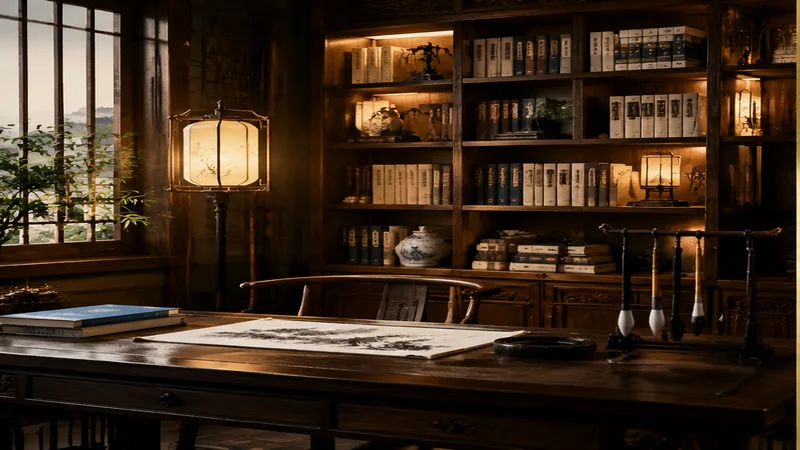
Bookshelf Feng Shui: How to Arrange Books for Academic Success
In the practice of Feng Shui, the environments we inhabit directly influence our mental clarity, motivation, and ability to absorb knowledge. For students, researchers, and lifelong learners, the bookshelf is far more than a storage unit—it is a mirror of the mind. When your books are arranged with intention, your study space becomes a nurturing haven for concentration and intellectual growth. Conversely, a chaotic or poorly positioned bookshelf can create stagnant energy that blocks academic progress. This guide will walk you through the essential principles of feng shui for books, transforming your shelves from mere furniture into powerful allies for learning.
Bookshelf Placement: Finding the Commanding Position
Where you place your bookshelf matters just as much as what you place on it. In a study room, the bookshelf should sit in a supporting position relative to your desk. Ideally, place the shelf behind you or to the side, never directly behind your chair with the spine facing your back. This placement creates a sense of stability and protection, symbolizing that your accumulated knowledge supports your forward momentum. If the bookshelf is directly in front of your desk, it can act as a visual and energetic barrier, making you feel weighed down by unfinished reading or looming deadlines.
Pay attention to the solid wall behind the bookshelf. A sturdy, grounded wall represents the mountain element in Feng Shui, providing a foundation for steadfast focus. Avoid placing a bookshelf under a window, as the energy of the books will dissipate through the glass, weakening their supportive influence. Similarly, keep the shelf away from the doorway—if you see the edge of a shelf when entering the room, it creates a subtle "cutting" energy that disrupts calm. Instead, angle the shelf so it greets you warmly, offering a sense of welcome to your scholarly pursuits.
Open vs Closed Shelving: Balancing Air and Protection
One of the most important decisions in book organization is choosing between open and closed shelving. Open shelves expose your books to the air and light, making them accessible and visually stimulating. This openness encourages the free flow of chi, which can boost creativity and spontaneous insight—perfect for brainstorming sessions or conceptual studies. However, too many open shelves crammed with books can create visual chaos, leading to scattered thoughts and anxiety. If you have a large collection, consider mixing open and closed units.
Closed shelving, with doors or fabric curtains, offers a different energetic quality. It contains and protects the knowledge within, symbolizing discernment and boundary-setting. For academic work that requires deep focus, such as exam preparation or technical writing, closed shelves help keep distracting titles out of sight. They also prevent dust accumulation, which in Feng Shui represents stagnant energy. A practical approach is to display a small selection of your current reference texts on open shelving, while storing the bulk of your library behind closed doors. This balance gives you the best of both worlds: vibrant access for active learning and a calm, uncluttered environment for deep concentration.
Book Organization: Categorizing for Mental Clarity
The way you arrange your books physically shapes your mental landscape. Disorganized shelves, with books stacked horizontally, wedged in at odd angles, or mixed with unrelated objects, create energetic "traffic jams" that block new knowledge. Begin by sorting your collection into clear categories: fiction, non-fiction, research materials, reference works, and personal development. Within each category, arrange books either by theme or by priority of use.
- Place frequently used books at eye level. This subtle Fng Shui princple ensures that your most relevant resources are easily accessible, reducing friction and promoting efficient study.
- Stand books upright, like students paying attention. Leaning or tilted books represent disorder. If a book is too tall, lay it flat on top of a vertical stack rather than forcing it.
- Leave a little breathing room. Don't pack shelves to the brim. A small gap of an inch or two (2-3 cm) every few books allows chi to circulate, keeping your mind open to new ideas.
- Use bookends wisely. Choose heavy, solid bookends made of wood or stone. They ground the energy of the shelf and prevent books from toppling over, which can be a metaphor for shaky foundations.
For academic success, group your most challenging subjects to the left side of the shelf (from your perspective when facing it). In Feng Shui, the left side is associated with the dragon, representing knowledge, wisdom, and career growth. The right side (the tiger) is more action-oriented. So, place your poetry, philosophy, and theoretical texts on the left, and your practical manuals, problem sets, and to-do resources on the right. This arrangement harnesses the supportive energy of the dragon to absorb complex theory, while the tiger helps you apply it.
Sharp Bookshelf Edges: Avoiding "Poison Arrows"
Feng Shui warns against sharp bookshelf edges that point toward your body or your desk. These edges act like "poison arrows" (sha chi), directing negative energy at you, which can manifest as irritability, headaches, or a subtle sense of unease during study sessions. If your bookshelf has sharp corners, especially at the height of your head or neck, you must address them.
The simplest cure is to angle the bookshelf so that the edges do not face your regular workspaces. If moving the unit is not possible, soften the edges with adhesive felt pads, or place a trailing plant such as ivy or pothos along the offending corner. Another technique is to position a small crystal sphere on the shelf near the corner—the crystal's roundness converts the harmful energy into benign, supportive light. The key is to become aware of any sharp lines cutting through the air where you sit and read. Rounding them off, either physically or energetically, creates a safe container for your academic efforts.
Study Room Synergy: Combining Bookshelf and Desk
In the context of a study room, the bookshelf should work in harmony with your desk, chair, and other elements. The relationship between your desk (representing your active work) and the bookshelf (representing your accumulated knowledge) should feel like a trusted partnership. Place the bookshelf to the left of your desk for most people, as this allows the "dragon" side to feed your creative thinking. Left-handed individuals, however, may benefit from placing it to the right, optimizing their own energetic flow.
Keep the top of your bookshelf clear of clutter, but do add a small, meaningful altar to learning: a framed quote, a stones representing wisdom (such as amethyst or clear quartz), or a small plant with upward-pointing leaves. These objects infuse the shelf's energy with intention. Avoid storing snacks, gym equipment, or emotional clutter on the bookcase—the bookshelf should remain a pure vessel for knowledge. Also, ensure proper lighting. A small, focused lamp on the shelf illuminates your materials and, in Feng Shui, illuminates the mind. Natural light from a nearby window (not directly on the shelf) is ideal.
Regularly dust your books and rearrange them at the start of each semester or study cycle. This simple act of refreshing the arrangement shifts the chi and reminds your subconscious that you are in charge of your learning path. Remove any books that no longer serve you—donate outdated textbooks or novels you disliked. Holding onto negative or irrelevant books creates energetic weight that slows down your academic growth. By curating your shelf with love and precision, you send a powerful message to your brain: this space is for serious, joyful scholarship.
Final Thoughts on Feng Shui for Books
Academic success requires more than just studying hard—it requires creating an environment that supports your internal focus. The bookshelf is an underutilized ally in this mission. By mindfully considering its placement, choosing between open and closed shelving, organizing with intention, and softening sharp edges, every book you own becomes a stepping stone toward your goals. Remember that Feng Shui is not a rigid rulebook but an adaptive practice. Trust your intuition. If a particular arrangement feels calming and empowering, that is the right one for you.
"A well-ordered shelf is silent testament to an orderly mind. When the books rest quietly, the thoughts arise clearly. Let your library breathe, and your intelligence will follow." — Adapted from classical Feng Shui wisdom
Take twenty minutes today to stand before your bookshelf. Look at it with fresh eyes. Ask yourself: Does this support my learning? Does it invite me to sit down and read? If the answer is yes, you have already begun to harness the subtle power of arrangement. If not, make one small change—move one book, clear one corner, or reposition a plant. With each thoughtful adjustment, your bookshelf transforms from a passive piece of furniture into a dynamic partner in your academic journey. As you practice these principles, you will notice not only better grades and sharper recall but also a deep sense of order that radiates through every page you turn.