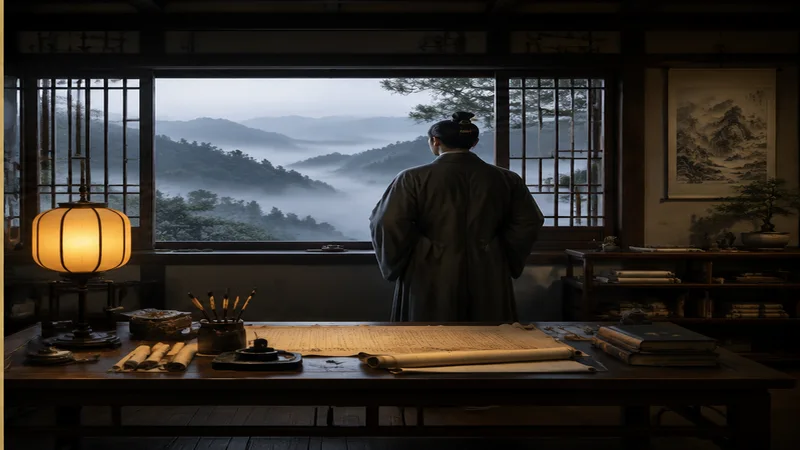
What Is the 'Looking Into Empty Space' Feng Shui Layout?
In the practice of Feng Shui, the arrangement of your environment directly shapes your energy, focus, and sense of stability. One of the most subtle yet disruptive configurations is known as wang kong, or "looking into empty space." This term describes a layout where a person sits or works facing a large, open, undefined area—such as a wide window, an empty hallway, a glass wall, or a spacious room—while having no back support whatsoever. At first glance, this might feel airy and modern. But in the classical Feng Shui tradition, it is considered a serious flaw that undermines your foundation, drains your confidence, and particularly creates a study concentration problem.
The phrase "looking into empty space" is not about gazing out at a beautiful landscape. Instead, it refers to the energetic void that opens up in front of you when your position lacks a defined boundary or a "guardian" element beyond your immediate line of sight. Picture sitting at a desk that faces a floor-to-ceiling window with nothing but sky ahead, or a workstation placed in the middle of a large open-plan office with a vast corridor stretching out before you. In both cases, your energy is constantly leaking forward into the void, while your back remains exposed and vulnerable. This is the essence of wang kong—a concept that translates literally as "looking into the void" or "facing emptiness."
The Unsupported Position: Why Your Back Matters
In Feng Shui, the principle of the unsupported position is central to understanding why this layout fails. Your back is considered your "mountain"—the source of stability, protection, and rootedness. When you sit with a solid wall, a tall cabinet, or even a sturdy bookshelf behind you, you are energetically backed by a force that shields you from surprise, distraction, and unseen challenges. However, when you sit facing open space without that rear support, you are in an unsupported position. You may intellectually know that nothing is behind you, but your subconscious mind remains on high alert, scanning for potential threats from the rear. This constant low-level vigilance consumes mental energy that could otherwise be used for deep focus, creative work, or studying.
The problem becomes even more pronounced when the open space in front is large and undefined. Feng Shui teaches that energy flows wherever it can move freely. When you face a vast, empty area—be it an empty room, a long hallway, or a massive window—your own qi is pulled outward, dispersing into that emptiness. Instead of gathering and circulating around you, it drifts away, leaving you feeling scattered, restless, and disconnected. This is why wang kong is often described as "looking into empty space": the openness in front of you offers no energetic anchor, no point of focus, and no sense of containment. It is the opposite of the ideal "commanding position" where you have a clear view of the entrance but are protected from behind.
The Study Concentration Problem: A Direct Consequence
One of the most common complaints from people working or learning in a wang kong layout is the study concentration problem. Students and remote workers frequently set up their desks near a large window to enjoy natural light, only to find that they cannot maintain attention for more than a few minutes. Why? Because every passing car, bird, or changing cloud catches their eye. The open space in front provides endless visual stimulation, and without a solid visual boundary, the mind struggles to stay anchored. In classical Feng Shui texts, this is described as "the wandering mind follows the wandering space." The lack of a supportive wall behind you compounds the issue, as you never feel fully settled in your chair, leading to constant micro-adjustments and restless movements.
For those who already wrestle with study concentration problems, facing into empty space is almost guaranteed to sabotage any attempt at sustained focus. The brain interprets the unbounded openness behind and in front of you as a sign that your environment is not safe or secure. This triggers a subtle stress response, releasing cortisol and adrenaline. Over time, you may experience mental fatigue, procrastination, and a persistent sense of being unable to "settle down" into your work. Even if you consciously enjoy the aesthetic of an open room, your deeper energetic system is constantly working against you.
How to Identify Wang Kong in Your Own Home or Office
To see if you are dealing with wang kong, ask yourself a few simple questions. Sit in your usual working or studying position. Is your back directly against a solid wall or high-backed chair? If not, you likely have no back support. Now look forward. Is there a large window, a glass partition, an open doorway, or an empty stretch of floor that runs uninterrupted for several feet or more? If yes, you are facing a classic open space in front. Even a desk placed in the corner of a room where two walls meet on your left and right, but with a window directly ahead and an open door behind you, can qualify as a mild form of this problematic layout.
Another sign of looking into empty space is the feeling of being "on display." If you sit at a desk that faces a central living area or a shared office aisle, you are visually exposed to movement and activity. You may find yourself constantly glancing up to see who is passing, which prevents deep engagement with your tasks. Similarly, if you have a chair that is positioned such that the door is directly behind you, you are not only facing empty space but also sitting in a vulnerable position where you cannot see who enters. This double vulnerability—exposed in front and unprotected behind—is the hallmark of a severe unsupported position.
Remedies and Corrective Measures for Wang Kong
The good news is that wang kong layouts can be easily remedied with thoughtful adjustments. The primary goal is to create a sense of enclosure, support, and focused direction. Here are some effective Feng Shui solutions:
- Add a solid barrier behind you. If your back is exposed, place a tall piece of furniture—a bookshelf, a storage cabinet, or even a large screen—behind your chair. This instantly gives you the no back support solution by creating a figurative mountain. Even hanging a heavy tapestry or placing a tall plant behind you can help.
- Anchor the space in front of you. If you face a huge window or an empty floor, place a low bookshelf, a small table, or a decorative screen about three to five feet in front of your desk. This redirects your focus and creates a secondary boundary without blocking all light. A standing plant with broad leaves also works beautifully to temper the open space in front.
- Use a high-backed chair. If you cannot rearrange the room, wearing a high-backed chair that rises above your shoulder blades can simulate the protective presence of a wall. Pair this with a small rug under your feet to ground your energy, which helps mitigate the study concentration problem.
- Hang a mirror strategically. In Feng Shui, a mirror can "reflect" a solid wall behind you, giving you visual awareness of the rear without physically changing the layout. Place a mirror on your desk or on a side wall so that when you look ahead, you can also see who or what is behind you. This converts the unsupported position into a more informed, aware posture.
- Define your immediate work area. Use a desk lamp, a small tray, or a simple desk mat to create a focused "command center." This tiny contained zone gives your energy a clear target, helping to counteract the diffusion caused by looking into empty space.
"In Feng Shui, what lies behind you is far more important than what lies before you. A mountain at your back and a clear, defined path ahead—not an endless void—is the foundation of peaceful concentration and steady success." — An old Feng Shui adage
Making Peace with Openness
It is important to note that not all open spaces are problematic. A garden view, a distant horizon, or a spacious room can be uplifting when you are facing it from a supported position. The trouble with wang kong is the combination of unbounded space ahead and unprotected space behind. This creates an energetic "leak" in both directions. By adding a few simple barriers and focal points, you can enjoy the benefits of openness—light, air, and a sense of expansion—without suffering the negative consequences of no back support or a distracting open space in front.
If you have been experiencing persistent restlessness, poor focus, or a vague sense of unease at your desk, examine your current layout for the signs described above. Move your chair against a solid wall, place a plant or low shelf to define the space ahead, and you will likely feel an immediate shift in your ability to concentrate. The ancient principle of wang kong reminds us that true productivity and calm require both a safe rear and a purposeful front. Facing empty space is not inherently harmful, but doing so without any support or anchor is. By respecting this subtle relationship, you can transform any room into a sanctuary of focused energy—and finally overcome that lingering study concentration problem for good.