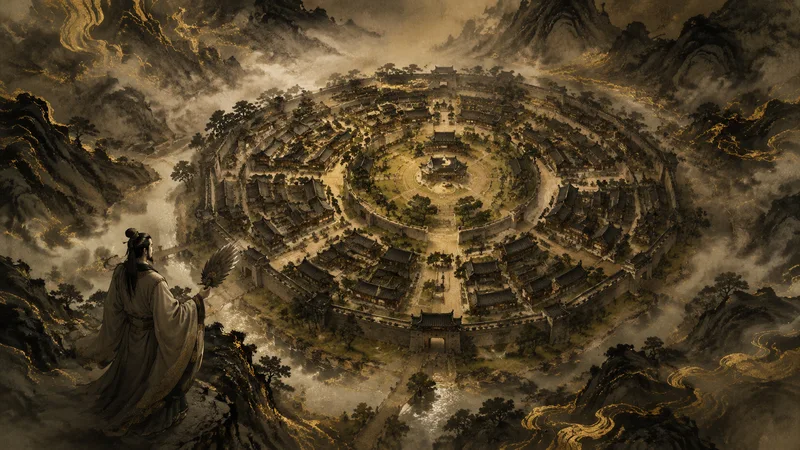
Zhuge Bagua Village: A Real Chinese Village Built on Eight Trigrams
Hidden among the lush hills of Zhejiang province lies a place that seems to have stepped out of a legend. The Zhuge village, also known as Zhuge Bagua Village, is not a mythical creation or a designer’s fantasy—it is a real place where everyday life unfolds within the mysterious geometry of the eight trigrams design. For centuries, this settlement has stood as a living testament to the profound intelligence of Zhuge Liang, the famed strategist of the Three Kingdoms period. But what makes this village truly extraordinary is not just its age or its beauty. It is the way that feng shui architecture has been woven into every stone, every lane, and every shadow, creating a space that is both deeply functional and deliberately disorienting.
When you first step into Zhuge village, you may feel a strange sense of being watched. The streets twist in ways that defy logic. Alleys that appear to lead forward suddenly curve back. Courtyards that look identical reappear around corners like echoes of themselves. This is no accident. The village was built according to the bagua layout, an ancient system of orientation based on the eight trigrams from the I Ching. Each trigram represents a different natural force—heaven, earth, thunder, wind, water, fire, mountain, and lake—and together they form a matrix of energies that govern the flow of qi, or life force. In Zhuge village, the bagua is not just a philosophical concept. It is the very blueprint of the town’s physical structure, and its most immediate and memorable effect is how thoroughly it can confuse visitors who are not familiar with its hidden order.
The Bagua Layout: More Than Just a Design
The genius of the bagua layout is that it works on multiple levels at once. On the surface, it is a practical system for organizing a community. The village is centered on a large pond that reflects the sky and acts as a gathering point. From that center, eight main lanes radiate outward, each one named after a trigram: Qian for heaven, Kun for earth, Zhen for thunder, Xun for wind, Kan for water, Li for fire, Gen for mountain, and Dui for lake. These lanes do not run straight. They curve, split, and reconnect in a pattern that mirrors the cyclical nature of the trigrams themselves. Between these lanes, smaller alleys branch off in a maze-like network. To an outsider, it feels like a labyrinth. To a resident, however, the pattern is clear: each house is positioned to optimize its relationship to the central pond and the prevailing winds, ensuring that qi flows smoothly through every home and courtyard.
The eight trigrams design also encodes a deep symbolic meaning. The trigrams are not just directions; they represent a dynamic balance of energies. For example, houses in the Kan (water) sector are often placed near wells or drainage channels, while those in the Li (fire) sector have kitchens with hearths that face south. This is not superstition. It is a sophisticated form of environmental psychology and ecological planning that predates modern zoning laws by centuries. The village’s layout ensures that no home is exposed to harsh northern winds, that sunlight reaches every courtyard at the right time of day, and that water flows away from living spaces to prevent stagnation. In this way, the bagua layout is an early example of sustainable design, one that has kept the village safe from floods, fires, and even invaders for over 700 years.
Feng Shui Architecture in Action
The term feng shui architecture often conjures up images of rearranged furniture or strategically placed mirrors. But in Zhuge village, feng shui is the very skeleton of the built environment. Every element—from the height of a wall to the width of a doorway to the position of a tree—was chosen with intention. One of the most striking features is the village’s relationship with the surrounding hills. The settlement sits in a natural basin, with mountains rising to the north and east, protecting it from cold winds and harmful spirits alike. To the south, a gentle stream flows past the entrance, bringing fresh water and symbolizing the inflow of wealth. This classic positioning—mountains behind, water in front—is a cornerstone of classical feng shui, and it is executed here with textbook precision.
Yet the feng shui architecture of Zhuge village goes far beyond its macro-scale siting. Look closely at the details. The roofs of the houses curve upward at the eaves, not just for beauty but to deflect negative sha qi (sharp energy). The windows are smaller on the lower floors to keep out dust and prying eyes, but larger on upper floors to capture light and views. Door thresholds are raised to prevent energy from leaking out and to keep insects at bay. The central pond, called Zhongtang, is shaped like a half-moon, which in feng shui represents both the gathering of water (wealth) and the balance of yin and yang—the flat side faces the village, symbolizing receptivity, while the curved side faces the sky, symbolizing active potential. Even the paving stones in the lanes are laid in patterns that guide the eye and the feet toward auspicious angles. Nothing is arbitrary.
What truly sets Zhuge village apart, however, is the deliberate use of disorientation. The eight trigrams design is not simply about harmony; it is also about defense. The village was founded by descendants of Zhuge Liang, who were not only scholars and farmers but also keen strategists. They knew that an enemy who entered the village would quickly become lost in the winding lanes, unable to find the center or the exits. The maze-like streets, the identical-looking courtyards, and the sudden dead ends all combine to create a natural fortification. Even the names of the lanes are designed to mislead. A lane called Lu (road) may twist back on itself; a lane called Zhi (straight) may curve sharply. This tactical use of space is a direct inheritance from Zhuge Liang’s legendary military tactics, such as his famous Stone Sentinel Maze, where soldiers were trapped by an array of stone formations. The village is, in effect, a lived-in rendition of that same principle.
Why Confusing Visitors is Intentional
It might be tempting to think that the village’s complexity is simply an old-world quirk. But the intentional confusion serves multiple purposes. First, it acts as a physical test. In traditional Chinese thought, the ability to navigate a bagua layout demonstrates an understanding of harmony and order. Visitors who do not grasp the underlying pattern are seen as outsiders, not just in a spatial sense but in a spiritual sense. Second, confusion creates a threshold. Crossing the boundary into Zhuge village is like passing through a gate between ordinary reality and a more contemplative space. When you are lost, you are forced to slow down, to observe, to ask for help. This encourages a state of mindfulness that is central to the village’s heritage as a center of learning and culture. The descendants of Zhuge Liang have always valued wisdom over haste, and the layout reflects that priority.
This design also protects the community’s privacy. Because confusing visitors is a built-in feature, the residents enjoy a degree of seclusion even in the busiest tourist seasons. The lanes are narrow enough that pedestrians cannot walk side by side in large groups. The courtyards are hidden behind heavy wooden gates, each one requiring a subtle shift in level or a turn in direction to access. This means that everyday life—the drying of herbs, the chatter of children, the grinding of rice—continues undisturbed. In a world where authenticity is often sacrificed for accessibility, Zhuge village offers a refreshing alternative: a place that asks you to earn your understanding, to pay attention, and to let go of your map and your preconceptions.
“He who knows the path through the eight trigrams knows the path to his own heart.” — Old saying from Zhuge village
Visiting Zhuge Village: What You Need to Know
If you plan to visit this real place in Zhejiang, come with an open mind and comfortable shoes. The best way to experience the village is to walk slowly, without a guide, and allow yourself to get lost for at least an hour. Pay attention to the subtle clues that the residents use to navigate: the carving of a trigram above a door, the direction of a roof ridge, the position of a stone lion. Notice how the light shifts as you move from one sector to another. In the water sector, the air feels cooler and damper. In the fire sector, you will find more kitchens and hearths. These are not feng shui gimmicks; they are the results of centuries of thoughtful placement.
Here are a few practical tips to deepen your appreciation of the feng shui architecture while you explore:
- Start at the central pond. This is the navel of the village. From here, identify the eight main lanes and try to trace each trigram’s direction. You will quickly see why the layout works.
- Look for the ancestors. The village has a dedicated ancestral hall, which is the spiritual center of the community. It is oriented to the southeast, the direction of wind and wood, symbolizing growth and prosperity.
- Check the thresholds. Count the steps between each courtyard. Many homes have a raised step or a small screen inside the door to slow down energy and prevent it from rushing straight through.
- Observe the water. Rainwater is channeled through a series of open gutters that feed into the central pond. This is not just drainage; it is a visible cycle of qi moving from the periphery to the core.
- Ask a resident. Most locals are descendants of Zhuge Liang’s family and are proud of their heritage. A respectful question will often earn you a fascinating story about how a specific lane or house was placed to solve a particular problem.
The true genius of Zhuge village is that it teaches you feng shui without a single lecture. You feel the difference in the air when you step from a shaded alley into a sunny courtyard. You notice how some lanes make you feel restless and others calm. That is the bagua layout speaking directly to your body, not to your intellect. It is a rare gift in a world of superficial design. The village does not explain itself; it simply exists, inviting you to learn by experience. So come to Zhuge village in Zhejiang, and let the eight trigrams design show you what true harmony looks like—not as an abstract idea, but as a place you can walk through, touch, and remember long after you leave.
Ultimately, Zhuge Bagua Village stands as a profound reminder that architecture can be more than shelter. It can be a teacher, a protector, and a sanctuary. By honoring the wisdom of Zhuge
Frequently Asked Questions