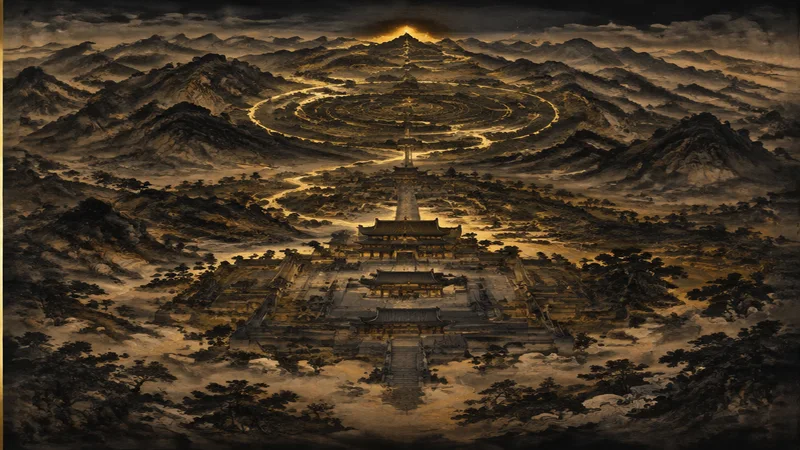
Zhu Yuanzhang and the Feng Shui of the Ming Imperial Tombs
When Zhu Yuanzhang, the Ming dynasty founder, ascended from humble beginnings to become the Hongwu Emperor, he faced a task few rulers ever contemplate: securing his legacy for eternity. For the imperial tombs near Nanjing, he harnessed the ancient art of Feng Shui with an intensity that would set the stage for the entire Ming dynasty’s architectural and spiritual vision. The result was not merely a burial ground, but a carefully orchestrated dialogue between heaven, earth, and human ambition—a perfect demonstration of how the dragon vein, the life-force of the landscape, can be channeled into a mortal monument. To understand this achievement, one must first appreciate that Feng Shui was never about decoration; it was about survival, prosperity, and the uninterrupted flow of ancestral power.
The Search for a Perfect Burial Site
Legend holds that Zhu Yuanzhang personally scoured the hills around Nanjing, rejecting dozens of locations before settling on the southern slope of Purple Mountain (Zijin Shan). His choice was no accident. In classical Feng Shui, a perfect burial site requires the presence of four symbolic animals: the Black Tortoise to the north, the Azure Dragon to the east, the White Tiger to the west, and the Red Bird to the south. Purple Mountain rose majestically behind, providing the tortoise’s protective shell. The rolling hills on either side formed natural dragon and tiger arms, embracing the site. In front, the vast plain and the distant Qinhuai River offered the red bird’s open view. Zhu Yuanzhang’s eye, guided by his imperial geomancers, recognized that this terrain already possessed the essential dragon vein—a subterranean current of vital energy that could support not just one emperor, but an entire dynasty.
What sets Nanjing apart is the unusual configuration of its dragon vein. Unlike the straightforward north-south alignment favored in many tombs, the Ming Xiaoling Mausoleum, as Zhu Yuanzhang’s tomb came to be called, faces south but curves subtly to the west. This isn’t a mistake; it’s a refined adaptation to the local terrain. The S-shaped flow of the vein follows the underlying mountain strata, and the tomb was positioned precisely at a point where the energy rises to the surface—what Feng Shui practitioners call the "acupoint" of the earth. This careful reading of the landscape allowed Zhu Yuanzhang to merge his own destiny with the land’s natural power, ensuring that his descendants would inherit a stable and thriving mandate. Without this meticulous geomantic research, the Ming dynasty might have crumbled under its own spiritual vulnerability.
The Feng Shui Principles Applied
The construction of the Ming Xiaoling Mausoleum was an architectural achievement in every sense, but its deepest significance lies in its adherence to a set of rigorous Feng Shui principles. Every element—every wall, gate, tree, and stone—was placed with intentionality. Modern practitioners often study this site to understand how large-scale engineering can coexist with natural geomantic forms. The original complex covered over 100 square kilometers, yet it was designed to feel like a quiet progression from the mundane world to the sacred realm. The path from the outer Xiaoling Gate to the inner coffin chamber extended for nearly two kilometers, each step increasing the concentration of qi. This is a textbook example of how positive energy can be accumulated through spatial sequencing.
The Ming Xiaoling Mausoleum: A Case Study in Form and Intent
A central feature of the tomb is the Perfect Burial Site’s enclosing structure. To the north, the massive Baoding (Treasure Mound) was raised as an artificial hill, its circular shape echoing the heavens and providing a commanding anchor for the dragon vein. The mound was built from hundreds of thousands of compacted earth and stone layers, then covered with pine and cypress—trees chosen for their evergreen vitality and their symbolic association with immortality. To the south, a series of bridges and arches were aligned along a central axis, but never in a rigidly straight line. Instead, the axis bends slightly, mimicking the natural meander of a stream. This "flowing axis" is a classic Feng Shui technique to slow down or stir the energy, preventing it from rushing too quickly from the tomb toward the mortal city.
The use of water is equally instructive. A crescent-shaped channel called the "Golden Water River" runs in front of the mausoleum, with three stone bridges spanning its length. In Feng Shui, water is the collector and transporter of qi. The presence of a gently curving body of water in front of a tomb is believed to gather and retain good fortune. Zhu Yuanzhang ordered this river to be rerouted slightly to ensure it flowed inward, toward the tomb, rather than outward. This detail reveals a sophisticated understanding of what geomancers call "water posture"—the idea that water must embrace, not split, the site. By tuning this natural feature, the Ming dynasty founder further solidified the spiritual integrity of his eternal home.
The Spirit Way and Its Symbolism
Perhaps the most iconic element of the tomb is the Sacred Way, or Spirit Way, lined with stone sculptures of animals and officials. But beneath its obvious artistry lies a deliberate Feng Shui map. The Spirit Way begins with a pair of white marble pillars (huabiao) that act as "gateways for the spirit," marking the transition from everyday space to sacred space. Then follow twelve pairs of animals—lions, camels, elephants, qilin, horses, and mythical beasts—each positioned to deflect negative influences and welcome positive ones. According to the principles of the dragon vein, these animals serve as sentinels that keep the vein’s energy stable and protected. The final section of the Spirit Way features pairs of civil and military officials, symbolizing the perfect balance of yin and yang. This balance is the ultimate goal of tomb Feng Shui: to harmonize the emperor’s soul with the cosmic forces so that his spirit can continue to influence the realm.
“Feng Shui is not about submitting to the land; it is about reading the land as a living text written by heaven. When the tomb aligns with the dragon, the dynasty breathes with the earth.” — Classical geomantic saying, often cited in connection with Nanjing’s imperial sites.
The Architectural Achievement and Its Feng Shui Impact
The scale and precision of the Ming Xiaoling Mausoleum mark it as a pinnacle of Feng Shui applied to imperial architecture. Yet the architectural achievement is not merely about size. It is the ingenious placement of every structure in relation to the five elements. For instance, the entire mausoleum complex is oriented toward the southeast, the direction associated with wood and spring—the season of rebirth. This orientation allows the building to receive the first light of dawn, which in Feng Shui is considered the purest form of respiratory qi. The red walls along the Spirit Way are not utilitarian; they are painted with cinnabar to correspond with the fire element, which tempers the wood energy of the hill. Meanwhile, the glazed yellow roof tiles of the main hall represent earth, the central element that holds all others in check. This five-element matrix is a sophisticated method of preventing any single force from dominating and thus avoiding the extremes of stagnation or aggressive energy.
The Role of Water and Mountains in Historic and Modern Context
For centuries, Feng Shui masters have toured the Nanjing tombs to teach the relationship between the "mountain behind and water in front." In the case of Zhu Yuanzhang’s tomb, the mountain is the formidable Purple Mountain, whose name itself suggests the purple haze of good fortune. The water is the Yangtze River, visible in the distance from the main hall. This combination creates a "harvest" pattern: the mountain stores the energy, while the water distributes it. The emperor’s burial chamber was dug deep into the mountain’s southern slope, placing his body directly in contact with the rocky core of the dragon vein. This is said to allow his spirit to merge with the ancestral line of the earth itself. Modern visitors even today report a sense of awe and calm—a phenomenological proof that the Feng Shui design continues to function, albeit in a subtle manner.
Aligning with the Cosmos
Beyond the physical layout, the tomb was also astronomically aligned. The center of the coffin chamber was positioned to correspond with the North Star, the celestial anchor in Chinese cosmology. The surrounding mounds and gates were placed in accordance with the 28 lunar mansions, creating a microcosmic map of the heavens on earth. This alignment was meant to ensure that the imperial spirit would always have a clear path to the celestial bureaucracy, allowing the emperor to petition the gods on behalf of his living descendants. Zhu Yuanzhang understood that a tomb is not a dead end but a gateway—and his geomancers designed every stone to keep that gateway wide open. This integration of geomancy and astronomy is perhaps the highest expression of the perfect burial site concept, as it unifies three realms: the underworld of the dragon, the middle world of human ritual, and the upper world of stars.
Lessons for Modern Feng Shui Practice
What can the modern practitioner or homeowner learn from Zhu Yuanzhang’s pursuit of geomantic excellence? First, the importance of the dragon vein—whether you live in an apartment in Shanghai or a house in Texas, the principle of following the land’s natural contours remains paramount. Avoid building your home directly on a steep slope with no support behind; instead, find a "throne" of parent structures, just as the tomb rests on the mountain. Second, the use of a curving path or opening, rather than a straight line, is a simple yet powerful technique. The Spirit Way’s bends prove that energy should never be allowed to shoot through a space. Third, water features, even small fountains or birdbaths, should curve gently toward your main entrance, not away from it. The Golden Water River at Ming Xiaoling is a monumental example that translates to a modest backyard pond.
Third, the tomb teaches the value of layers. Modern Feng Shui often focuses on a single entrance or a single room, but Zhu Yuanzhang recognized that protective energy must be built progressively. His mausoleum used gates, arches, trees, and sculptures as successive "filters" to refine the qi. Your own home should have a similar approach: a pathway, a porch, a foyer, and then the main living area, each step slowing and purifying the energy. Fourth, don’t neglect the power of color and material correspondences. The cinnabar red and imperial yellow of the tomb are not arbitrary; they are the elemental pigments of fire and earth. In your own space, choose colors that support, rather than clash with, the dominant energy of each room. Finally, remember that the ultimate goal is harmony, not domination. Zhu Yuanzhang did not carve a mountain into submission; he chose a mountain that already embodied grace. The Ming dynasty lasted 276 years, an astonishing run that many historians attribute partially to the stability of its spiritual foundations.
In summary, the imperial tombs of Nanjing, and specifically the Ming Xiaoling Mausoleum, stand as a living textbook for anyone serious about Feng Shui. Zhu Yuanzhang, the Ming dynasty founder, turned a fear of death into a comprehensive map of life. He demonstrated that the dragon vein is not a poetic