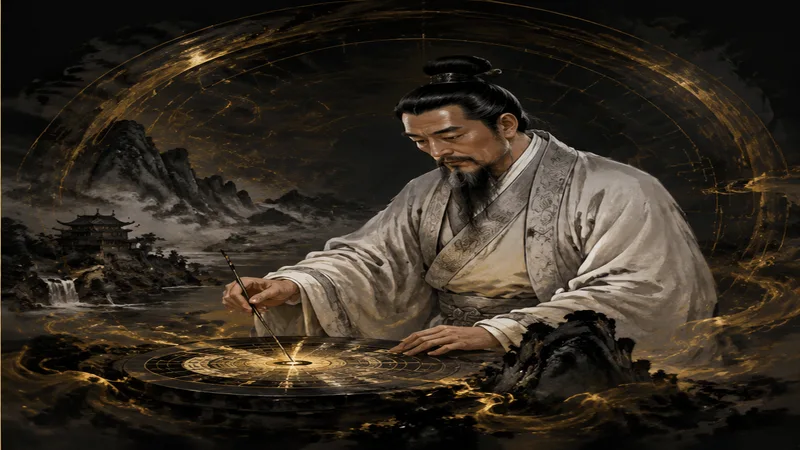
Yang Junsong: The Master Who Founded Form School Feng Shui
When people speak of classical Feng Shui, few names carry more weight than Yang Junsong (also known as Yang Yun Song). A legendary figure of the Tang dynasty, Yang Junsong is revered as the founder of the form school of Feng Shui — an approach that reads the visible landscape, the shapes of mountains, the flow of water, and the subtle contours of the earth to determine auspicious sites for homes, tombs, and temples. His work transformed Feng Shui from a closely guarded imperial mystery into a practical discipline accessible to common people, effectively popularized feng shui across China and later the world.
To understand the magnitude of Yang Junsong’s contribution, we must first recognise the historical context. During the Tang dynasty, Feng Shui was largely a privilege of the imperial court. The emperor’s geomancers advised on palace orientations, city layouts, and royal burial grounds, using complex astronomical observations and cosmological calculations. Yang Junsong himself served as an imperial geomancer, entrusted with the most sensitive and powerful knowledge of the time. But unlike his predecessors, he chose to break convention. He took this royal knowledge and, through his teachings and writings, shared it with ordinary people — a radical act that forever changed the practice of Feng Shui.
The Life and Legend of Yang Yun Song
Historical records are sparse, but tradition holds that Yang Junsong was born around 834 AD, during the late Tang dynasty. He served as the governor of Ganzhou in Jiangxi province, a region that to this day remains a heartland for classical Feng Shui. It is said that he held a high rank in the imperial court as the “Master of the Golden Compass,” the senior imperial geomancer responsible for identifying the most auspicious locations for the emperor’s palaces and ancestral tombs. Yet after a political upheaval, Yang fled the court and traveled south, carrying with him the forbidden texts of Feng Shui.
Rather than hoarding this esoteric wisdom, Yang Junsong began teaching it to ordinary villagers, farmers, and monks. He believed that well-sited homes, prosperous graves, and harmonious villages should not be reserved for the elite. This missionary spirit earned him the title “the compassionate master” and laid the ethical foundation for what we now call form school Feng Shui. His disciples went on to establish distinct branches of the form school, creating lineages that survive to this day.
“The earth is a living body. Its veins are the mountains, its blood is the water. Whoever reads these signs with sincerity will find the pulse of fortune.” — attributed to Yang Junsong
What Is the Form School?
The form school (Xing Fa) is the oldest and most intuitive branch of Feng Shui. Instead of relying solely on compass directions or astronomical cycles, it focuses on the physical features of the landscape. Yang Junsong taught that the qi (vital energy) of a place is strongly influenced by the shapes, directions, and relationships of mountains, hills, rivers, and plains. These forms are not random; they are expressions of the same natural forces that create winds, rains, and seasons. By studying these forms, one can determine where sheng qi (vital, nourishing energy) gathers and where sha qi (harmful energy) disperses.
At the heart of Yang’s method lies the imagery of the Azure Dragon and the White Tiger — the hills to the left and right of a site. Behind the site should be the Black Tortoise, a protective mountain, and in front the Vermilion Bird, an open, level space. Water should flow gently in front, ideally curving toward the site without rushing away. Yang Junsong’s brilliance was to codify these landscape relationships into a system that could be both taught and practised, regardless of whether you were advising a royal tomb or a farmer’s courtyard.
The Tianyujing: A Sacred Text of Form School
Yang Junsong’s most famous written work is the Tianyujing, or “The Heavenly Jade Classic.” This poetic yet practical treatise is considered a cornerstone of the form school. Within concise, enigmatic verses, Yang lays out the principles for identifying dragon veins (mountain ridges), water courses, and the key points where qi accumulates. The Tianyujing does not merely describe landscapes; it teaches the reader to feel the landscape, to observe subtle transitions in slope, soil color, and vegetation, and to judge the character of a place as one would judge a person’s face.
One of the core themes in the Tianyujing is the concept of the “dragon.” In Feng Shui, a dragon is not a mythical beast but a line of powerful qi flowing through mountains and hills. Yang Junsong described many types of dragons — heavenly dragons, water dragons, and earth dragons — each with different qualities. The art of finding an auspicious site begins with following the dragon’s path, observing where it pauses, turns, and ultimately settles. This is why Yang Junsong is often called the grandfather of “dragon-seeking,” a discipline still used by practitioners of the form school today.
Key Principles Taught by Yang Junsong
To truly benefit from Yang Junsong’s teachings, we must understand the practical principles that form the foundation of the form school. These principles are not abstract theories; they are applicable to real sites, whether you live in a countryside home, a suburban villa, or an urban apartment. Let us break down the essential lessons.
- The Five Mountain Shapes: Yang Junsong categorised mountains into five elemental shapes — Wood (tall and straight), Fire (pointed and active), Earth (flat-topped), Metal (rounded and dome-like), and Water (irregular and flowing). Each shape has its own quality of energy. For example, a rounded Metal mountain behind a house gives stability, while a pointed Fire mountain in front of the main door might create stress.
- The Importance of the Water Mouth: In the form school, where water exits a site is often more important than where it enters. Yang Junsong taught that water is the “yin” to the mountain’s “yang.” The point where water leaves should be guarded, ideally by small hills or by a curve that slows the flow. This ensures that the qi of the site is retained and not drained away.
- The Ancestor and the Grandfather: A good site should have a long lineage of mountains behind it. The highest, most distant peak is the “Ancestor”; the closer ridge is the “Grandfather”; and the immediate hill behind your home is the “Parent.” Yang emphasised that qi becomes more refined as it moves from ancestor to parent. A site with no supporting chain is like a person with no family — vulnerable and isolated.
- The Four Emblems: The left, right, rear, and front protections must be balanced. If the left dragon is too arrogant and the right tiger is too weak, the site may bring quarrels or losses to the male members of the household. If the rear is too low, long-term support is missing. Yang Junsong’s genius was in balancing these features with simple, intuitive rules.
- Avoiding “Secret Ruptures” in the Land: Not all mountains are good. Yang Junsong warned against jagged, broken, or bald rocks that denote lingering sha. Similarly, stagnant water, dry riverbeds, or water that flows in a straight line away from the site are all considered inauspicious. These guidelines work even in modern cities: a tall building with sharp edges pointing at your home echoes the same destructive forms.
How Yang Junsong Popularized Feng Shui
Before the Tang dynasty, Feng Shui was buried under layers of court intrigue. Many geomancers deliberately wrote in obscure, flowery language so that only the initiated could understand. Yang Junsong changed everything. He adopted a style of instruction that was direct and memorable, using the language of the land itself. He encouraged his students to go out into the hills and practise looking at real forms, rather than staying inside with abstract charts. This hands-on approach made Feng Shui comprehensible to non-scholars. Consequently, he popularized feng shui not just in terms of frequency but in terms of spirit — shifting it from aristocratic superstition to a universal craft for health, harmony, and prosperity.
His legacy is visible in the many villages throughout southern China that were designed according to his principles. Walled villages, ancestral halls, and communal courtyards were oriented not by arbitrary compass readings but by the physical terrain around them. The natural drainage, the slope of the hills, and the position of the groves were incorporated into daily life. The wisdom of the form school became folk wisdom. Farmers knew that building a house below a thickly wooded hill protected them from cold winds; they knew that facing the bend of a river rather than the straight line of a road brought calm. These practical observations echo Yang Junsong’s original vision: that Feng Shui is a matter of perceiving, not merely calculating.
Tianyujing in Everyday Feng Shui Practice
If you are new to Feng Shui, you can begin applying the core insights of the Tianyujing without needing to master the full scholarly text. For instance, look at your front door. In the form school, the front door is the “mouth” of the home, taking in qi. Ideally, the path leading to it should be gently winding, not arrow-like. You should be able to stand at your door and see an open space — or at least a clear, unobstructed area — in front. This is simply the urban adaptation of the Vermilion Bird principle. Likewise, the wall behind your back while you sit at your desk or bed matters: a solid wall behind you acts as your Black Tortoise, giving support and security. A window behind you is seen as a vulnerable back, a classic problem in many modern offices.
“Do not ask the compass to tell you where to sit. Look first at the hills around you, feel the breeze on your neck, notice the water’s mood. The compass is the servant; the landscape is the master.” — Traditional Form School saying
Comparing Form School with Other Schools
It is helpful to understand how the form school differs from the Compass School and the Flying Star School. The Compass School, which gained prominence later, relies heavily on the orientation of a building according to the directions of the Eight Trigrams and the Luo Pan compass. The Flying Star School uses annual and decennial cycles of stars to calculate fortune over time. Both are valuable, but Yang Junsong taught that form is the root. If the physical shape of the site is poor — surrounded by steep cliffs, polluted water, or sharp angles — no amount of compass adjustment can completely fix the issue. Conversely, a site with beautiful forms can often absorb a few directional shortcomings. This is why many modern Feng Shui masters begin their analysis with the principles of Yang Junsong before moving to more esoteric calculations.
This priority on form also makes the form school remarkably relevant today. Environmental awareness, sustainable architecture, and the growing preference for living in harmony with nature align directly with Yang’s methods. When we plant trees to shield our homes from harsh winds, when we design our living rooms to face a garden rather than a parking lot, and when we choose to live near healthy water systems, we are unconsciously echoing the original teachings of Yang Junsong.
The Ethical Legacy of Yang Yun Song
Beyond technique, Yang Yun Song’s ethical stance is deeply influential. He is believed to have written verses that warn against using Feng Shui to harm others or to gain wealth at another’s expense. Ancient accounts describe him as a man who refused rich patronage from tyrants, instead helping the poor and the marginalised. He taught that true Feng Shui practice is an act of renFrequently Asked Questions