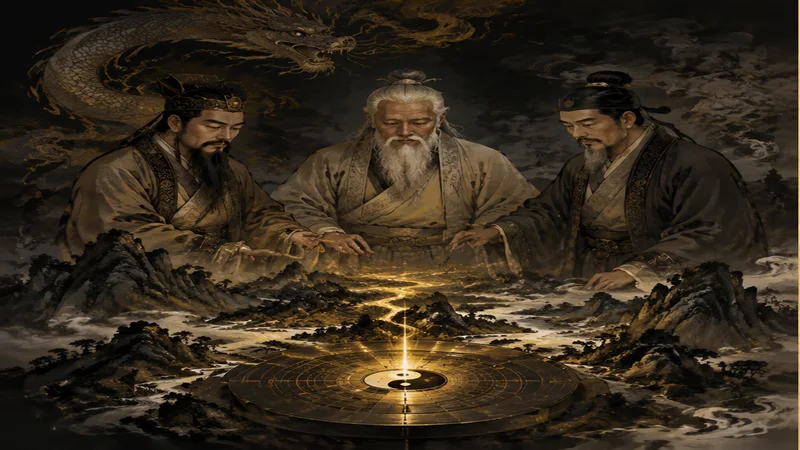
The Su Family Feng Shui Lucky Land: How Three Literary Giants Were Shaped by Sichuan's Auspicious Energies
When we speak of Su Shi (also known as Su Dongpo), we are not merely recalling a poet, essayist, calligrapher, and statesman of unmatched brilliance. We are witnessing the extraordinary outcome of what traditional Chinese metaphysics calls a feng shui lucky land. But Su Shi did not arise in isolation. He was part of the Su family, a household that produced three literary giants: Su Xun (the father), Su Shi, and Su Zhe (the two sons). Together, they are known in Chinese history as the "Three Su" (San Su), an unprecedented phenomenon that invites us to explore the hidden environmental and ancestral factors behind their genius.
Feng shui, the ancient art of harmonizing with the landscape, teaches that the quality of the land we inhabit, the orientation of our homes, and the resting places of our ancestors all conspire to shape our destiny. When we examine the origins of the Su family, we find a powerful example of how a feng shui lucky land can nurture creativity, intellect, and moral integrity across generations. This article will take you into the hills of Sichuan, where the Su family's ancestral burial sites and home environment together created a perfect storm of auspicious energy.
The Geographical Blessing of Sichuan: A Basin of Converging Qi
To understand the Su family's fortune, we must first look at the larger landscape of Sichuan. This province is often called the "Land of Abundance" (Tianfu Zhi Guo), and feng shui practitioners have long regarded it as a uniquely protected and fertile region. Surrounded by mountains on all sides – the Longmen Mountains to the northwest, the Daba Mountains to the northeast, and the Hengduan Mountains to the west – Sichuan forms a natural basin. In feng shui terms, this is a classic "Ming Tang" (bright hall) where qi (vital energy) accumulates rather than disperses.
For the Su family, this geographical setting was not a coincidence. They lived in Meishan, a county in southern Sichuan, located at a strategic point where rivers and hills create a dynamic interplay of yin and yang. The Min River, a major tributary of the Yangtze, flows through the region, carrying water energy that symbolizes wealth, intelligence, and the flow of ideas. In feng shui, water governs the "mouth of the dragon" – the source of scholarly fame. The presence of clean, winding water near the Su ancestral home ensured that the family would be blessed with eloquence and literary power.
But a basin alone is not enough. The key lies in how the surrounding mountains and waterways are oriented. In our study of the Su family's fortunate destiny, we find that the mountains behind their ancestral home formed a "crouching dragon" shape, offering support and protection. Meanwhile, the river in front curved gently like a "jade belt" (Yudai Shui), a highly auspicious formation in feng shui that signals the arrival of noble and learned offspring.
The Ancestral Burial: A Crucial Foundation for Talent Generation
No discussion of the Su family's rise would be complete without addressing the practice of ancestral burial. In Chinese metaphysics, the burial site of one's forebears is considered the single most powerful factor influencing the destiny of descendants. This is because the bones of the ancestors are said to transmit the energy of the earth (earth qi) directly into the bloodline. A well-chosen grave can activate talent generation for several generations, while a poorly placed one can cause decline and misfortune.
According to historical records and feng shui legends, the Su family's ancestral cemetery was located on a slope called "Penglai" (Fairy Island) near Meishan. This site was selected by a renowned feng shui master who recognized a rare pattern known as "the wind gathers the spirit" (Jufeng Ling). The tomb of Su Xun's father (Su Xu) faced the rising sun, with a clear view of a distant peak shaped like a writing brush. This is a classic "Wenbi Peak" (literary brush mountain) configuration, which directly encourages scholarly success and creative brilliance.
An ancient feng shui verse states: "If the grave is placed where the dragon's heart meets the water's curve, sons and grandsons will hold the golden pen and serve in the court of letters." The Su family's ancestral burial is a living testimony to this principle.
However, ancestral burial is not just about the physical location. It also involves proper rituals and sincere filial intent. The Su family, despite their later prominence, remained deeply rooted in Confucian values. They honored their ancestors not only with gravesite offerings but also with a lifelong commitment to moral cultivation and social responsibility. This combination of auspicious land and virtuous conduct is what allowed the feng shui lucky land to express itself fully through three generations of literary giants.
Su Xun: The Father Who Awakened the Family's Literary Destiny
While the world remembers Su Shi and his younger brother Su Zhe, we must not overlook their father, Su Xun. He was a late bloomer who did not begin serious study until his late twenties. Yet, in classical feng shui terms, Su Xun served as the "dragon gate" – the channel through which ancestral energy flowed into the next generation. Without his determined effort and eventual mastery of prose and poetry, the family's literary tradition might never have been established.
Su Xun's home study was positioned in the eastern wing of the Su residence, a direction associated with the "Qinglong" (Azure Dragon) – the guardian of wisdom and scholarly achievement. The study had a large window facing a small pond, which reflected the morning sunlight. In feng shui, a reflective water element near a study stimulates the "Tai Yang" (Great Yang) energy, enhancing concentration and memory. Su Xun often wrote that he felt a "clearness of mind" when working in that room, a direct result of the harmonious layout of his environment.
Moreover, Su Xun deliberately chose to bury his own father with a specific intention: to awaken the "peacock spreading its tail" (Kongque Kaiping) formation. This burial pattern is said to produce offspring who are not only intelligent but also charismatic and expressive. Indeed, both Su Shi and Su Zhe become famous not just for their writing but for their ability to captivate audiences and inspire followers. This is evidence that the Su family understood that a feng shui lucky land is not merely a passive space but an active partner in shaping character and destiny.
Su Dongpo: The Living Masterpiece of Feng Shui Energy
When we examine Su Dongpo (the favorite name of Su Shi), we see a person who seemed to carry the very essence of his ancestral landscape within him. He was bold, innovative, and unafraid to speak truth to power – traits that feng shui practitioners associate with strong "Fire" energy in the natal chart, enhanced by the "Wood" energy of his home region. Sichuan's dense forests and vibrant vegetation provided the wood qi that feeds the fire of creativity. Su Dongpo's enduring poetry, calligraphy, and culinary inventions are all manifestations of this dynamic combination.
One of the most famous feng shui stories about Su Dongpo involves his later years, when he was exiled to the remote southern island of Hainan. Even in exile, he insisted on arranging his simple dwelling according to feng shui principles. He aligned his writing desk to face the easy south, with the ocean bringing refreshing "water qi" to his mind. He wrote to his brother: "Wherever I place my mat, there is the center of the universe." This demonstrates that a true master of feng shui does not depend solely on a fixed location – the principles are internalized, allowing the individual to harmonize with any environment.
But for the purpose of this article, it is the family's original lucky land in Sichuan that laid the foundation. The three literary giants – Su Xun, Su Shi, and Su Zhe – all shared a common bloodline, but they also shared a common spatial inheritance: the ancestral burial ground, the homely study, and the protective embrace of mountains and rivers. Their collective talent generation cannot be explained by genetics alone. Feng shui provides a more holistic framework, suggesting that the energy of a place can actively influence the development of the brain, the creativity of the mind, and the resilience of the spirit.
Practical Feng Shui Lessons from the Su Family Lucky Land
Now, you might be wondering: "How can I apply these insights to my own life?" The story of the Su family is not just a historical curiosity. It offers practical guidance for anyone seeking to enhance their own intellectual or creative potential. Below are actionable lessons drawn from the feng shui lucky land that gave birth to the three literary giants.
- Choose a supportive larger environment. If possible, live or study in a place that has a naturally uplifting landscape – gentle hills, clean water, and abundant greenery. Even within a city, find a park or a riverfront to spend time in, as this brings "living qi" into your daily routine.
- Set up a dedicated study corner in the auspicious direction. In feng shui, the "intelligence" direction for most people is the east or southeast. Place your desk facing these directions, and add a small water feature (like a fountain or a bowl of water) to activate the "scholarly star" of the year.
- Honor your ancestors with respect. You may not have an ancestral burial site, but you can create a small family altar at home. A clean, well-lit space with photos or heirlooms of your grandparents or parents can strengthen the root of your family's energy, which supports your own growth.
- Protect the "back" of your desk and home. The Su family's home had a mountain behind it, symbolizing support. In your home, place a solid wall behind your desk or chair. Avoid having a window or a door directly behind you, as this represents unstable qi and disrupts focus.
- Incorporate the "writing brush" symbol. The Su ancestral tomb faced a peak shaped like a brush. You can imitate this by placing a tall, thin plant (like bamboo) or a calligraphy brush on your desk. This serves as a reminder of the energy of literary excellence and creates a subtle resonance with the archetype of the scholar.
- Balance water and fire elements. The Su family thrived because Sichuan provided a balance of moist (water) and warm (sunlight) energies. In your study, avoid too much electronic clutter (fire/wood) or too much darkness (water). A lamp with warm light and a window that opens occasionally will help maintain the right mix.
The Deeper Meaning: Talent Generation as a Holistic Process
Many people misunderstand talent generation, thinking it is a magical way to turn an average individual into a genius overnight. But the story of the Su family teaches us that feng shui works in synergy with effort, morality, and education. The feng shui lucky land of Sichuan provided the soil, but the seeds of hard work and virtue were planted by the family itself. Su Xun burned his own past essays to start anew. Su Shi endured political exile yet continued to write with humor and depth. Su Zhe remained loyal and steadfast beside his brother. These are qualities that no landscape can impose, but a blessed landscape can certainly amplify them.
In the end, the three literary giants of the Su family are a beacon of hope for all of us who feel limited by our circumstances. While you may not have a mountain-dragon formation or a jade-belt river outside your window, you can still apply the principles of feng shui on a smaller scale. Your home, your desk, and your daily practices are all fields of energy that you can cultivate. By aligning your environment with your aspirations, you open the door to a deeper creative flow – the very same flow that