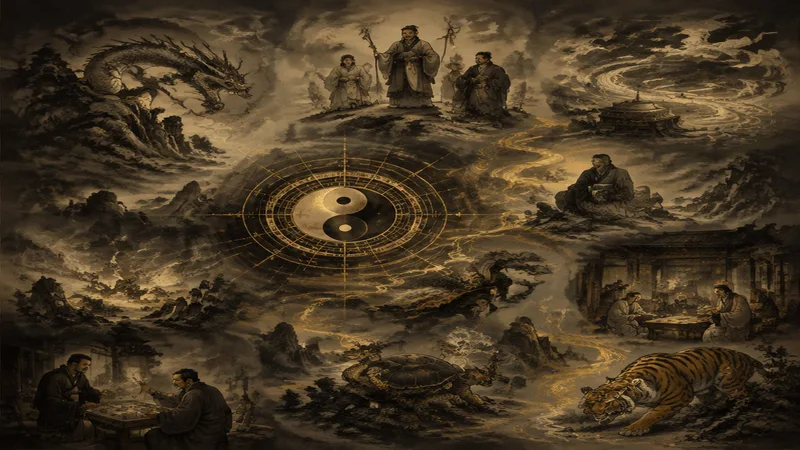
10 Strange Feng Shui Stories from Chinese History
Few traditions blend the mystical with the practical quite like Feng Shui. For over three thousand years, this ancient Chinese practice of arranging space to harmonize with cosmic energy has shaped cities, palaces, homes, and graves. But behind the calm principles of balance and flow lie some truly bizarre and unsettling tales. From emperors who moved mountains to curses that brought down dynasties, these ten strange feng shui stories from Chinese history reveal a world where invisible forces decided the fate of kingdoms. These are not just historical legends; they are the backbone of Chinese folklore, passed down through generations of geomancers, monks, and chroniclers.
1. The Self-Burying Tomb of Zhuge Liang
Zhuge Liang, the legendary strategist of the Three Kingdoms period, was as skilled in the occult as he was in warfare. According to ancient stories, before his death, he instructed his most loyal soldiers to bury his body in a specific spot along the Han River. The catch? The grave had to be dug by a single man pulling a rope that would snap at the exact moment the coffin was lowered. That rope, he said, was tied to his own destiny.
When the soldier followed the orders, the rope snapped, and a sudden landslide covered the coffin, leaving no trace. To this day, no one knows where Zhuge Liang rests. Feng shui masters believe he chose a "dragon's tail" position—a terrain that flows like a serpent's spine—so that his spirit would continue to guide the fate of his adopted kingdom. This mysterious grave remains one of China's most profound feng shui tales, a perfect fusion of humility and cosmic control.
"When the rope breaks, the dragon sleeps. When the mountain moves, the lord lives forever." - attributed to Zhuge Liang
2. The Dragon Vein of Qin Shi Huang
The first emperor of China, Qin Shi Huang, was obsessed with immortality. His mausoleum, guarded by the Terracotta Army, is a masterpiece of feng shui layout. But the strangest part is the hidden "dragon vein" beneath Mount Li. Geomancers of the time identified a central meridian of cosmic energy running from the Kunlun Mountains to the East China Sea. Qin ordered his engineers to divert the water from two rivers to wash against this vein, believing it would activate the power of the dragon and grant him eternal rule.
Historical legends say that the emperor's engineers built a massive underground palace with rivers of mercury, exactly aligned to the constellation of the Purple Forbidden Enclosure. To this day, geologists have detected high mercury levels in the soil around the tomb. Feng shui practitioners argue that the emperor's forced manipulation of natural waterways disrupted the local energy field, which is why his dynasty collapsed only four years after his death. A warning to all: you can bend the dragon, but you cannot break it.
3. The Cursed Ground of the Ming Tombs
The Ming Dynasty's imperial necropolis, the Thirteen Tombs, sits in a valley north of Beijing, chosen for its perfect "armchair" formation of hills. But one tomb—the Dingling Mausoleum of Emperor Wanli—was built on ground that feng shui masters had specifically warned against. The site was originally a swamp that drained all vital energy into a hidden underground river. Wanli's advisors begged him to move, but the emperor was in a hurry to enjoy his afterlife.
After his burial, a strange series of events unfolded. The hidden river, which should have carried away negative sha chi, instead flooded the tomb's inner chambers. The stone coffins were repeatedly displaced by water, as if the tomb itself were trying to expel the emperor. This strange feng shui story is cited in many ancient stories as proof that a misaligned grave can curse an entire lineage. The Ming Dynasty indeed declined sharply after Wanli's reign, and his tomb was the first to be deliberately looted by archaeologists in the modern era—an act many believed brought bad luck for decades.
4. Empress Wu Zetian's Ghost City
Wu Zetian, the only female emperor in Chinese history, was a master of dramatic gestures. For her mausoleum, the Qianling Tomb, she chose a site near Xi'an that was considered so powerful that it could "make a commoner a king and a king a god." But here's the strange part: she ordered the construction of a massive "Spirit Road" lined with stone statues of foreign envoys, all deliberately decapitated. This was not vandalism—it was a feng shui ritual.
The decapitated statues were intended to "cut off the breath of foreign invaders," according to qian zhai (shamanic texts). Over a thousand years later, the heads remain missing, and local folklore says that anyone who attempts to replace them falls gravely ill. This macabre feng shui tale blends political symbolism with energy manipulation. Wu Zetian's ghost city became a model for later rulers who used geomantic punishments to protect their borders, proving that in ancient Chinese history, even stone heads could carry cosmic weight.
5. The Hidden Waterways of the Forbidden City
The Forbidden City in Beijing is a masterpiece of feng shui engineering. Entire volumes are written on its alignment along the central axis, its golden roofs, and its five guardian gates. But the strangest feature lies underground. The palace complex was built over a network of hidden waterways, some of which flow in complete darkness for hundreds of meters. These channels were not for sewage; they were designed to "dilute and disperse evil spirits" that might travel from the north.
According to feng shui tales, the designers placed bronze "demon mirrors" at key junctions beneath the palace floor. These mirrors, engraved with dragon diagrams, were meant to reflect malicious energy back into the earth. When archaeologists excavated the southern section in 2005, they found small, deliberately placed animal bones—turtle shells, deer antlers, and crow feathers—beneath each alignment stone. These were offerings to the water dragon that was believed to protect the emperor. This hidden layer of ancient stories adds a deeply physical, almost cybernetic layer to the concept of cosmic shielding.
6. The Oracle Bones of the Yellow River
In 1899, a sick Chinese scholar named Wang Yirong bought a packet of "dragon bones" from a traditional pharmacy. These were actually ancient turtle shells and ox scapulae used for divination in the Shang Dynasty (1200 BC). Wang noticed strange scratches on them and decoded them as writing. But what made this a feng shui tale is the location where they were found: the village of Xiaotun, on the banks of the Yellow River.
Local legend holds that the river used to meander directly through the village. A great flood, caused by an angry dragon, changed the course to the south, leaving a "dragon's belly" of still energy. This attracted shamanic kings who buried their oracle bones precisely at the point where the old riverbed met the new one—a "confluence of dragon veins." When the bones were removed by modern archaeologists, the villagers claimed that their wells began to dry up. Whether you believe the superstition or not, the story illustrates how ancient Chinese divination and feng shui were inseparable. Those "dragon bones" were literally the roots of an entire written language.
7. The Dragon Gate of the Song Dynasty
During the Northern Song Dynasty, the capital city of Kaifeng faced a recurring nightmare: the Yellow River shifting its course, sometimes by over 100 kilometers in a single year. The emperor's feng shui masters determined that the city's southern gate, known as the "Dragon Gate," was misaligned. They claimed the gate's heavy bronze threshold was blocking the "auspicious entry" of river energy, causing the water to become wild and erratic.
In a stroke of bizarre geomantic surgery, they ordered the construction of a massive artificial hill outside the gate, shaped like a coiled dragon. This hill was intended to "attract" the river's spirit, guiding it to flow past the city rather than through it. It worked for a while. But in 1128, war broke out, and the Northern Song army deliberately broke the river dykes to slow down invaders. The resulting flood drowned the dragon hill entirely. The city never recovered its feng shui balance, and the dynasty fell within decades. This story is often told as a cautionary tale: using nature against your enemies often means using it against yourself.
8. The Hidden Treasure of the Last Emperor
Puyi, the last emperor of China, was also the most superstitious. When he was forced to leave the Forbidden City in 1924, he ordered his eunuchs to bury a large cache of gold, jewels, and jade objects in the palace grounds. But this was no simple hide-and-seek. Puyi's feng shui advisor arranged the treasure in the shape of a five-element mandala: wood objects in the east, fire-red gems in the south, metal coins in the west, water vessels in the north, and a central stone of yellow jade to bind the energy.
The idea was that this buried treasure would "anchor the dragon" of the Qing Dynasty, preventing the imperial lineage from completely losing its cosmic mandate. To this day, no one has found the casket. Some say it lies beneath the former Imperial Garden, now a public park. A few feng shui enthusiasts have tried to divine its location with compasses and pendulum rods, but the exact spot remains a mystery. This hidden treasure story is one of the few from modern Chinese history that still sparks daily pilgrimages of curious geomancers. The emperor lost his throne, but his hidden hoard still whispers of a return.
9. The Phantom City of the Mogao Caves
In the remote desert of Dunhuang, the Mogao Caves house over 700 Buddhist grottoes. But according to feng shui tales, the site was originally chosen for a much darker purpose. Early monks believed that the cliffs contained a "ghost city"—an underground labyrinth that would open if the gate of the nearby Sanwei Mountain were aligned to the rising sun on the winter solstice.
A Tang Dynasty monk named Le Zun arrived in 366 AD and detected a vision of golden light emanating from the cliffs. He interpreted it as a sign to carve the first cave. But geomancers later realized that the construction pattern of the caves follows a unique feng shui principle called "the turning dragon"—where the rock formations mimic the dorsal spines of an underground beast. Buddhist monks, in turn, used the site to "tame" this restless dragon by placing thousands of painted Buddhas along its body. The result is a feng shui wonderland that blends sanctity with geology. Many ancient stories claim that the caves' hidden rooms contain sacred texts and gold that were buried to stabilize the region's energy. That is precisely what was discovered in 1900: a hidden library with over 50,000 manuscripts, hidden behind a painted mural for 900 years.
10. The Sabotaged Dragon Head of Nanjing
Our final strange story takes us to Nanjing, capital of the early Ming Dynasty. The Zhu family, founders of the Ming, had their ancestral tomb on Purple Mountain. It was a near-perfect feng shui site: two hills like a reclining dragon, with the Yangtze River serving as the "water spirit." But the first Ming emperor, Hongwu, became paranoid that future enemies would discover and "break" the dragon vein. So he ordered a massive wall built around the entire mountain, with walls that were over 40 feet thick.
But the sabotage came later, in the 16th century, when the Qing armies invaded. A feng shui general from the north, who had studied Chinese folklore