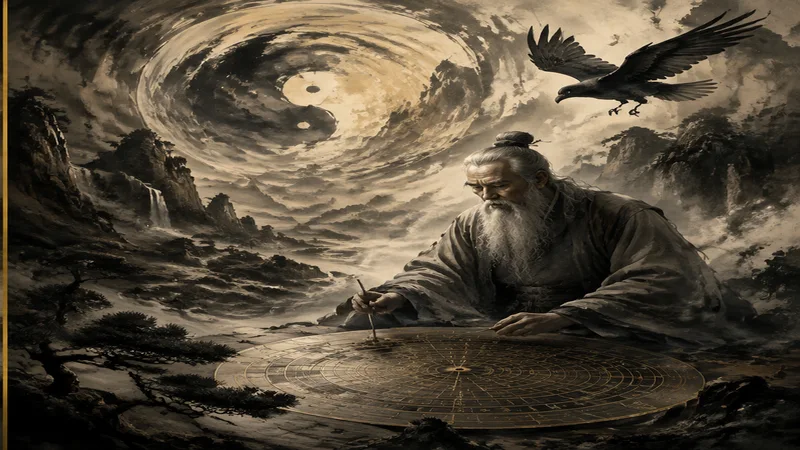
Qingwu Zi: The Mysterious First Feng Shui Master
In the vast and layered history of Chinese metaphysics, few names carry as much intrigue as Qingwu Zi. Later tradition calls him the first feng shui master, yet his historical identity is uncertain and the surviving accounts are wrapped in legend. That uncertainty is part of the story: a sage at the edge of mist, credited with turning observations of wind, water, mountains, and shelter into a language of environmental harmony. To read Qingwu Zi is to enter the mythic foundation of the art while keeping history and folklore distinct.
The Legendary Origin of Qingwu Zi
Who was Qingwu Zi? The name itself offers the first clue. "Qingwu" translates as "Blackbird" or "Blue Crow," a symbol steeped in celestial significance. In Chinese lore, the blackbird is often a messenger between heaven and earth, a creature that sees across the veil of the mundane. Qingwu Zi, therefore, is the "Master of the Blackbird"—one who understood the secret communications between the cosmos and the terrestrial realm. His legendary origin places him in the era of the Yellow Emperor, roughly five thousand years ago, when Chinese civilization was coalescing from myth into structured society. Some accounts say he was a minister or advisor to the legendary ruler, while others insist he was a wandering sage who appeared from the misty mountains with a scroll of cosmic diagrams in hand. What remains consistent is that he was the first to codify the observation of qi—the life force that animates all things—into a coherent system of environmental harmony.
The very title of "first feng shui master" carries a weight of responsibility. It implies that before Qingwu Zi, there were only fragmented intuitions, isolated observations of how a river bends or how a hill shelters a valley. Qingwu Zi synthesized these observations into a unified framework. He recognized that the landscape was not a random collection of geological features, but a living body of energy, with veins of qi flowing along mountain ridges and arteries of water shaping the vitality of the land. His teachings, passed down orally for generations, laid the groundwork for what would eventually be known as kan yu—the art of "patterning the opportunity of the sky and earth"—and later, simply as feng shui.
The Qingwu Jing: An Ancient Text of Cosmic Wisdom
Central to Qingwu Zi's legacy is the Qingwu Jing, the ancient text attributed to him. Unlike later feng shui manuals that are packed with technical formulas and intricate compass lore, the Qingwu Jing is a poetic and concise classic. Its lines are elliptical, rich with metaphor, and deliberately ambiguous—a hallmark of early Chinese esoteric writing. The text is not a step-by-step guide; it is a meditation on the principles underlying all feng shui. It speaks of the dragon lines (long mo) that run through mountains, the importance of the "embracing water" (huan bao) that gathers qi, and the balance of yin and yang in the land. The Qingwu Jing asserts that the quality of a site is not determined by outward grandeur alone, but by the subtle interplay of form, direction, and time.
"The qi rides the wind and scatters, but is retained by water. The ancients gathered it to prevent its dispersal, and guided it to ensure its retention. Thus, it is called feng shui."
This famous passage—often considered the very definition of feng shui—is deeply embedded in the Qingwu Jing. It encapsulates the essence of Qingwu Zi's insight: the wind (feng) disperses vital energy, while water (shui) collects and holds it. The practice of feng shui, then, is the art of finding or creating places where qi is not scattered but retained, where life can flourish in a protected and nourishing environment. For the student of Chinese metaphysics, the Qingwu Jing is not merely a relic; it is a living scripture. To study it is to sit at the feet of the master himself, learning to see the landscape as a dynamic and communicative system.
Qingwu Zi's Teachings and Methods
While later traditions divided feng shui into the Form School and the Compass School, Qingwu Zi's original teachings were fundamentally holistic. He did not separate the shape of the land from the cardinal directions; both were expressions of the same underlying cosmic order. His method began with the observation of the four celestial animals—the Black Tortoise to the north, the Azure Dragon to the east, the White Tiger to the west, and the Red Bird to the south. This framework was not symbolic but literal: a good site should have a tall protective mountain behind (Tortoise), rolling hills on the left (Dragon), a lower ridge on the right (Tiger), and a clear, open space with a view of water in the front (Phoenix). Qingwu Zi taught that these configurations allowed qi to settle and accumulate, creating ideal conditions for homes, graves, and cities.
Beyond landforms, Qingwu Zi emphasized the importance of water flow. He noted that water is the ultimate carrier of qi; it can bring life or, if misdirected, bring illness and misfortune. His principles for evaluating water were precise:
- Water should be slow and meandering—it allows qi to gather and move gently, nourishing the surrounding land.
- Water should not flow straight out—a site with a river that leaves quickly is said to "let go" of prosperity, losing its energetic charge.
- Water should embrace the site—curves and bays that wrap around a location create a "storage" effect, holding wealth and health in place.
- Clear and clean water—the quality of the water reflects the quality of the qi; murky water signals stagnating energy.
These seemingly simple observations were revolutionary for their time. They showed that feng shui was not superstition but an empirical study of environmental patterns. Qingwu Zi's genius lay in his ability to correlate natural phenomena with human outcomes, a method that predates modern environmental psychology by millennia.
The Mythological Figure and His Enduring Legacy
As a mythological figure, Qingwu Zi occupies a liminal space between history and allegory. Some legends claim he transformed into a crane and ascended to heaven after completing the Qingwu Jing, while others say his tomb was found empty, his body disappeared into the very earth he taught others to read. These tales are not mere fantasy; they speak to the archetypal nature of the feng shui founder. Qingwu Zi is not just a person but a personification of the spirit of observation—the human capacity to harmonize with the environment. In this sense, the historical accuracy of his existence is secondary to the truth of his teachings. The ancient Chinese did not write history in the modern, fact-checking sense; they wrote meaning. Qingwu Zi represents a moment in time when humanity consciously began to align its built environment with the natural order of the universe.
His legacy is immense. Without Qingwu Zi, there would be no Luo Shu square, no He Tu diagram, no Xuan Kong flying stars, no Ba Zhai eight mansions. Every feng shui system that followed owes a debt to his foundational vision. The Tang dynasty master Yang Yun Song, often called the "Secret of the Dragon" and the patron of the Form School, built directly upon the concepts first articulated in the Qingwu Jing. The Song dynasty scholar Lai Wen Jun, father of the Laiyang branch of the Compass School, also cited Qingwu Zi as his ultimate authority. Even today, when a modern practitioner walks a site, noting the slope of the land, the direction of the wind, and the curve of a stream, they are unconsciously following in the footsteps of the first master.
How Qingwu Zi's Wisdom Applies Today
The principles of Qingwu Zi are not confined to ancient Chinese graveyards or imperial palaces. They hold profound relevance for our modern, urban world. While we may not have hills and rivers in our apartments, the same energetic logic applies. In a city, the "mountain" is the tall building behind you, providing support and stability. The "water" is the street in front, carrying the flow of people and opportunities. The "wind" is the ventilation and the layout of rooms, and the "dragon" is the pattern of the neighborhood's energy. A thoughtful reading of Qingwu Zi's teachings inspires us to create spaces that feel protective, supportive, and alive.
For example, the principle of "embracing water" translates into placing your desk or bed in a position where you have a clear view of the entrance (the "water mouth") but are not directly in line with it. This echoes Qingwu Zi's observation that qi will gather in a sheltered spot, not in a straight, exposed corridor. Similarly, his emphasis on the balance of yin and yang appears in our efforts to combine natural light (yang) with cozy, shadowed corners (yin) in our home. The spirit of Qingwu Zi is one of deep attention—of training the eye to discern how energy moves through a space, and then acting accordingly.
To honor the memory of the first feng shui master is to cultivate this attention in our own lives. We might not need to interpret the scales of a dragon's spine in the mountains, but we can learn to recognize the energetic patterns in our own bedrooms, offices, and gardens. Qingwu Zi's mysterious origin is a reminder that true wisdom has a timeless quality; it arises from a direct encounter with reality, not from accumulating formulas. The legendary origin of Qingwu Zi teaches us to look beyond the surface and seek the hidden order of things.
Whether one views Qingwu Zi as a historical personage, a compilation of ancient insights, or a purely symbolic embodiment of feng shui's first principles, his impact is undeniable. The Qingwu Jing remains a touchstone for serious practitioners—a text that rewards lifelong study and contemplation. To understand Qingwu Zi is to understand that feng shui is not about adding ornaments for luck, but about aligning oneself with the fundamental rhythms of the earth and sky. As the first master knew, when we align with the environment, we align with ourselves.
In a world of increasing disconnection from nature, the lessons of Qingwu Zi ring out with renewed urgency. He asks us to slow down, to observe, to feel the wind and listen to the water. He asks us to remember that we are not separate from the landscape but part of it. The mystery of his identity is the mystery of all fundamental truths: they are simple, yet infinitely deep. Qingwu Zi may have been the first, but his spirit lives on in every attempt to create a harmonious dwelling, a peaceful workplace, and a balanced life.
Whether you are a seasoned practitioner or a curious beginner, the story of Qingwu Zi offers a powerful touchstone. It anchors the practice of feng shui in something ancient, respectful, and deeply human. For in the end, the historical reality of Qingwu Zi matters less than what he represents: the permission to look at the world with reverence and to act wisely within it. That is the true gift of the mysterious first feng shui master.