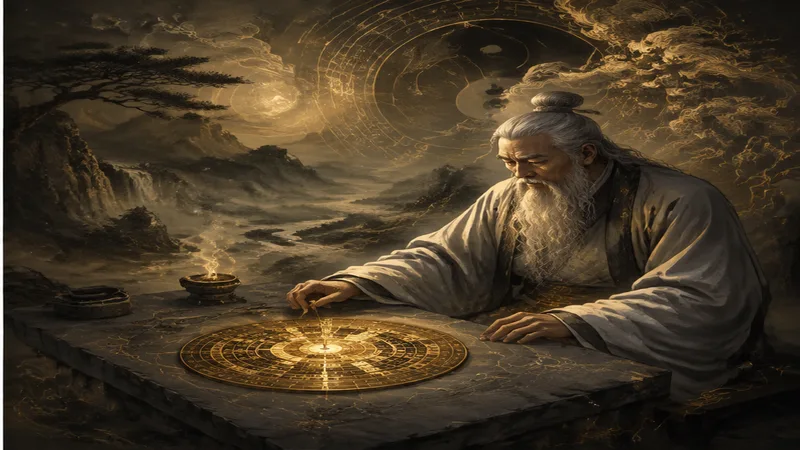
Guo Pu: Why Is He Called the Ancestor of Feng Shui?
When discussing the history of Feng Shui, one name towers above all others: Guo Pu. While countless scholars, monks, and geomancers have contributed to the development of this ancient Chinese art, Guo Pu is universally recognized as the feng shui ancestor. But why exactly does he hold this singular title? What did he do that no one before him had done? And why does his work continue to shape how we understand the flow of chi in landscapes, homes, and gravesites to this very day?
To truly appreciate Guo Pu's legacy, we must travel back to the Jin dynasty, a period of immense political chaos, scholarly creativity, and spiritual exploration. It was in this turbulent era that Guo Pu wrote the Book of Burial — known in Chinese as the Zangshu. This short but profound classical text would become the foundational scripture of Feng Shui, earning its author the title of "ancestor" not because he invented the concept, but because he was the first to codify its deepest principles in a systematic, poetic, and enduring form.
"The Book of Burial is to Feng Shui what the Torah is to Judaism, what the Bible is to Christianity, what the Quran is to Islam — a founding revelation that organizes all that came before and all that follows."
The Historical Context: Jin Dynasty and the Search for Harmony
The Jin dynasty (265–420 CE) was a time of transition. The Han dynasty had collapsed, and China was divided into rival kingdoms. Wars, famines, and forced migrations caused widespread suffering. In such uncertainty, people increasingly looked for ways to control their fate. They turned to ancient practices of divination, ancestor veneration, and natural observation. It was within this milieu that Guo Pu, a brilliant scholar of cosmology, poetry, and lore, sought to bring order to the scattered ideas about how to choose auspicious locations for burial and dwelling.
Before Guo Pu, there were certainly traditions regarding burial sites. Ancient Chinese nobility had long chosen graves based on mountains, waters, and directions. However, these traditions were mostly local, oral, and fragmented. There was no unified theory, no single authoritative text that explained why a certain hill faced south, why a certain bend in a river was fortunate, or why a family tomb could influence the descendants' luck. Guo Pu changed that forever.
By compiling, analyzing, and enhancing these older practices, Guo Pu created a coherent theoretical framework that linked the energy of the earth — qi (chi) — to the fate of the living. He argued that if you place a body in a location where qi naturally gathers, then the spirit of the deceased will remain peaceful, and the descendants will receive the beneficial influences of that environment. This may sound simple, but it was revolutionary. It turned Feng Shui from a set of superstitious anecdotes into a discipline with principles that could be learned, taught, and passed down.
The Book of Burial (Zangshu): A Classical Revelation
The Book of Burial (Zangshu) is Guo Pu's masterpiece. It is a short text — often just a few dozen scroll segments — yet its depth is unmatched. In the Zangshu, Guo Pu captures the essence of Feng Shui in highly poetic, metaphorical language. He writes about the "dragon veins" of the earth, the importance of "shelter from the wind," and the critical need for "water first" — all terms that are still used by Feng Shui practitioners around the world.
One of the most famous passages from the Zangshu reads:
"When qi courses through the earth, it creates landscapes. The bones of the deceased receive qi, thereby the descendants are influenced by fortune. Thus, the method of Feng Shui first requires the collection of qi. With wind, qi disperses. With water, qi stops. The ancient sages so constructed methods to halt the wind and preserve qi."
In this single statement, Guo Pu laid out the core principle of Feng Shui: qi must be gathered, not scattered. Wind represents the forces that scatter energy, while water represents the forces that hold and concentrate it. Therefore, a good location is one where mountains protect from strong winds, and where water flows gently to gather qi. This principle applies not just to graves but also to homes, offices, and entire cities. That is why the Zangshu is considered the classical text that anchors all of Feng Shui practice — every school, from the Form School to the Compass School, ultimately traces its roots back to Guo Pu's insight.
Why "Feng Shui Ancestor"? The Legacy of Guo Pu
The title feng shui ancestor is not merely an honorary nickname. It reflects a deeper reality: Guo Pu's ideas became the non-negotiable foundation upon which every later art of Feng Shui was built. Without the Zangshu, there would be no standardized terminology, no shared reference points, and no cohesive philosophy. Let us examine the primary reasons why Guo Pu holds this title.
- He synthesized ancient knowledge — Before Guo Pu, Feng Shui knowledge was scattered across oral traditions and disjointed regional customs. His genius was to unify these fragments into a single, coherent system based on qi, yin-yang, and the five elements. This synthesis allowed Feng Shui to be practiced not only in China but eventually across the entire world.
- He gave Feng Shui its core metaphors — The dragon, the tiger, the water, and the wind: these are not just poetic images. They are functional concepts that explain how to read landscapes. Guo Pu's use of these terms gave practitioners a universal language for discussing landforms, directions, and energy flow.
- He connected burial to destiny — Guo Pu assertively linked the treatment of the dead to the fortunes of the living. This may be controversial from a modern rationalist perspective, but it was a powerful cultural idea that shaped funerary practices across East Asia for nearly two millennia. It also created a deep, respectful motivation for studying Feng Shui, because it was not just about aesthetics — it was about filial piety and family legacy.
- He inspired the Form School — Later known as the "Jiangxi School" or "Luan Tou" (forms and images) tradition, this branch of Feng Shui focuses on the physical shapes of mountains, hills, and watercourses. Its methods descend directly from Guo Pu's observations in the Zangshu. Even today, practitioners of the Form School still study the Book of Burial as their foundational scripture.
- His aura of mystery and mastery — Like many great founders, Guo Pu became surrounded by legends. He was not just a scholar writing abstract theories; he was also said to have practiced what he preached with incredible efficacy. His personal story, including his dramatic and tragic death, added to his mystique, making him a legendary master, not merely an academic contributor.
The Death Story: How Guo Pu's Destiny Echoed His Teachings
Guo Pu's death story is as dramatic as his life, and it is often retold to illustrate the potency of his Feng Shui skill. According to historical records, during the fall of the Jin dynasty, Guo Pu was serving as an aide to a military governor named Wang Dun. Wang Dun had begun to plot a rebellion against the emperor. He asked Guo Pu to perform a divination regarding the success of his campaign. Guo Pu, being a loyal and principled Confucian, saw that the omens were bad. He honestly told Wang Dun: "If you rise in rebellion, you will fail, and your fate will be sealed."
Wang Dun was infuriated by this unwelcome prediction. He then asked Guo Pu to divine Guo Pu's own fate. Guo Pu calmly answered: "Today is the day of my death." Wang Dun, still furious, retorted, "How long do you have?" Guo Pu replied, "No more than the time until noon." Enraged, Wang Dun ordered Guo Pu's immediate execution. Guo Pu was taken to the execution grounds, where he asked the executioner where he would be buried. The executioner told him that, on the city's outskirts, near a cypress tree. Upon arriving, Guo Pu examined the spot, nodded, and said, "This is a good place. The qi is abundant here, and my descendants will prosper." He even predicted the exact circumstances of a future person who would steal a rice jar from his grave — a prediction that is said to have come true years later.
While this story may be part legend, it powerfully reinforces Guo Pu's image as a legendary master who did not fear death, because he understood the higher ordering of fate. He trusted in the principles he taught. Even under the shadow of execution, he could see the flow of qi, identify an auspicious spot, and know the consequences of the earth's energies. This anecdote has been passed down through centuries, and it serves to demonstrate that Feng Shui is not merely about maximizing wealth or comfort — it is about perceiving the profound and unavoidable connection between heaven, earth, and humanity.
How to Use Guo Pu's Teachings in Modern Life
Now, you might be thinking: "This is all fascinating history, but what can Guo Pu do for me today?" The answer is: plenty. The principles from the Book of Burial are not just ancient museum pieces. They can be practically applied to your home, yard, and even urban apartment. Here are some actionable takeaways inspired by Guo Pu that you can incorporate into your own living space:
- Observe the water first — Guo Pu famously said: "First, examine the water." Water represents wealth and the retention of qi. In your home, ensure that your faucets do not leak, that your drains are clean, and that any water features (like a small fountain) are gently flowing toward the direction of your front door, not away from it. Avoid a stagnant pond or a cluttered water closet, as these represent blocked qi.
- Let the Qi collect, not scatter — Walk into your front door. Is there a direct path through to the back door, allowing energy to rush straight through? If so, place a screen, a bookshelf, or a rug to slow the energy down and let it swirl, collect, and nourish your home. This reflects Guo Pu's core teaching that wind disperses qi and water stops it. You want the "water" of your home layout to encourage qi to linger.
- Protect your back (Supportive Mountains) — In nature, a strong mountain behind a house provides shelter and support. In an urban setting, that "mountain" might be a taller building, a wall of large trees, or simply the back of your office chair. Always sit with firm support behind you, and place your bed or desk against a solid wall. Never sit with your back to a door or a large window. This simple rule follows Guo Pu's form-based guidance and helps you feel secure and grounded.
- Respect the Yin and Yang — Guo Pu emphasized a balance of light and shadow, movement and stillness. Make sure that no room is too dark (excessive yin) nor too blindingly bright with harsh light (excessive yang). Use appropriate curtains, warm lighting, and a mix of colors to create a harmonious balance. You can also include both soft and hard surfaces to achieve the same effect.
- Let Nothing Be Oppressively Close — In the Zangshu, Guo Pu warns against "immediate cliffs" and "sharp rocks" that pierce or suffocate a dwelling. In modern terms, avoid living under a huge overhanging balcony, next to a narrow alley with a visible garbage dump, or with a lamp directly over your head when you sleep. If such features exist, soften their effect with tall plants, screens, or artificial light to redirect the qi.
Real-World Example: Applying Zangshu Principles
Let me illustrate how a professional Feng Shui consultant might apply Guo Pu's philosophy in a simple house inspection. Consider a suburban home with a long, straight driveway that leads directly to the front door, with no gentle curve. According to Guo Pu's principle, a straight path carries qi too quickly —