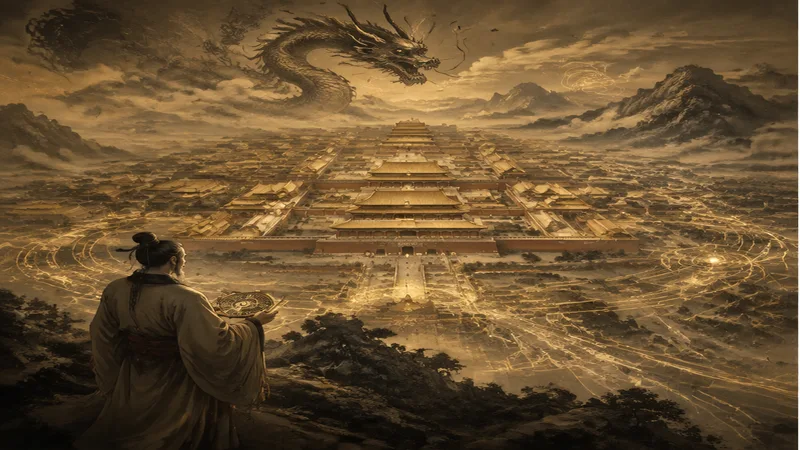
Beijing as a Feng Shui Capital: Mountain Backing, Dragon Veins & Imperial Power
When we speak of great cities in the tradition of Chinese geomancy, few places rival Beijing. For over eight hundred years, this sprawling metropolis has served as the imperial capital of dynasties from the Yuan to the Qing, and its enduring power is no accident. In Feng Shui, a capital is not merely a political center—it is a living organism, shaped by the invisible currents of qi that flow through mountains, water, and human design. Beijing's layout, with its famed central axis, its deliberate positioning relative to surrounding ranges, and its profound reliance on dragon vein theory, offers one of the most sophisticated examples of applied geomancy anywhere in the world. To understand Beijing is to understand how ancient sages read the earth as a text of energy, and how they inscribed the mandate of heaven into bricks, stone, and soil.
Mountain Backing: The Symbolic Protection
In classic Feng Shui, the ideal site requires a protective mountain to the north—the mountain backing—as this provides shelter from cold winds and, more importantly, anchors the flow of energy. Beijing has precisely this, with the Western Hills and the Jundu Mountains rising to the northwest. These ranges are not merely geographic features; they are the physical embodiment of the Black Tortoise, the guardian of the north in the four celestial animals system. The tortoise gives stability, longevity, and support. Without such a backing, a city is said to have no root, no inheritance of ancestral power. Beijing's mountainous shield gives it that root, creating a stone spine that channels dragon energy into the plains below.
To the east and west, Beijing is also embraced by lower hills—the Mangshan and Fenghuang ranges—which form the Azure Dragon and White Tiger flanking positions. In Feng Shui, these guardians should be gently curving, never aggressive, and Beijing's topography fits this model beautifully. The city's founders, especially during the Ming dynasty design period, understood that a capital must be nestled like a pearl in a half-closed palm. Thus, the mountain backing is not a distant ornament; it is the very reason the city's qi is considered so potent. It provides a slow, steady descent of energy from the high northern peaks, which then accumulates and circulates through the urban grid.
Dragon Veins: The Energy Pathways
Beyond visible mountains, Feng Shui speaks of dragon veins—subterranean or topological lines of energy that run through the earth, much like acupuncture meridians in the human body. Beijing sits at the confluence of several major dragon veins, most notably the Kunlun vein that originates far off in the Kunlun Mountains of western China. These veins are said to carry the breath of the earth, pulsing with both yin and yang rhythms. For an imperial capital, tapping into a robust dragon vein is essential. If the vein is weak, the dynasty will be weak; if it is disturbed, chaos can follow.
The Forbidden City, at the heart of Beijing, is built directly over what geomancers identified as the main dragon vein of the region. Its placement is not coincidental. The ancient astrologers and geographers tracked how the vein surfaced from the northern mountains, dipped below the ground near the present-day Jingshan Park (an artificial hill created expressly as a "seat" for the dragon's pulse), and then emerged again at the very throne room of the emperor. This continuous line was believed to give the ruler direct access to the earth's generative power. The artificial hill of Jingshan, often called Coal Hill, is perhaps the most brilliant stroke of geomancy in the entire city. It was constructed with the earth excavated from the palace moats, and it visually completes the mountain backing while sealing the dragon vein's energy in place. It is, in effect, a man-made mountain designed to perfect what nature provided imperfectly.
The Central Axis: Imperial Power Alignment
Perhaps no feature encapsulates Beijing's Feng Shui more than its central axis—a straight line that runs roughly 7.8 kilometers from the Bell Tower in the north to the Yongding Gate in the south. This axis is not a simple road; it is the symbolic backbone of the empire, the line along which the emperor, the Son of Heaven, aligned himself with the cosmic order. In Feng Shui, the central axis is the dragon's spine, and every key structure—Gate of Supreme Harmony, Hall of Supreme Harmony, the Great Hall of the People—is placed either on or in precise relation to this line. The Forbidden City itself is centered on it, ensuring that the emperor, when seated on his throne, faced due south, as all great rulers must. This cardinal orientation places the ruler in harmony with the sun's noon heat, with winter's absence of yang, and with the summer's peak of fire energy, thereby balancing the entire realm.
The axis also serves a practical and spiritual purpose. It forms a clear channel for qi to flow through the city like a broad river. For this reason, the layout of Beijing is often compared to a chessboard, with the central axis as the king's line. This alignment was deliberately reinforced by the Ming and Qing courts. Gates, arches, and bridges were all built to preserve an unobstructed view along this axis, so that the emperor's vision—and the heaven's gaze—could sweep unimpeded from north to south. In modern Beijing, the axis remains the physical and psychological center of the city, a testament to how deeply a geomantic concept can shape urbanization for centuries.
Ming Dynasty Design and Geomancy
The Ming dynasty design of Beijing, particularly after the Yongle Emperor moved the capital from Nanjing, is a masterclass in applied Feng Shui. Emperor Yongle commissioned a near-total rebuild of the city in the early 1400s, and he instructed his advisors to follow the strictest geomantic principles. The result was a city that intentionally mirrored the cosmos. The palaces were built in the tu earth element, with yellow glazed tiles representing the imperial center. The city walls were not merely defensive; they were also meant to define a sacred boundary, a walled alter where the emperor performed the annual sacrifices that kept the universe in balance.
The Ming geomancers also paid close attention to water. Earth is the carrier of qi, but water is its greatest mover. Beijing's original waterways, including the canal system and artificial lakes surrounding the Forbidden City, were designed to gently curve, never blading sharply into the palace. This is because Feng Shui warns that straight or aggressive water can cut the dragon vein. The famous "C-shape" moat and the calm waters of the North and South Seas (Beihai & Zhongnanhai) are exemplary instances of geomantic water management. They slow down energy, prevent stagnation, and create a harmonic rhythm between solid structures and the surrounding land. In the Ming era, no imperial structure could be built without first consulting a geomantic compass (luo pan), and we can see the result in every gate, every courtyard, every roofline.
"In Beijing, the earth itself was made to serve as a throne. The mountains are its armrests, the dragon vein its spine, and the central axis its gaze. To build a city this way is to declare that no human power is separate from the power of the planet."
Key Elements that Make Beijing a Feng Shui Capital
If we distill the geomantic genius of Beijing, we find a set of transferable principles. These are not purely historical curiosities; they can inspire how we design homes, workplaces, and even our personal lives. Consider these core Feng Shui lessons from the imperial capital:
- Backing is non-negotiable: Position your desk, your bed, or your main living area against a solid wall, like Beijing's mountain range. This gives you support, reduces anxiety, and prevents opportunities from slipping away behind you.
- Find your own dragon vein: In a city setting, a dragon vein might be a main road, a corridor, or a long hallway. In Feng Shui, we want to sit alongside this flow, not directly in it. Beijing's Forbidden City sits adjacent to the dragon vein line, not literally astride it, allowing it to receive its energy without being overwhelmed.
- Keep your central axis clear: What is the path between your front door and your most important room? Feng Shui suggests keeping this passage unobstructed, just as Beijing kept its central axis free of clutter. This allows life-giving qi to move smoothly.
- Balance water and stone: Beijing balances the heavy earth energy of the Forbidden City with the softly flowing waters around it. In your own home, aim to combine stable elements (furniture, books, heavy objects) with moving elements (plants, fountains, even open windows). This is the mingling of Yin and Yang.
- Honor the cardinal directions: The Ming dynasty designers placed the emperor facing south. You may not be a sovereign, but you can still orient your primary seating so you face a door or a window with a view—this creates openness and awareness, akin to an emperor surveying his realm.
The Later Life of a Geomantic Masterpiece
Even after the fall of the Ming and Qing dynasties, Beijing's Feng Shui footprint remained potent. The spirit of the central axis has continued to exercise an almost gravitational pull on how the city grows and how its landmarks are arranged. Whether one subscribes to the mystical or merely to the symbolic power of aligned space, it is undeniable that Beijing's layout continues to influence how the Chinese people view their capital. Modern architects have tried to soften the strict geomantic grid, but many still pay homage to its principles. The Bird's Nest stadium, for instance, was constructed with a wavelike pattern that mimics the subtle curves of a dragon's body, and the CCTV headquarters has been criticized and praised for its sprawling, unconventional shape, which some say disrupts the flow of energy along the eastern edge of the city.
Visitors to Beijing today may not consciously feel the qi, but they do feel the awe. Walking through the Gate of Heavenly Peace, through the Meridian Gate and into the Forbidden City, one is immersed in a sequence of open courtyards, heavy gates, and magnificent halls. Each step is a gradual shift in energy, a slow accumulation of power. This is not accidental. It is the result of centuries of geomancy practiced at the highest level. The architects of the Ming dynasty design knew that the human spirit responds to space, balance, and order. They built a capital that would, in itself, be a message to all who enter: you are not merely in a city; you are in a cosmic pattern made tangible.
For students of Feng Shui, Beijing offers a living textbook. It demonstrates that the principles of mountain backing, dragon veins, and central axis are not abstract theories. They are practical tools that have shaped one of the oldest continuous civilizations on earth. When we study Beijing, we study how humans can align themselves with the earth's deepest structures. The capital's ancient geomancers would likely be astounded by skyscrapers, subways, and airports, but they would also recognize a deeper truth: that the land still breathes along its ancient bones. The mountain backing remains, the dragon veins pulse beneath the asphalt, and the central axis still points to the heart of power. For those who pay attention, Beijing is not just a place. It is a boundary, a path, and a seat of energy that continues to shape the people who live within its embrace.