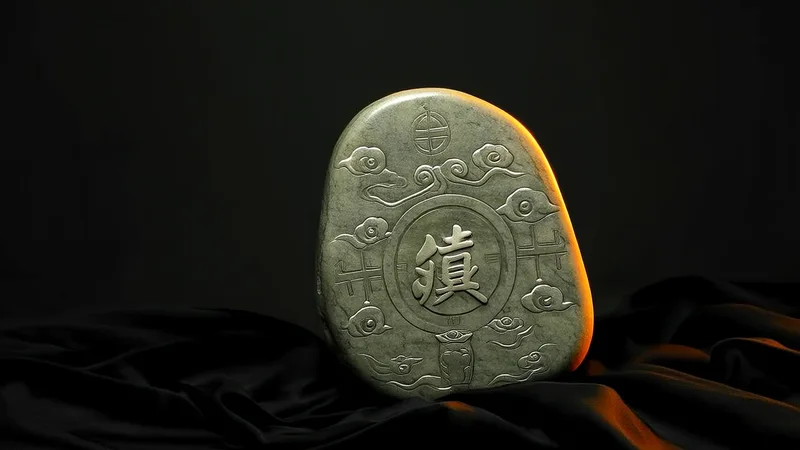
Tai Shan Shi Gan Dang: The Protective Stone Explained
In the rich tapestry of Feng Shui, few objects carry as much weight—both literally and symbolically—as the Tai Shan Shi Gan Dang. In Chinese folk tradition, the carved stone is said to 挡灾保平安—to hold back misfortune and keep a household safe—when placed near an entrance, crossroads, or village lane. That is a民俗故事 and protective symbol, not a tested guarantee. We unpack its origins, legends, placement customs, and practical considerations so you can decide whether this piece of cultural heritage suits your space.
What Is the Tai Shan Shi Gan Dang?
The Tai Shan Shi Gan Dang is a rectangular stone tablet, typically inscribed with the characters 泰山石敢當 (Tài Shān Shí Gǎn Dāng). In English, the name is often translated as "Mount Tai Stone That Dares to Withstand" or "The Stone of Mount Tai That Takes on All Evil." It is not a gemstone or a polished crystal; rather, it is a rough-hewn, upright slab, often placed at the entrance of a building, at the end of a street, or at a sharp bend in a road.
The stone's power is deeply tied to Mount Tai (Tai Shan) in Shandong Province, one of China's most sacred mountains. For millennia, Mount Tai has been a site of imperial sacrifice, religious pilgrimage, and natural spiritual reverence. The stone quarried from its slopes is believed to carry the essence of the mountain—a stabilizing, grounding, and immensely protective energy. By inscribing the mountain's name upon a slab, the Tai Shan Shi Gan Dang effectively calls upon that energy to stand guard against harm.
The Origin of the Tai Shan Shi Gan Dang
Historical records trace the use of Tai Shan Shi Gan Dang back to the Han Dynasty, though some scholars suggest its roots go even further. The earliest references are found in ancient texts that describe placing stones at the foot of village walls to ward off evil spirits and suppress malevolent forces. However, the full-fledged practice of inscribing the specific phrase "Tai Shan Shi Gan Dang" became widespread during the Tang and Song Dynasties.
One popular legend attributes the custom to a brave general who used a stone from Mount Tai to block a demonic breach in a city wall. Another story speaks of a benevolent official who, upon seeing villagers plagued by misfortune, ordered inscribed stones to be placed at every dangerous crossroads and T-junction. Over time, the practice became embedded in folk tradition, and the stones were treated as guardians not only of homes but of entire communities.
What makes the origin particularly fascinating is that the Tai Shan Shi Gan Dang was never merely a decorative object. The carved stone was an active spiritual tool, and its placement was governed by strict rules. The stone had to be quarried from Mount Tai—or at least blessed and consecrated in its name—and then inscribed on a specific lunar date by a master calligrapher or priest. This ritualized craftsmanship was believed to infuse the stone with a permanent protective consciousness.
The Feng Shui Purpose: How the Protective Stone Works
In Feng Shui vocabulary, sha qi—the “killing breath”—describes the uneasy feeling of a sharp angle, straight road, drain, or rooftop aimed toward an entrance. Traditional stories say the stone stands as a steadfast counter-symbol that can 挡煞、挡灾 and help a family feel protected. These are民俗 meanings attached to the inscription; physical hazards, illness, arguments, and financial setbacks still require ordinary design, maintenance, and professional help.
Why is it so effective? The stone works on several levels:
- Presence and Mass: A solid, upright stone disrupts straight-line energy by physically blocking the path of sha qi. Its weight and density absorb and ground the harsh vibrations.
- Sacred Text: The inscribed characters act as a verbal mantra and visual command. "Shi Gan Dang" literally means "stone that dares to resist and block"—so the stone's message is its function.
- Mount Tai's Spiritual Backing: Mount Tai is associated with stability and the protection of heaven. The stone draws on this immense local deity and natural power to create an unbreakable shield.
- Yin-Yang Balance: The hard, yang nature of the stone is perfectly suited to overcome the yin, malicious, or excessive energy of sha qi.
In ancient Chinese writings, the Tai Shan Shi Gan Dang is described as "a loyal general who never sleeps." It stands silently, day and night, watching over the entrance and ensuring that no harmful influence can cross its threshold.
Tai Shan Shi Gan Dang Front Door Placement
By far the most common application in modern Feng Shui is the front door placement of the Tai Shan Shi Gan Dang. The front door is considered the primary mouth of a home—the main gateway for all qi. If that gateway is exposed to external sha qi, the entire living environment is compromised. Placing a protective stone just outside the front door provides a literal and energetic barrier.
When Do You Need a Tai Shan Shi Gan Dang?
You might benefit from this protective stone if you notice any of the following conditions from your front door or from a side entrance that you use regularly:
- A straight road, street, or long driveway points directly at your door.
- A narrow alley or corridor ("arrow of poison") leads straight to your entrance.
- Another building, roof corner, or wall corner "cuts" through your doorway.
- A dry riverbed, ditch, or descending path sends negative energy toward your home.
- A large tree, telephone pole, or lamp post stands directly in alignment with your door.
- `A neighbor's home or a public building creates a "T-junction" that directs approaching traffic toward you.
In all these scenarios, the Tai Shan Shi Gan Dang should be placed on the ground, facing the source of the sha qi. Ideally, it is placed to the left or right of the entrance, not directly centered in the doorway, but still in a position where the inscribed face is perpendicular to the incoming harmful energy. If you cannot place it outside due to apartment rules or space constraints, it can be placed just inside the doorway, but its potency is significantly reduced—so try to keep it as close to the outside threshold as possible.
The Correct Way to Install the Stone
Like any Feng Shui cure, proper installation is essential. Simply buying any decorative stone and propping it against the wall is not enough. Here are the traditional guidelines:
- Source: Use a carved stone that is clearly inscribed with the correct characters. A genuine Tai Shan Shi Gan Dang should be rectangular, with the top rounded or slightly arched—never square or pointed.
- Height: The stone should be at least one chi (about 33 cm/13 inches) tall, though taller stones can be used for larger buildings. It should be firmly grounded in the earth or on a flat, stable base.
- Orientation: The inscribed side must face outward, toward the path of the sha qi. The back of the stone should be closer to your home.
- Consecration: If possible, choose a stone that has been consecrated with a simple ritual—burning a small amount of incense, bowing three times, and mentally instructing the stone to protect the household. If you do this yourself, do it on a morning with clear weather, preferably during the waxing moon.
- Avoid Covering: Do not paint over the stone, glue decorations to it, or allow plants to completely hide it. The stone must be visible and unobstructed to perform its duty.
A common mistake is to place the Tai Shan Shi Gan Dang flush against the wall. To effectively block sha qi, there should be a few inches of open space behind the stone as well. This allows the protective energy to circulate and form a complete shield.
The Deeper Folk Tradition and Cultural Significance
The Tai Shan Shi Gan Dang is not merely a Feng Shui gadget; it is a living piece of folk tradition that embodies the Chinese cultural view of the relationship between humans, nature, and the supernatural. In rural China, these stones are still placed not only at home entrances but also at the entrance of entire villages, at the foot of bridges, and along dangerous mountain passes. Some stones are even placed at the bottom of hills where landslides are common, as the stone is thought to stabilize the land itself.
This tradition is a beautiful example of how practical environmental awareness intersects with spiritual symbolism. The stone is a physical reminder that our homes are connected to larger natural forces—and that it is wise to respect and manage those forces. The Tai Shan Shi Gan Dang does not "fight" the energy aggressively; rather, it embodies the quality of a wise guardian that stands firm, absorbs the impact, and transforms harmful force into harmless ground energy. In that way, it reflects the Taoist ideal of wu wei—effortless action that is nevertheless powerful.
From a modern perspective, the protective stone also offers psychological reassurance. When you stand at your front door and see that sturdy, carved stone facing outward, you are reminded that you have taken steps to safeguard your home. That intention itself can reshape your personal qi, promoting confidence, calm, and a sense of security. In Feng Shui, the mind is the most powerful remedy of all—the stone is a physical anchor for that mental resolve.
Tai Shan Shi Gan Dang vs. Other Feng Shui Cures
It is helpful to compare the Tai Shan Shi Gan Dang with more popular cures like mirrors, bagua, or wind chimes. While those tools can deflect or transform energy, their effects are often subtle and temporary. The Tai Shan Shi Gan Dang is considered a "heavy" and permanent solution. It does not need cleaning, adjusting, or recharging like crystals. It does not have to be hung at a specific height nor aligned with your personal Kua number. It is a committed guardian stone that works independently once it is placed.
However, due to its strong presence, some households find its appearance too severe or intimidate their guests. If that concerns you, you can place the stone offset from the main door, perhaps near a garden border or alongside a pathway, as long as it remains in the line of sight between the source of sha qi and the entrance. You can also choose a carved stone that is slightly smaller and more subdued in shape, but never compromise on the legibility of the characters.
In Feng Shui literature, a common saying states: "The strongest dragon cannot overcome a straight line, but an inscribed stone from Tai Shan can." This sums up the deep trust that Feng Shui masters have in this particular cure.
Practical Purchasing and Care Guide
If you are ready to invite a Tai Shan Shi Gan Dang into your home, here are some final practical considerations:
- Where to Buy: Look in traditional Feng Shui supply stores, Chinese cultural shops, or reputable online sellers. Avoid generic "garden stones"—only those specifically inscribed with the traditional characters are effective.
- Material: Natural granite, slate, or bluestone is best. Avoid painted or plastic reproductions. The stone should feel cool to the touch and be clearly hand-carved or laser-cut with deep relief.
- Placement Timing: The best time to place the stone is early in the morning, preferably during the Dragon hour (7–9 AM), on a day with strong sunlight. This maximises the stone's active yang energy.
- Cleaning: Wash the stone with clean water (not soap) once or twice a year. While doing so, respectfully wipe away dust and silently renew your intention for protection.
- Relocating: If you move, you can take the stone with you—it is not bound to the land. After a house is demolished or a residence changes ownership, the stone can be respectfully retired by burying it in clean earth or returning it to nature.
The Tai Shan Shi Gan Dang is one of the few Feng Shui remedies that has survived the test of time without dilution. It is not a trend or a stylish decor object. It is a functional, sacred, and historically profound protective stone that connects you to the ancient wisdom of Chinese folk tradition. Whether facing a