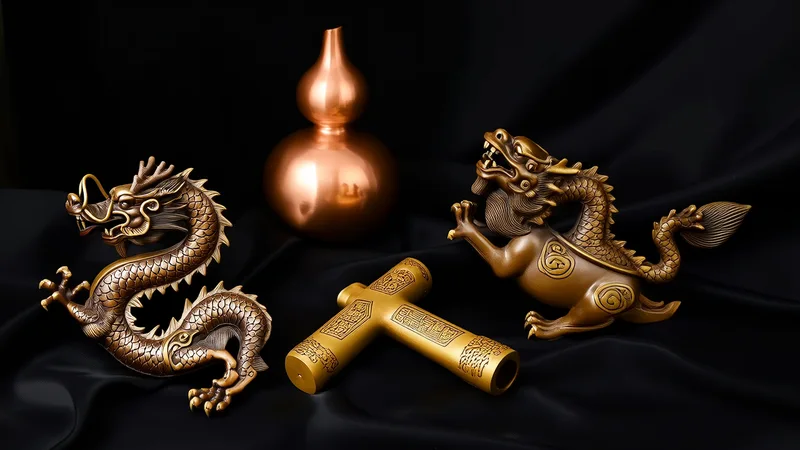
Understanding Feng Shui Protection Cures
In the practice of Feng Shui, some homes and workplaces feel unsettled by busy roads, sharp corners, staircases, or structures that press uncomfortably close. Traditional Chinese stories call these impressions sha qi and answer them with protection cures: dragons, guardian lions, gourds, and other objects whose forms carry protective meaning. They are not mere decorations, but neither are they tested shields; their value lies in culture, intention, and thoughtful placement.
Before introducing any cure, a responsible Feng Shui practitioner will first assess the specific problem. A cure placed without understanding the underlying imbalance is like putting a bandage on a wound without cleaning it. The goal is always to restore harmony—not to fight invisible enemies, but to create a sanctuary where health, prosperity, and peace can flourish.
The Feng Shui Dragon: Benevolent Power and Protection
The feng shui dragon is arguably the most revered of all celestial creatures in Chinese cosmology. Unlike the fire-breathing dragons of Western mythology, the Chinese dragon is a benevolent, auspicious being associated with rain, rivers, and the clouds. It represents power, courage, and good fortune, and it is one of the most potent protection cures available to the practitioner.
When placed correctly, a feng shui dragon can guard a home against hostile influences and bring commanding presence to those who live or work there. Its ideal placement is in the east sector of a home or office, or on the left side of the main door (when standing inside looking out), which is traditionally considered the "dragon side."
An old Feng Shui saying holds: "The dragon brings the rain; the tiger guards the mountain." Together, they create a landscape of safety and abundance. But the dragon alone, placed with intention, can turn the tide of stagnant or threatening energy.
Materials matter. A jade dragon is excellent for career growth and gentle refinement. A metal dragon, especially bronze or brass, is more suited for defensive purposes, particularly if the home faces a pointed structure or a "poison arrow" from a neighboring roof. Never place a dragon in the bedroom, however—its yang energy is simply too active for restful sleep. The dragon should face outward, toward the source of any incoming sha qi, never toward the occupants of the home.
Stone Lions: Guardians of the Threshold
If the dragon represents celestial power, stone lions (often called "fu dogs" in the West) are the earthly sentinels. These majestic pairs have guarded temples, palaces, and noble homes for millennia. Their purpose is straightforward: to protect the entrance from harmful influences and to signal that this space is under divine and earthly protection.
In traditional practice, stone lions are always placed in pairs—a male with his paw resting on a globe (representing dominion over the material world) and a female with a cub beneath her paw (representing protection of the family and nurturing). They should flank the main entrance, facing outward. The placement is precise: they must be at a slight angle, not directly facing one another, and never blocking the door itself.
Size and material should align with the scale of the home. A sprawling estate calls for substantial carved granite or marble lions. An apartment or smaller residence may benefit from smaller soapstone or bronze versions. What matters most is that the lions look dignified and fierce, not cartoonish. Their energy must carry the weight of their protective function.
For those who cannot install actual stone lions, a pair of porcelain or resin lions on a high shelf near the entrance can serve as a symbolic protection cure, provided they are kept clean and given clear sightlines to the door.
The Copper Gourd: The Healing Wu Lu
Of all the traditional objects in the Feng Shui canon, few are as versatile and universally recommended as the copper gourd, or wu lu. The gourd has held deep symbolism in Chinese culture for thousands of years. Its hollow interior was once used to store medicine and water, and its narrow waist is said to trap negative energy and illness, preventing them from circulating freely through a space.
In Feng Shui medicine, the copper gourd is a powerful remedy for health-related sha qi remedies and general protection. Copper itself is believed to have grounding, conductive properties that neutralize harmful electromagnetic fields and cutting energies. A genuine wu lu is typically made of pure copper, often with a lid that can be opened or closed, and sometimes engraved with auspicious symbols or the Bagua.
Where should you place a copper gourd? The list of uses is long:
- Above the front door on the inside, to protect the entire household and absorb negative influences before they enter.
- In the bedroom, particularly near the bed, to promote healing sleep and counteract relationship stress or chronic fatigue.
- In the kitchen, to guard against financial drains and household discord, since the kitchen represents nourishment and wealth.
- In the bathroom or toilet area, where beneficial qi tends to drain away. An open-mouthed wu lu here helps "capture" escaping energy.
- On a desk or office shelf, to ward off gossip, legal trouble, and conflicts with colleagues.
The wu lu can be displayed empty, but many practitioners recommend placing a few grains of rice or a small piece of cinnabar inside to "activate" its storage capacity. If you are using it for a specific health concern, some traditions suggest writing the person's name and birth date on a piece of red paper, folding it, and placing it within the gourd. This must be done with respect and clear intention, not as a superficial ritual.
A copper gourd hung above the family bed is one of the gentlest yet most effective protection cures in Feng Shui practice. It does not fight energy; it simply receives and transforms it, like a vessel of stillness in a noisy world.
Other Traditional Objects and Chinese Amulets
Beyond the dragon, the lions, and the gourd, the Chinese tradition offers a vast arsenal of Chinese amulets and symbolic protections.
Pa Kua mirrors are perhaps the most defensive of all. An octagonal mirror with a concave or convex surface, the Pa Kua is used to reflect or absorb specific negative energies aimed at the home. However, it requires great care. A Pa Kua mirror should never be hung inside the house, and it should never be pointed at a neighbor's home directly—this creates aggressive energy and can escalate disputes. It is a cure of last resort, for clear cases of "hidden arrows" or graves, hospitals, or sharply angled structures visible from the front door.
Chi Lin (or Qilin), the mythical "Chinese unicorn," is another powerful guardian. Often depicted with a dragon's head, deer's body, and horse's hooves, the Chi Lin is believed to appear only in the presence of wise rulers. In the home, it protects against bad influences and is particularly auspicious for couples hoping to conceive. A pair of Chi Lin placed beside the front door or in the living room brings peace and blessings.
Bamboo flutes, typically made of aged bamboo and hung in pairs, are used to lift stagnant energy and promote upward movement in careers. They are especially useful under beams or above doors to soften the oppressive weight of structural overhangs. The hollow bamboo naturally channels chi upward, and the sound of wind through the flutes is said to clear negativity.
Chinese coins, especially the round coins with square holes, are timeless Chinese amulets when strung with red thread. They attract wealth but also protect against loss. The red thread is the binding element—it "ties" the energy of the coins to the intention. Hanging five or six coins from the handle of an inward-opening door is a classic remedy for retaining wealth.
I-Ching hexagrams, often mounted in metal or wood frames, can be placed above the door to dispel negative influences. They derive their power from the ancient divination text, and each hexagram carries specific protective meanings. These are subtle cures—they don't "shout" at the energy but rather recalibrate it through ancient symbolic mathematics.
How to Choose and Combine Your Cures
The most common mistake in Feng Shui is overcorrecting. When someone feels unsafe or unlucky, they may clutter every corner with dragons, lions, gourds, and mirrors, creating a chaotic and aggressive environment. This is counterproductive. True Feng Shui is about harmony, not attack.
Here are practical guidelines for using protection cures responsibly:
- One strong cure per problem. If your front door faces a sharp corner, one well-placed feng shui dragon or a pair of stone lions is sufficient. Adding three more cures will not triple the protection; it will create clutter and imbalance.
- Match the cure to the issue. Physical structural threats (shared walls, corners, protruding objects) call for grounding, dense objects like stone or metal. Emotional or health disruptions call for gentler remedies like the copper gourd or bamboo flutes.
- Respect the creatures. Dragons and lions are not toys. Once placed with intention, they should be kept clean and upright. Dusting them regularly is a form of respect. If you must move or remove them, do so mindfully, acknowledging their service.
- Use the five elements. Copper is metal; stone is earth; wood flutes are wood. Keep the elemental balance of the room in mind. A room already overloaded with metal objects may not benefit from an enormous metal dragon—perhaps a stone or porcelain one is wiser.
Ultimately, Feng Shui cures are not superstitions. They are tools for focusing the mind and shaping the environment. A copper gourd hung above a sickbed does not "magically" heal, but it reminds the occupant of their intention to heal, and it creates a visual anchor for the family's care and prayers. Similarly, stone lions at the gate do not physically repel intruders, but they send a clear, subconscious signal of boundary and guardedness—both to those outside and to the residents within.
Conclusion: Protection as a Practice
The use of traditional objects in Feng Shui is both an art and a science of placement. Whether you choose the majestic feng shui dragon, the stoic stone lions, or the gentle and healing wu lu gourd, the underlying principle remains the same: to create a space where positive energy circulates freely and negative energy finds no foothold.
Begin with the basics. Clear the clutter, repair what is broken, and let light and air move through every room. Only then introduce your chosen protections. Honed by millennia of Chinese cultural wisdom, these protection cures and Chinese amulets serve as reminders that our environment is not neutral—it is a participant in our wellbeing. By nurturing our spaces with intention and meaning, we nurture ourselves.
Choose your cures thoughtfully, place them with reverence, and trust the wisdom of a tradition that has safeguarded homes and families for untold generations. In the most authentic sense, these objects are not guarding against the outside world—they are guarding the peace, prosperity, and love that you cultivate every day within your own walls.