High-Rise Apartment Feng Shui: What Changes on the 30th Floor?
Living in a high-rise apartment asks old Feng Shui images to meet a new setting. On the 30th floor, wind exposure, qi gathering, and mountain support become questions about airflow, light, views, structure, and privacy. You are reading the skyline, clouds, and surrounding towers rather than a village hillside. This is where modern urban feng shui can remain poetic while staying grounded in building comfort and safety.
Mountain Support: Who Has Your Back on Floor 30?
In classical feng shui, a home needs a mountain at its back – a slow, solid elevation that shields from harsh winds and represents ancestors, stability, and career support. On ground level, that might be a hill or a taller building behind yours. But on the 30th floor, your actual physical support is the steel and concrete of the entire tower beneath you. The building itself becomes your mountain, but that only works if the building is structurally sound, well-maintained, and appropriately grounded in the local energy grid.
The more subtle issue is what stands behind you relative to your apartment's main door and your daily seating position. On a high floor, you may be looking down at lower rooftops, or you may be level with other building tops. This changes the meaning of mountain support dramatically. A traditional "backing" of a gentle hill or a large building is now often replaced by a void – open air where a solid mountain should be. To compensate, modern practitioners recommend creating a symbolic internal mountain: a tall bookshelf, a solid headboard, or a substantial piece of dark, heavy furniture placed behind your work or sleeping position. This creates the sense of being supported from behind, even when physical terrain is absent.
Conversely, if you have a taller building directly behind the direction your apartment's main door faces, that can serve as a genuine external mountain — "behind" is defined relative to your facing direction, not a fixed compass point. But on the 30th floor, you must check the actual height of that building relative to yours. If it rises another 20 floors above you, good – you have real backing. If it is shorter than your window sill, the support is weak, and you must rely more on interior remedies.
Qi Gathering at High Altitudes: The Blessing and the Challenge
One of the greatest advantages of a high-rise apartment on the 30th floor is the potential for qi gathering in a very yang, vibrant form. Wind and light are more abundant up there, and the quality of qi tends to be clearer, more energetic, and less polluted by ground-level disturbances such as traffic noise, exhaust, and the chaotic energy of passersby. This is why many people report feeling more alert, creative, and inspired in high-rise dwellings – the qi is simply fresher.
However, qi that gathers at altitude is also more prone to drifting away. On the ground, qi naturally accumulates in low spots, sheltered corners, and behind vegetation. On the 30th floor, there is no natural basin to hold the energy. The qi is like water poured onto a flat roof – it spreads thin and quickly evaporates. To foster genuine qi gathering, you must create focal points inside the apartment. A well-placed water feature (small tabletop fountain) near the entrance or in the wealth corner can hold qi. Dense indoor plants with broad leaves (like monstera or rubber tree) act as "qi anchors," slowing down the energy and allowing it to settle rather than whooshing straight out the windows. Rugs with rich textures, floor cushions, and layered lighting also help to "thicken" the energetic field in a space that otherwise might feel too airy and ungrounded.
Wind Exposure: The Invisible Enemy at 30 Floors Up
Classical feng shui warns that "wind scatters qi." The ideal site is sheltered from strong, gusty winds while allowing a gentle, flowing breeze to circulate. On the 30th floor, you are squarely in the wind zone. Even on a calm day at street level, a 30-storey building can experience noticeable airflow around windows and balconies. In turbulent weather, the wind exposure can be ferocious, attacking your living space from every side. This is not merely about comfort – it directly affects the energetic health of the home.
"Qi rides the wind and scatters; it is bounded by water and stops. The ancients gathered it so it would not scatter, and moved it so it would come to rest — thus it was called feng shui (wind-water)." – Guo Pu, Zangshu (Book of Burial)
The problem is that wind exposure at high altitude creates "sha" – destructive, cutting energy – even if it comes from a perfectly benign direction. Sharp, unbroken wind rushing past a corner window creates the same energetic effect as a knife blade slicing toward your home. To mitigate this, observe which direction the prevailing wind hits your apartment. If it comes from the north or west, you may need heavier curtains (not just blinds) to soften the flow. Also, avoid placing your bed, sofa, or desk directly in line with a window and an opposite door – that creates a "wind tunnel" through your living space, flushing out your luck daily. Adding a solid screen or tall plant between the window and your seating area acts as a windbreak and helps maintain stable internal qi.
Surrounding Buildings: Your New Mountain Range, Rivers, and Islands
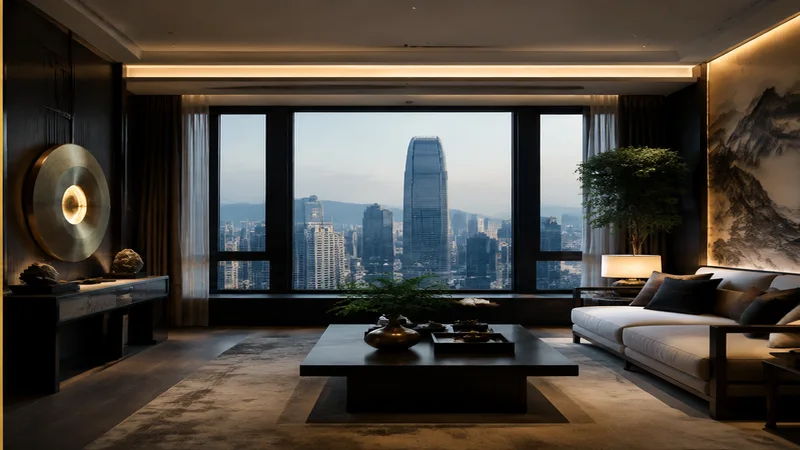
On the 30th floor, your surrounding buildings are your landscape. A nearby skyscraper acts as a mountain, a low rooftop might represent a lake, and a crane or antenna is like a single tree in a field. The entire urban skyline becomes your feng shui map. You must evaluate what you see from each window – not only for beauty, but for energetic quality. Here are key situations to assess for high-rise apartments at floor 30:
- Dominant larger buildings: If a significantly taller or wider building looms directly in front of your view, it can "press down" on your qi, creating a sense of oppression, low energy, or lost opportunity. Especially problematic if the building's edge cuts straight toward your window – a classic "cutting qi" pattern.
- Gaps between buildings: A narrow gap between two towers that directs wind straight at your window is known as a "wind corridor" or "revealing light gap." This generates harsh, piercing qi that can bring headaches or relationship conflicts. Use a mirror facing outward (bagua mirror is strong, but even a plain round mirror helps) to deflect the sha, or simply keep that window's curtain closed during peak windy hours.
- Equal-height towers: If your surrounding buildings are roughly the same height as yours, you have a balanced, friendly landscape – like being in a valley among hills of similar size. This is generally the most comfortable situation for a 30th-floor apartment, provided no sharp corners or roof structures point at you.
- Open sky with no obstacles: While it feels liberating, a completely unobstructed horizon (e.g., facing an ocean or vast empty plains) actually leaves you with no support and excessive exposure. The qi rushes away. To restore equilibrium, add a "mountain" back to your interior – a large landscape painting of a mountain in the direction of the open view, or a tall shelf near that window.
One common mistake in modern urban feng shui is to assume that higher means better. In reality, the 30th floor places you in a very exposed energy ecosystem. The solution is not to move lower, but to understand the unique interplays of wind, light, and perspective that only exist at such heights. Observe your specific building's position relative to power lines, water towers on adjacent rooftops, cell towers, or construction cranes. All of these act as "features" in your man-made landscape, just as rivers and trees do in the natural world.
Practical Adjustments for Your 30th Floor High-Rise Apartment
Applying modern urban feng shui at this altitude requires a combination of traditional logic and creative interior shaping. Consider these targeted recommendations:
- Anchor your bed and desk: Ensure that your bed's headboard and your desk chair both have solid wall support. Never float your bed in the center of the room under a skylight, and never sit with your back to a window, even with a beautiful view. The void behind you will undermine your confidence and invite instability.
- Use heavy materials strategically: On a 30th floor, the element of earth is your friend. Use ceramic vases, stone coasters, clay pots, or a dense wooden table to "weigh down" energy in key corners. This counters the excessive metal and air that dominate high-altitude environments.
- Create inside and outside boundaries: Layer your window treatments – a sheer curtain (to soften the direct light and wind) plus a heavier blackout or thermal curtain (to block harsh qi when needed). This gives you the ability to adjust the energetic flow of your home throughout the day, just as you would open and close a door in a courtyard house.
- Place plants near large windows: Broad-leaf plants act as "qi collectors" on windy balconies or near sliding doors. They don't just purify air; they break up the relentless movement of wind, giving it a place to gently swirl and settle. A tall ficus or a palm in the corner of the living room is both beautiful and functional feng shui.
The Deeper Meaning of Living at 30 Floors
Ultimately, a high-rise apartment on the 30th floor offers a profound lesson in perspective. Classical feng shui was developed in low-rise, earth-bound environments where humans slept close to the ground, walked on soil, and rarely climbed above tree level. When you live on the 30th floor, you are continuously in the realm of wind and light – the yang extremes of feng shui. This demands more conscious cultivation of yin: the cool, moist, grounded, and quiet. Your home must become a retreat, not an observation deck. By respecting the principles of mountain support through interior mass, qi gathering through anchors and plants, and taming the harsh effects of wind exposure with thoughtful layered barriers, you turn the 30th floor from a challenging exposure into a magnificent living sanctuary. The landscape below becomes your garden; the sky above, your ceiling; and the surrounding buildings, your protective – or provocative – neighbors. Learn to read them, and your modern high-rise apartment becomes a masterpiece of contemporary feng shui.