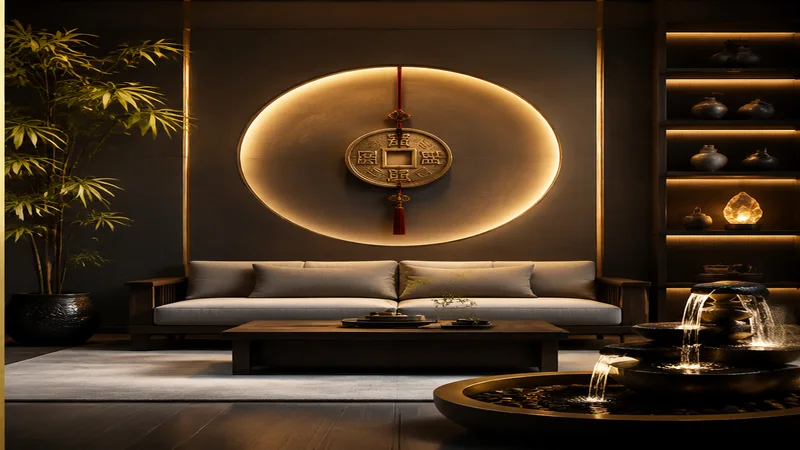
Have you ever walked into a room and immediately felt comfortable and at ease? Or visited a place and inexplicably felt oppressed and anxious?
Behind those feelings, more often than you might expect, lies the influence of Feng Shui.
Feng Shui — this ancient knowledge transmitted across thousands of years — is commonly misunderstood as mysterious superstition or a luxury reserved for the wealthy. In reality, it is a practical science of harmony between people and their environments, one that influences health, prosperity, relationships, and overall energy. And every single principle can be applied by ordinary people in ordinary homes.
You don't need to become an expert. You don't need an expensive Feng Shui consultation. You need to understand the core principles — and then make small, intentional changes to your space.
Why Feng Shui Gets Misunderstood
Most Feng Shui books and websites make one of two mistakes: they are either bewilderingly obscure (pages of compass calculations, conflicting rules, jargon-filled formulas), or they oversimplify everything into a shopping list (buy this crystal, place this Pi Xiu, paint this wall red).
Neither approach captures what Feng Shui actually is.
Traditional Feng Shui is about the relationship between people, space, nature, time, and the surrounding environment. It developed from centuries of careful observation — watching how landscapes affected human settlements, how building orientation affected health, how spatial arrangement affected mood and productivity.
That accumulated observation contains genuine wisdom. The goal of this website — and this article — is to make it accessible.
What Feng Shui Is Actually About
Strip away the mystical language, and Feng Shui addresses questions that every human being cares about:
- Why does this room feel good to be in? (Light, proportion, air quality, visual openness)
- Why do I sleep better in some bedrooms than others? (Bed position, light control, sound, air circulation)
- Why does this office make me feel productive while that one drains me? (Position, view, air, clutter)
- Why do family dinners feel better at a round table than a rectangular one? (Spatial equality, eye contact, no sharp corners)
- Why do some homes feel welcoming from the moment you enter? (Entrance design, light, clear pathways)
Feng Shui has been asking and answering these questions for 3,000 years. Modern environmental psychology has been asking them for about 50 years — and arriving at remarkably similar conclusions.
Four Feng Shui Principles With Real Impact
1. You Need a Clear Entrance
In Feng Shui, the main entrance is where energy enters your home. A cluttered, dark, or blocked entrance creates a difficult first experience — for your guests and for yourself.
Practically: keep your entrance clear, well-lit, and welcoming. Remove shoes, bags, and clutter. Add a plant if space allows. Make it a conscious transition from outside to inside.
Environmental psychology confirms: first impressions of a space affect how we feel throughout our entire time in it. A welcoming entrance genuinely changes how residents experience their home.
2. Your Bed Position Matters More Than You Think
Traditional Feng Shui places enormous emphasis on bed position. The "command position" — able to see the bedroom door from bed, but not directly in line with it, with a solid wall behind the head — is considered essential.
The logic: humans feel more secure when they can see who is entering a room without being directly exposed to the doorway. This reduces unconscious vigilance during sleep, improving rest quality.
Sleep research supports this. A sense of security and control over the sleep environment significantly affects sleep quality. Feeling exposed or startled by movement near doorways is genuinely disruptive to deep sleep stages.
3. Natural Light Changes Everything
Classical Feng Shui consistently valued natural light — particularly morning sunlight — as a source of positive qi. Spaces that receive good morning light were considered especially auspicious for bedrooms and study areas.
Modern research is unambiguous: natural light improves mood, regulates circadian rhythms, boosts vitamin D production, and increases productivity. A room with good natural light is simply a better place to be in, in ways that are measurably physiological.
4. Clutter Blocks More Than Space
Feng Shui's insistence on decluttering is not about aesthetics. The traditional view is that clutter creates "stagnant qi" — areas where energy accumulates and stops moving. Stagnant spaces are associated with depression, lethargy, and blocked opportunities.
Cognitive psychology confirms something remarkably similar: visual clutter competes for cognitive resources, increases stress hormone levels, and reduces the brain's ability to focus. An environment filled with unresolved visual tasks — unpaid bills, unworn clothes, unused objects — creates a constant, low-grade cognitive burden.
Why You Don't Need to Believe in Qi to Benefit
This is important to say clearly: you do not need to accept any supernatural claims to benefit from Feng Shui principles.
You can understand qi as "the quality of the living environment" and get 80% of the practical value. You can apply bed positioning logic as ergonomic security design. You can understand the wealth corner as a dedicated space for financial planning and aspirational intention-setting.
The wisdom works because it is drawn from millions of observations about how people actually feel in different spaces. The traditional vocabulary is symbolic and cultural. The underlying observations are real.
Feng Shui Is for Everyone
Traditional Feng Shui was not created for the wealthy. Farmers used it to choose well-oriented fields. Villages used it to site settlements protected from harsh winds. Scholars used it to arrange study spaces for focused work. Families used it to plan kitchen stoves in positions that maximized warmth without creating fire hazards.
The practical version of Feng Shui costs nothing. Rearranging your furniture, cleaning your entrance, positioning your bed correctly, removing clutter, opening your curtains — these are the most important Feng Shui changes you can make, and none of them requires buying anything.
This website exists to provide the clearest, most honest, most accessible Feng Shui resource in English. No commercial products to sell. No supernatural claims beyond the traditional ones. Just the accumulated wisdom of one of the world's oldest and richest traditions about people and space — explained plainly, applied practically.
Where to Start
If you are new to Feng Shui, start with these three things:
- Clear your entrance — everything that enters your home passes through here
- Reposition your bed — command position, solid wall at back, see the door
- Add one source of natural light — open a curtain, clean a window, move a lamp
These three changes alone will noticeably improve how your home feels. Then, when you're ready, explore the deeper principles. There is a great deal to discover.