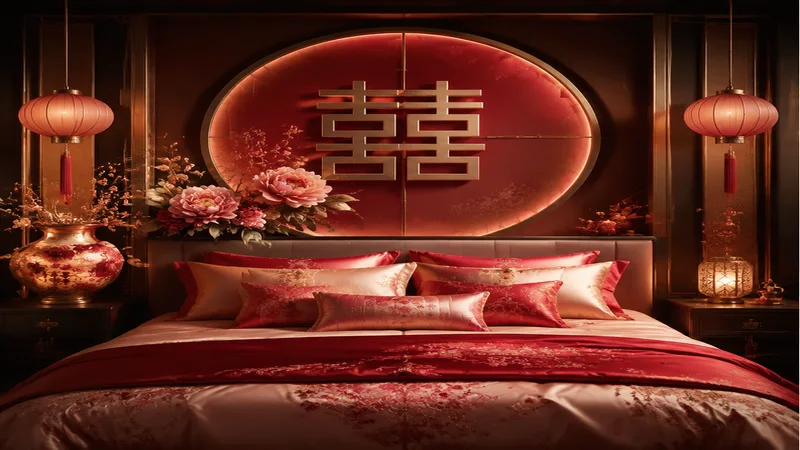
Marriage is not only about romance. It is also about living together — sharing the same bedroom, the same furniture, the same morning routines, the same small irritations, and the same quiet moments that make up a life.
Traditional Chinese feng shui has therefore developed many ideas about the relationship between the couple's bedroom and the quality of married life. Some of these ideas are highly symbolic. Others have a practical wisdom that holds up remarkably well even without the feng shui framework.
This guide covers the most important traditional recommendations for the couple's bedroom, along with a modern interpretation of what each really means.
The Dragon and Phoenix Symbol
One of the most celebrated symbols of marriage in Chinese culture is the Dragon and Phoenix pairing (long feng cheng xiang, 龙凤呈祥).
In traditional cosmology, the dragon embodies yang energy — power, protection, movement, and masculine qualities. The phoenix represents yin energy — beauty, grace, renewal, and feminine qualities. Neither is complete alone. Together, they create balance.
This is the deeper message of the Dragon-Phoenix symbol in the context of marriage: a strong union is one of complementary strengths, not identical personalities. The couple who can recognize and respect their different qualities — rather than trying to be identical — has access to something the Dragon and Phoenix already embody.
Decorative Dragon-Phoenix objects — carved in jade, depicted on fabric, rendered in ceramic or wood — are among the most traditional of Chinese wedding gifts. Placed in the bedroom, they are intended as a daily visual reminder of this complementary ideal.
Keep the Bedroom About the Couple
One of the strongest and most consistent themes in traditional Chinese relationship feng shui is that the marital bedroom should exclusively represent the current couple. Objects belonging to former romantic partners — photographs, gifts, letters, meaningful objects tied to past relationships — are considered energetically incompatible with a healthy shared space.
The feng shui explanation speaks of conflicting emotional energy. The psychological explanation is simpler and perhaps more compelling: objects carry memories.
If a former partner's photograph still sits on a shelf in the bedroom, it creates a presence. Every time it is seen — consciously or subconsciously — it activates associated memories and emotions. In the intimate space of a shared bedroom, these activated memories can create invisible distances between partners.
Removing such objects does not mean erasing the past. It means making a clear statement about where your emotional primary investment now lives.
Electronics in the Bedroom
Traditional feng shui consistently discourages placing televisions, computers, and other electronic devices in the bedroom. In classical terms, these devices introduce active, distracting yang energy into a space that should be yin — calm, restful, and intimate.
Modern sleep research provides the practical backing. Screens before bed:
- Emit blue light that suppresses melatonin production and delays sleep onset
- Provide stimulating content that keeps the mind active when it should be winding down
- Create habits of late-night scrolling that gradually erode both sleep quality and couple conversation time
- Transform the bedroom's psychological identity from a sanctuary into an entertainment space
- Reduce the amount of time couples spend actually talking to each other before sleep
The feng shui tradition and modern behavioral science agree: the bedroom should primarily be a place for sleep and intimacy, not for screens.
Aggressive Imagery in the Bedroom
Traditional feng shui discourages placing aggressive or violent imagery in the couple's bedroom — images of predatory animals, weapons, battle scenes, or visually intense abstract art. The concern is that such imagery creates an atmosphere of tension and conflict rather than warmth and intimacy.
Modern interior design reaches a similar conclusion through aesthetic reasoning. Bedroom decor should generally be calming rather than activating. The visual atmosphere of the room shapes the emotional state of the people in it. A bedroom that feels like a den of aggression will not feel like a sanctuary for love.
This does not mean the bedroom must be completely neutral or featureless. Meaningful art that you and your partner both love — landscapes, abstract work in soothing palettes, cultural imagery that holds positive meaning — is entirely appropriate. The goal is intentionality: choose what is on the walls of your shared space together, and choose things that make both of you feel welcome and at ease.
The Principle of Pairs
Across all traditions of Chinese love feng shui, the principle of pairs appears again and again. The bedroom of a couple should reflect partnership through symmetry and balance. Practical examples:
- Two matching bedside tables — equal space and equal importance for each partner
- Two bedside lamps — symmetry that visually reinforces balance
- Two pillows — perhaps the simplest possible symbol of a shared life
- Paired decorative objects — Mandarin ducks, twin candles, matching vases
- Symmetrical furniture arrangement — the bed accessible from both sides with equal space
A bedroom where one person's side is clearly more developed, personalized, or comfortable than the other subtly reinforces inequality. The traditional principle of pairs pushes in the other direction: both partners matter equally, and the space should show it.
Plants in the Bedroom
Traditional feng shui has nuanced views about plants in the couple's bedroom. Plants with soft, round leaves and gentle energy are generally considered positive — they represent growth, vitality, and natural life. Plants with sharp, pointed leaves or thorns are sometimes discouraged in intimate spaces, as their visual sharpness may be felt as a form of energetic friction.
From a practical standpoint, a few considerations matter more than feng shui rules:
- Avoid plants you are allergic to
- Choose varieties suited to low-light conditions if your bedroom has limited sun
- Keep plants manageable — a few well-chosen plants create calm; an overgrown indoor jungle can create clutter
- Water regularly; dying plants create the opposite effect of their intention
The Most Powerful Bedroom Feng Shui
Every feng shui recommendation for the couple's bedroom — no matter how symbolic its original framing — points toward the same practical outcome: a space that is calm, welcoming, comfortable, and oriented toward the partnership between two specific people.
But traditional feng shui itself acknowledges a limit:
No decoration can fix a relationship where two people refuse to communicate. The most powerful form of relationship feng shui is putting down your phone, turning off the television, sitting together, and talking.
Rearranging the bedroom can create better conditions for the relationship. But the relationship itself is made by the two people in it, through their choices, habits, conversations, and care for each other.
A beautiful, thoughtfully arranged bedroom is an act of respect for the relationship. The conversations that happen in that space are the relationship itself.