Staircase Feng Shui: Direction, Shape & Placement Rules
In Feng Shui, a staircase is more than a functional connection between floors: it is a visible channel for qi, carrying movement upward and downward. Traditional readers describe a balanced staircase as supportive of health, wealth, and harmony, while a steep or exposed stair can create qi rushing—a vivid image of speed and unsettled attention. In practical terms, we also need safe treads, good lighting, clear landings, and comfortable circulation.
Stair Placements: Where to Put the Staircase
The location of your staircase within the home is the single most important factor in determining its Feng Shui impact. A staircase that is awkwardly positioned can disrupt the natural flow of energy, affecting every room connected to it. Let's explore the key placement rules, including the particularly crucial issue of a staircase facing door.
The Staircase Facing Door: A Classic Challenge
Arguably the most discussed issue is the staircase facing door layout. Traditional language says incoming qi rushes upward and fails to settle. That imagery can also describe a real experience: a narrow entry, an abrupt visual line, or a trip risk. A screen, landing, better lighting, or clearer sightline can soften the transition; the layout is not a forecast of financial loss or missed opportunity.
If the staircase faces the door and is moving downward (i.e., you must walk downstairs upon entry), the effect is less dramatic but still draws energy away from the ground floor. The key is to slow the qi down and give it a place to gather before it reaches the stairs.
Feng Shui principle: The main entrance should feel like a welcoming embrace, not a slide for energy. If the staircase faces the door, you must introduce a barrier or a redirecting element to keep the qi from fleeing.
Solutions for a staircase facing door: If you have this layout, do not panic. There are effective cures. Place a substantial screen or a bookcase between the front door and the staircase. A well-placed plant with rounded leaves, such as a money tree or a jade plant, can also slow down the energy. Hanging a crystal ball or a wind chime in the space between the door and the staircase can help diffuse and slow the qi. Another popular cure is hanging a mirror, but you must be cautious: a mirror should not reflect the staircase in a way that doubles the harmful effect. The goal is always to create a small foyer or landing area where energy can pool and be directed gently around the home.
Stairs in the Center of the Home
Stair placement in the center of the house is another major concern. The center, or the heart, of the home is considered the most sacred area in Feng Shui. It is the energetic core that supports all other rooms. Placing a staircase there can cause instability, as the constant up-and-down movement acts like a knife cutting through the heart of the family. This is believed to lead to disagreements, health issues, and a general sense of being unsettled. If your staircase is central, you can offset this by adding a heavy piece of furniture, such as a round pedestal table with a bowl of natural stones, at the base of the stairs to anchor the energy. Avoid placing a television or a large piece of metal directly under the stairs, as this can add more chaotic energy.
Ideal Staircase Locations
The most auspicious positions for a staircase are near the rear of the house or along a side wall, rather than directly facing the entrance. The southeast, northeast, and west sectors are generally considered favorable for stairs, but the exact direction should always be based on the individual home's floor plan and the occupants' natal charts. In principle, the staircase should be situated so it is not the first thing you see when you enter, and it should allow the energy to climb gently and progressively through the house.
A good stair placement will include a generous landing at both the top and bottom. These landings allow the qi to pause and stabilize before moving on to the next level. When you descend a staircase, you should feel a sense of gradual transition, not abrupt arrival. Consider the area at the bottom of the stairs as a mini "energy pool"—if you can place a comfortable chair, a small table with a lamp, or a piece of art there, you are giving the qi a chance to gather and enrich the ground floor.
Staircase Direction: Which Way Should the Stairs Face?
Staircase direction refers not only to the orientation of the steps themselves, but also to the direction of the qi that flows along the stairs. In Feng Shui, the "direction" of the stairs is often approximated by the diagonal line from the top step to the bottom step. Different compass directions can have different influences on the residents' energy, career, and health.
Compass Directions and Their Effects
If your staircase ascends from the southeast (wood element) to the northwest (metal element), this creates a controlling cycle in which metal dominates wood, since metal is what cuts and shapes wood in the five-element relationships. This is a mix that can create both ambition and tension. A staircase running from the north (water) to the south (fire) is dramatic because water and fire are opposite. This is often considered challenging for stability, as it polarizes the energy—fostering dynamic change but also potential burnout. In contrast, a staircase that runs from the southwest (earth) to the northeast (earth) is grounding and stable, supporting the family's roots and long-term security.
Many Feng Shui practitioners agree that the best staircase direction is one that follows the natural flow of the building, avoiding direct, sharp, or diagonal lines that slice through the space. For practical purposes, do not become overly obsessed with compass perfection. Instead, focus on the fundamentals: the stairs should not point directly at a major door, and they should feel integrated into the architecture, not like an afterthought.
Shape and Design: How the Structure Affects Energy
The physical shape of your staircase has a profound impact on the way qi flows. From straight runs to sweeping curves, each design carries its own Feng Shui message.
The Straight Staircase: Speedy Energy
A straight staircase with no turns or landings is the most common, but also the most problematic. Because there is no interruption, the Qi will travel from one floor to another in a rapid, unbroken line. This is the essence of qi rushing—the energy moves so quickly that it becomes "poison arrow" energy. It shoots from the lower floor to the upper floor (or vice versa), leaving the surrounding areas drained. It is especially damaging if the straight staircase faces the main door. If you have a straight staircase, break up the line of sight by adding a tall plant at the base, hanging a flat-paneled painting halfway up the wall, or placing a sculptural object on a small pedestal at the base. The goal is to create a visual interruption that causes the qi to slow and turn slightly.
The Spiral Staircase: Beware of Draining Qi
Spiral staircases are visually striking and can save a great deal of space, but they are usually avoided in traditional Feng Shui. The tight, circular, unwinding shape acts like a vortex, churning the qi into a whirlpool. This can cause dizziness and confusion, and it tends to pull energy downward, creating a draining effect. When a staircase spirals up in a clockwise direction, it may feel very dynamic, but it is not grounding. A spiral staircase can also put pressure on the central area if it is located in the middle of the home, which is one of the worst placements. If you do have a spiral staircase, you can mitigate the effects by ensuring it is made of solid materials (not hollow metal) and by hanging a facet-cut crystal from the center to stabilize the energy. Do not use a spiral staircase if you have a tendency toward anxiety or restlessness.
Open Stairs: The Airy Flow
Open stairs are those that have no risers—the vertical part between each step is missing, leaving an open view through the stairwell. Because of this openness, air and qi can pass freely, which sounds positive. However, open stairs also allow energy to leak downward. The gaps under each step mean that qi cannot gather and accumulate on the stair tread; instead, it falls through the openings, creating a fragmented, unsettled flow. Also, open stairs can feel precarious on the second glance, which unconsciously increases anxiety in the residents. For good Feng Shui, you want closed risers. If you have open stairs, you can place solid-looking objects under the stairs (like a cabinet or large storage boxes) to block the energy loss and create a sense of solidity underneath.
Curved or L-Shaped Staircases: The Auspicious Compromise
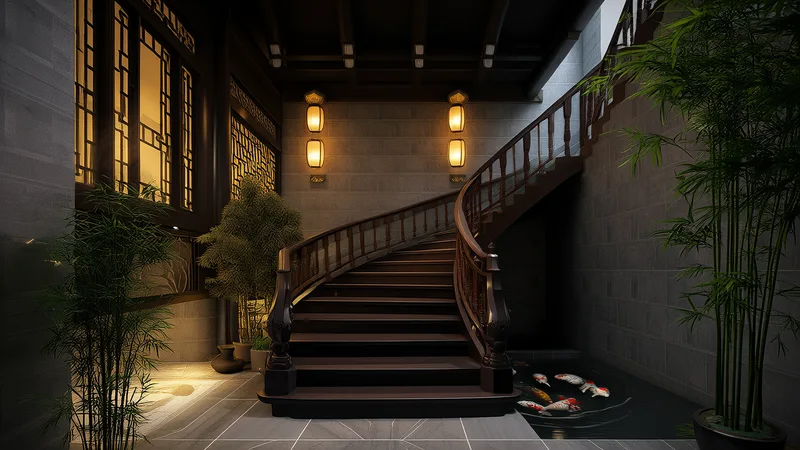
The best staircases in Feng Shui feature a gentle curve, an L-shape, or a U-shape with a landing. These allow the qi to meander and descend/ascend gradually, gathering smoothly. A curved staircase with wide, rounded steps is considered very auspicious. It feels inviting, restful, and encourages a steady flow of good energy. The curve should not be too tight, though. A gentle sweep is far superior to a sharp turnaround. If you are designing a new home, this is the shape you should request.
Qi Rushing and the Art of Slowing Energy
As we have mentioned, the main threat of most staircases is qi rushing. But what exactly is this in practical terms? Think of qi like water. A straight, steep staircase is like a waterfall—fast, powerful, and erosive. A curved staircase with landings is like a winding river—gentle, nourishing, and life-giving. The purpose of Feng Shui is to emulate the gentle river in our built environment.
When qi rushes down a staircase, it strikes the lower floor with force. This can create a "sharp" feeling in the room, making it hard to concentrate or relax. When qi rushes up a staircase, it empties the lower floor of its energy. Residents might find themselves constantly habitually needing to go upstairs, or feeling that the ground floor is never a place to relax. In both cases, the solution is to create areas of stillness and weight at the base of the steps.
Using stair placement and design to prevent qi rushing is a twofold approach. First, ensure the stairs are not directly in line with a doorway, a prominent window at the far end, or a corridor that stretches out to another exit. The qi will accelerate in a straight line. Second, add objects of weight at the foot of the stairs. A large rug with a strong pattern is excellent. Crystals on a small console table are also good. But the most effective remedy is to add a piece of furniture that visually blocks the path, like a low cabinet with a lamp. This "steers" the qi sideways and allows it to settle.
Stair Placement and the Bagua: Finding the Right Sector
For those who wish to go deeper, you can map the Bagua (the Feng Shui energy map) onto your home and identify which hexagram governs the area where the staircase sits. The southwest corner may represent marriage, the east may be for health, and the southeast for wealth. If a staircase is located in one of these important sectors, the energy of that sector will be constantly under pressure