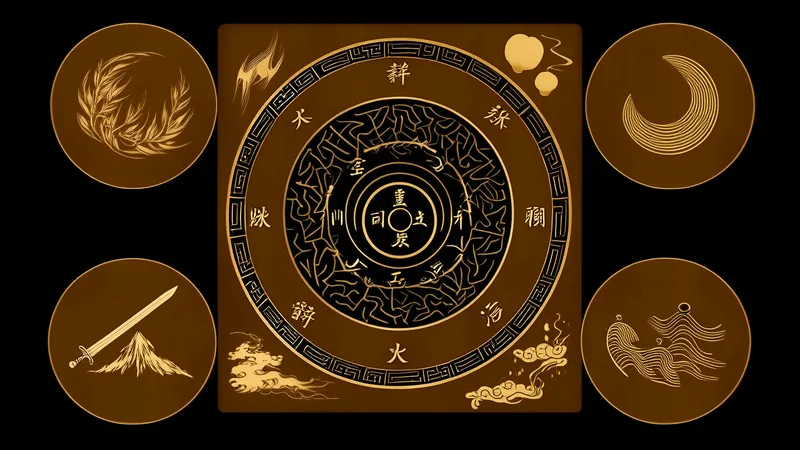
Understanding Tai Sui, Time Cycles & Directional Theory in Feng Shui
Feng Shui is often misunderstood as merely arranging furniture or decorating with crystals. While those are popular applications, the true depth of this ancient practice lies in its sophisticated understanding of time-based feng shui. By observing how cosmic energies shift annually, we can align our living and working spaces with favorable currents while avoiding pitfalls. Central to this are concepts like Tai Sui, the grand duke jupiter, the 60 year cycle, and the intricate system of annual stars and directional theory.
This article explores these foundational ideas, explaining how time interacts with space to create ever-changing energetic landscapes. Whether you are a curious beginner or a seasoned practitioner, understanding these cycles will deepen your appreciation of how Feng Shui works beyond static decor.
What is Tai Sui? The Grand Duke Jupiter
In Chinese metaphysics, Tai Sui is a powerful deity and astronomical reference. The name literally translates to “Grand Year” or “Great Year,” and it corresponds to a hypothetical star or energy point that moves through the zodiac over a 12-year cycle. However, Tai Sui is also known as the grand duke jupiter because ancient Chinese astronomers noticed that Jupiter takes roughly 12 years to orbit the Sun. They divided this orbit into 12 segments, each associated with a zodiac animal, creating the foundation for the Chinese zodiac.
Each year, the grand duke jupiter is assigned a specific direction. The position changes with the Earthly Branch, and traditional practitioners may avoid major renovations or noisy work in that sector as a gesture of respect. Folklore says disturbing it can bring arguments, setbacks, or health issues; these are cultural warnings, not forecasts. Use structural, budget, and safety checks for real projects.
Yet Tai Sui is not merely a threat. When properly honored, it can bestow stability and leadership. Many people perform a “Peace with Tai Sui” ritual at the Chinese New Year, especially if their zodiac sign “clashes” with the annual placement. This leads us to the larger framework of time cycles.
The 60 Year Cycle and Your Zodiac
While the 12-year zodiac is widely known, the full Chinese calendar operates on a 60 year cycle. This cycle is formed by pairing the 12 animal signs with the 10 Heavenly Stems (one of each of the five elements in yin and yang forms). For instance, 2024 is a Wood Dragon year, while 2025 is a Wood Snake year. The combination repeats only after 60 years, making the 60 year cycle a crucial tool for long-term planning.
Within this cycle, every person has a “natal” Tai Sui based on their birth year. When the annual Tai Sui moves to a position that directly opposes or clashes with your natal one, that year becomes a “Fan Tai Sui” (Offending Tai Sui) year. Common clash relationships include:
- Rat clashes with Horse
- Ox clashes with Goat
- Tiger clashes with Monkey
- Rabbit clashes with Rooster
- Dragon clashes with Dog
- Snake clashes with Pig
Additionally, your zodiac sign might “break” or “harm” the Tai Sui in other complex ways, making the 60 year cycle an indispensable reference. For example, a person born in a Snake year may face an “annual break” during certain years. Rather than causing panic, this knowledge allows proactive remedies such as wearing protective cinnabar, donating to charity, or avoiding major risk-taking during those months.
Annual Stars, Flying Stars & Directional Theory
Beyond Tai Sui, directional theory is the backbone of time-based feng shui. In the classical Flying Star school (Xuan Kong), every home or building has a time-based energy map that changes with each of the 20-year Periods (the most famous being Period 8 from 2004–2023 and Period 9 from 2024–2043). However, within each year, the energy patterns also shift, creating what are known as annual stars.
The flying stars are nine numbers (1 to 9) that each carry distinct elements and meanings. Number 1 is a water star for intelligence and career; number 8 is an earth star for wealth; number 5 is a malevolent earth star for bad luck; and so on. Each year, these stars “fly” to different sectors of your home based on a calculated sequence. The annual stars overlay the static Period stars, producing dynamic opportunities and hazards.
For instance, traditional charts may describe the annual 5 Yellow (Wu Wang) as a serious annual affliction and recommend a quieter, orderly center. The language of accidents, illness, and financial loss belongs to that symbolic system, not to medical or financial prediction. Use the chart as a cultural planning prompt while keeping real renovation and household decisions evidence-based.
Other notable annual afflictions to track include:
- Tai Sui – the sector where the Grand Duke resides (avoid sitting facing it and avoid construction)
- Three Killings – a direction that brings conflict and legal problems
- Annual Five Yellow – the center or a moving sector of catastrophic energy
- Grand Duke’s Opposite – the direction directly opposite Tai Sui, which also should be avoided for major projects
Understanding these afflictions is useful for seeing how directional theory changes across time. A bedroom that feels different next year may reflect a new routine, light pattern, or household need as much as a moving star. Traditional readers therefore revisit the current cycle rather than treating any room as permanently doomed.
How to Work with Time-Based Feng Shui in Practice
To apply time-based feng shui in your environment, start by learning the yearly chart for your home. You can consult a professional practitioner or use a reputable online calculator. Mark the sectors where the annual stars and afflictions are located. Then, follow these general guidelines:
Do not activate the area where the annual Five Yellow sits. Keep it clean, quiet, and free of moving objects. Never place a bed, sofa, or desk here. If you must use the space, hang a metal wind chime or place a metal bell to reduce the earth element’s negative effects. For Tai Sui’s sector, avoid construction, digging, or knocking on walls. Instead, respect the energy by bowing or offering incense at the start of the year.
In addition, use the favorable annual stars to your advantage. For example, if the annual star 6 (Heavenly Blades) visits your living room in a certain year, it brings mentoring and authority. Add a heavy metal object there, like a brass picture frame, to strengthen it. If the annual star 8 flies to your wealth corner, place a ripe fruit bowl or a small water feature to activate prosperity.
Remember that flying stars are not only about negative or positive, but also about the relationship between elements. Water, wood, fire, earth, and metal all interact. A good practitioner will check whether the annual star supports or depletes the sector’s base energy. For example, an annual fire star entering a metal room (like a bathroom with metal fixtures) creates cyclical conflict. In such cases, careful remedies are required to create harmony.
Another key aspect of time-based feng shui is the Chinese solar calendar, which begins on February 4 or 5 each year. Many seasoned Feng Shui enthusiasts update their home’s cures and enhancements from that date, not from January 1. This ensures you are working with the true “solar year,” the same one used by the annual flying stars system.
Making the Most of the 60-Year Cycle and Your Personal Qi
While annual adjustments are crucial, the 60 year cycle offers a macro-scale perspective for life planning. Each person’s natal chart, calculated from their birth year, month, day, and hour, reveals how the 10 Heavenly Stems and 12 Earthly Branches influence their luck phases. Two people may both be born in a Snake year, but one could be a Fire Snake and the other a Water Snake, producing strikingly different tendencies.
During your “clash years” (when the annual branch opposes your birth branch), you might notice increased turbulence. But this is not inherently bad. Clashes bring change, and change can be a catalyst for needed renewal. By combining that awareness with directional theory, you can place your desk so that you face your favorable directions in such years, tamping down the intensity of the clash.
For example, if you are a Rat born in 1972 and you enter a Horse year (the clash), you might avoid traveling toward the south (the Horse’s direction) as much as possible. Instead, prioritize your personal “luck directions” calculated from your Kua number. This synergistic approach—using both the time dimension (annual stars, Tai Sui, 60 year cycle) and spatial dimension (directional theory)—represents the true mastery of classical Feng Shui.
Final Thoughts on Time-Based Feng Shui
The beauty of Feng Shui lies in its layers. Understanding Tai Sui, the grand duke jupiter, the 60 year cycle, annual stars, and annual afflictions transforms Feng Shui from a pseudo-decoration style into a profound system of environmental timing. No matter how beautiful your home is, if you activate the wrong sector in a wrong year, you may experience unseen resistance. Conversely, a modest home that respects these time cycles can become a sanctuary of resilience.
As you continue your journey with this practice, adopt a mindset of curiosity and humility. Yearly changes mean that lifelong mastery is impossible—there is always something new to calculate, adjust, and learn. Time-based feng shui does not offer permanent cures; it offers a living relationship with the cosmos. By honoring the movements of Jupiter (Tai Sui) and the invisible flying stars, you align yourself with the natural rhythm of the universe. And that alignment, more than any talisman or cure, is the ultimate goal.