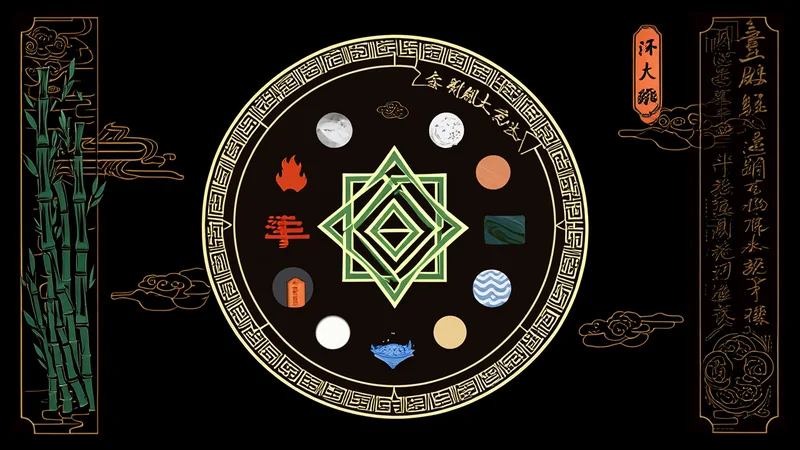
Imperial Feng Shui: How Beijing Was Designed as the Perfect Capital
When the Yongle Emperor of the Ming dynasty decided to move the imperial seat from Nanjing to Beijing in the early 15th century, he was not merely relocating a government. He was enacting a profound cosmological statement. The entire layout of the city, from the placement of the Forbidden City to the direction of its gates, was conceived through the lens of imperial geomancy – the ancient art of aligning human structures with the unseen currents of the earth. The result was not just a capital, but a living talisman designed to channel the power of the universe into the person of the Emperor.
Beijing’s status as a supreme example of Beijing feng shui design is no accident. It represents a culmination of centuries of geomantic theory, applied on a scale unmatched anywhere else in the world. The city is not a random collection of streets and palaces; it is a carefully calibrated machine for cosmic harmony, built to ensure the Mandate of Heaven remained firmly with the ruler.
The Foundations of Imperial Geomancy
To understand the design of Beijing, one must first grasp the core principles of feng shui, particularly as they apply to imperial capital planning. Unlike a simple house or garden, a capital city is a macro-scale intervention into the landscape. It must harmonize the five elements, balance yin and yang, and, most importantly, tap into the planetary and terrestrial energies that flow along dragon vein lines – the mysterious conduits of life force (qi) that traverse mountains and watercourses.
The ideal geomantic site, as described in classical texts, features a mountain backing to the north to protect from cold winds and provide shelter, a gentle slope to the south, and water flowing in front. The site should feel enclosed yet expansive, like an armchair cradling the occupant. Beijing already possessed many of these natural advantages, but the Ming dynasty engineers and feng shui masters amplified them through deliberate construction.
The Choice of Beijing: A Natural Geomantic Powerhouse
Beijing sits at the northern edge of the North China Plain, with the Western Hills to the west and the Jundu Mountains to the north. For a feng shui master, this was already a promising sign: the mountain backing was present, providing a literal shield and a symbolic throne for the capital. To the south and east, the land opens into the vast plain, offering a clear "bright hall" (mingtang) – an open space that allows qi to gather and circulate. But the Ming dynasty did not rely on natural luck alone. They enhanced the landscape with a series of artificial earthworks, canals, and structures to perfect the flow of qi.
One of the most significant acts of imperial geomancy was the deliberate rerouting and construction of water features. The feng shui principle that "water brings wealth" was applied with great precision. The Forbidden City's Golden Water River was not merely decorative; it was designed to slow down and purify the qi moving through the palace complex, ensuring that beneficial energies would not rush past too quickly.
The Central Axis: The Dragon's Spine of Beijing
The single most defining feature of Beijing’s imperial capital planning is its central axis. This is not a mere urban planning convenience; it is the symbolic backbone of the entire city, sometimes referred to as the "dragon vein" made manifest. This axis runs approximately 7.8 kilometers from the Bell and Drum Towers in the north to Yongding Gate in the south, and every major power structure is aligned along it.
The central axis is the line along which the Emperor was supposed to move, and it represented the path of the pole star – the celestial center around which all stars rotate. In feng shui terms, the Emperor, as the Son of Heaven, had to align himself with this cosmic pivot. The axis is not perfectly straight due to terrain and existing waterways, but the deviations were carefully calculated to avoid negative energy and to maintain the overall symbolic alignment.
“A capital city is not built for the comfort of its inhabitants alone. It is a ritual instrument, a giant compass that points the entire empire toward Heaven’s favor. Beijing was designed to be the very center of the world.”
Walking through the Forbidden City, you experience this axis physically. Each gate, each hall, each courtyard is placed on this line, reinforcing the authority of the ruler. The Throne of the Heavenly Purity Palace sits directly on the axis, so that the Emperor, sitting on his throne, was literally the center of the universe. The dragon vein energy was believed to collect and concentrate at this point, empowering the ruler to govern with cosmic authority.
The Forbidden City: A Microcosm of Cosmic Order
No discussion of Beijing’s feng shui is complete without a deep examination of the Forbidden City. This walled palace complex, built between 1406 and 1420, is the heart of the capital and the most densely packed geomantic symbol in China. Its design follows the classic rules of Chinese architecture: symmetry, south-facing orientation, and the separation of yin and yang spaces.
The entire complex is oriented along the central axis, with the main halls facing due south. In feng shui, the south is the direction of warmth, growth, and imperial power, while the north is associated with cold and darkness. By facing south, the Emperor invited the beneficial yang qi of the sun and the southern constellations into his halls. The rear of the complex, the imperial gardens and inner palaces, represents the yin, quieter and more private, while the front ceremonial halls represent yang, active and public.
The Numbers and Colors of Geomancy
Feng shui masters of the Ming dynasty were obsessed with numerical correspondences. The number nine, which sounds like the word for "long-lasting" in Chinese, is strongly associated with the Emperor and the dragon. You can see this in the nine-by-nine array of door nails on the main gates of the Forbidden City, and in the nine roof beasts that line the eaves of the Hall of Supreme Harmony. The number five, representing the five elements and the five directions, is also prominent. The city walls, for example, had nine gates (nine being the ultimate yang number), and the palace is laid out in five main sections.
Colors were equally important. The yellow glazed tiles on the palace roofs represent the earth – the central element in the five-element system – and the Emperor, as the ruler of the human world, sits at this center. The red walls of the palace symbolize fire, which in feng shui is both a purifying force and a symbol of life and vitality. The Forbidden City, from its rooftops to its courtyards, is a visual and energetic matrix designed to harmonize all elements under imperial control.
Water and the Dragon's Vein
The water systems of the Forbidden City are another testament to the detailed understanding of imperial geomancy. The Golden Water River winds through the Outer Court with deliberate curvature. In feng shui, a straight line of water is considered harsh and destructive, whereas winding water carries qi effectively without causing harm. The river’s bridges, positioned at specific points along the axis, are not just functional. The Bridge of the 5 Marble Arches, directly in front of the Gate of Supreme Harmony, symbolizes the rainbow bridge between Heaven and Earth, and it encourages the qi to flow gently around the three main halls.
The Outer City and the Dragon Vein Landscape
The influence of Beijing feng shui design extends well beyond the palace walls. The entire older city of Beijing, both the Inner City (where the Manchu nobility lived) and the Outer City (the market and residential area to the south), was laid out with geomantic principles in mind. The city was roughly rectangular, modeled on ideal cosmological plans. The north-south and east-west roads created a grid, but with deliberate offsets and turns at the local level to prevent the accumulation of negative qi.
Even the location of temples and pagodas was chosen to suppress or redirect unfavorable energies. For example, if a dragon vein appeared to stray into a residential area, a temple was often built on that spot to "anchor" the qi and prevent it from harming the inhabitants. The White Stupa at the Miaoying Temple, built in the Yuan dynasty and later restored in the Ming, is a prime example. It was placed to the west of the city to guard against the metal energy that could negatively affect the emperor’s wood energy.
The Ming Dynasty and the Rebuilding of the Capital
The Ming dynasty was not the first to use Beijing as a capital. The Yuan dynasty under Kublai Khan had already established a capital called Khanbaliq on the same site. But the Ming erased most of that palace and replaced it with their own. This was not simply an act of conquest; it was a calculated geomantic reformation. The first Ming emperor, Zhu Yuanzhang, had his capital at Nanjing, but his son, the Yongle Emperor, chose to rebuild and expand Beijing into a new capital that conformed even more strictly to feng shui ideals.
One legendary story about the construction of Beijing involves the central axis being deliberately aligned to miss a particular well, because the well was considered an unstable point in the earth’s energy. Whether or not this specific story is true, it illustrates the deeply ingrained belief that every decision in building the capital had to be tested against the principles of imperial geomancy. If a building or a street was out of alignment, it could disturb the harmony and bring disaster to the empire.
Maintaining the Perfect Balance
The real genius of Beijing’s feng shui is not in any single element, but in the balance of all elements. The artificial lakes to the west (such as the Three Seas) were dug not only for beauty but also to create water yin to balance the fire yang of the palace. The Temple of Heaven to the south uses circular structures to represent Heaven, while the Altar of Earth to the north uses a square platform to represent Earth – the perfect balance of the round and the square, the celestial and the terrestrial.
For the modern visitor or student of feng shui, Beijing feng shui design offers a masterclass in how environment and power can be woven together. It reminds us that a city is never just a collection of buildings; it is a living system of energy. The dragon vein may now be crossed by subways and buried under roads, but the fundamental geometry of the city still pulses with that ancient intent.
Lessons for Today
What can we learn from this imperial example? First, the importance of orientation. Just as the Emperor faced south, we can consider the direction our own homes and workplaces face. Second, the power of openness. The central axis created a clear circulation pathway for qi. Our own spaces, whether a home or an office, benefit from clear, unobstructed central corridors that allow energy to move freely.
- Respect the land: The Ming dynasty didn't fight the landscape; they enhanced its strengths. Laying a home on the best available spot with a mountain backing and a clear approach is still a timeless principle.
- Control the flow of water: In any imperial capital planning, water was life-giving wealth. In our lives, this can translate to keeping the entryways clean and inviting, symbolically welcoming the flow of opportunity.
- Create a statement of balance: The use of yin and yang in the Forbidden City – the public front versus the private back, the bright halls versus the secluded gardens – teaches that a good environment needs both active and passive zones.
- Use anchors: Just as temples were used to anchor stray qi, we can use plants, mirrors, or artwork in our spaces to stabilize and enhance positive energy in areas that feel neglected.
The Forbidden City is not just a palace. It is a treatise on the relationship between human power and cosmic harmony. Its walls and gates are the physical pages, and its courtyards are the open verses of an architectural poem dedicated to the unity of heaven and earth.
In examining
Frequently Asked Questions