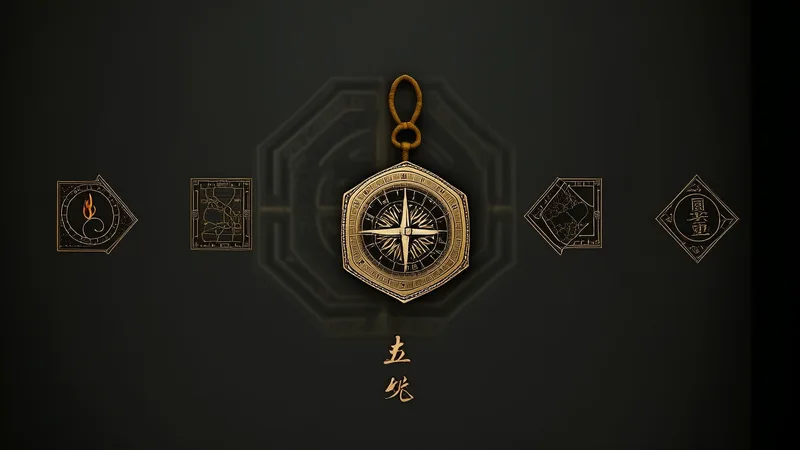
Introduction to Classical Feng Shui Tools
For centuries, the practice of classical Feng Shui has relied on a set of sophisticated instruments that bridge the gap between cosmic principles and tangible landforms. Among these, the luopan compass stands as the most iconic tool, while the hetu river map and luoshu magic square serve as the mathematical foundations that give the compass its profound meaning. These feng shui tools are not mere accessories; they are the keys to unlocking the hidden energies of a site. Without a deep understanding of these number diagrams, a practitioner cannot truly read the landscape or the subtle forces that shape human destiny. In this article, we will explore the luopan, the Hetu and Luoshu, and how these classical instruments work in harmony to guide modern practitioners.
The Luopan Compass: Heart of Compass Reading
The luopan compass is often called the "compass of the heavens" or the "Feng Shui compass." Unlike a simple magnetic compass used for navigation, the luopan is a highly complex instrument that integrates astronomy, geography, and numerology. Its origins date back to the Han Dynasty, where early versions of the compass were used for divination and orientation. Over time, the luopan evolved into a layered disc with dozens of concentric rings, each encoding a different aspect of classical Feng Shui knowledge. For any serious student of the art, mastering the luopan is a rite of passage, as it is the primary tool for compass reading in nearly all traditional schools.
Anatomy of the Luopan: Rings of Luopan
The rings of luopan are the most fascinating feature of this instrument. Each ring contains a specific set of symbols, trigrams, stars, or directional data. In total, a professional luopan may have anywhere from 36 to 52 rings, depending on the school. Here are some of the most essential rings that you will encounter:
- The Center Pool (Heaven Pool): The innermost section holds the magnetic needle. This needle always aligns with the Earth's magnetic field, and the red end points to the south pole, which is the opposite of a conventional compass.
- The Early Heaven Bagua Ring: This ring displays the arrangement of the eight trigrams as they appeared in the time of Fu Xi. It represents the ideal, spiritual world and is used for understanding the underlying cosmic order.
- The Later Heaven Bagua Ring: Used for actual directional analysis, this ring shows the trigrams attributed to the current world, as arranged by King Wen. This ring is crucial for determining the facing and sitting directions of a property.
- The 24 Mountains Ring: Perhaps the most widely used ring, it divides the 360-degree circle into 24 equal segments of 15 degrees each. These are named after the twelve earthly branches, eight heavenly stems, and four cardinal directions.
- The 64 Hexagram Ring: This ring correlates the directions with the hexagrams of the I Ching, offering deeper layers of interpretation for advanced practitioners.
Each ring interacts with the others, and the skill of compass reading lies in knowing which rings to prioritize for a given inquiry. The luopan is not a simple measuring device; it is a physical representation of the entire cosmological map.
How to Perform Compass Reading
To perform a proper compass reading, you must first hold the luopan level at your waist, ensuring the needle is free to rotate. The practitioner stands at the front door or center of the property, facing outward. After the needle settles, you rotate the inner dial until the needle aligns with the red mark at the base of the pool. The reading is then taken at the point where the crosshair intersects the outer rings. A classic rule is that the sitting direction is opposite the facing direction. However, every detail matters: even a half-degree shift can change the interpretation of an entire ring. That is why the luopan remains the most precise of all feng shui tools.
Hetu River Map and Luoshu Magic Square: Number Diagrams
While the luopan provides the directional framework, its inner logic is built upon two ancient number diagrams: the hetu river map and the luoshu magic square. These diagrams are said to have emerged from the Yellow River and the Luo River, respectively, in mythical antiquity. They encode the fundamental patterns of yin-yang, the five elements, and the eight directions. Without them, the rings of the luopan would have no numerical or symbolic depth.
Hetu River Map: The Blueprint of Heaven
The hetu river map is a pattern of black and white dots arranged in a cross-like structure. It is considered the "Heavenly" diagram because it describes the generation of the five elements in their pre-heaven state. The map pairs numbers from 1 to 10 with the five elements: water, fire, wood, metal, and earth. For example, 1 and 6 correspond to water, 2 and 7 to fire, 3 and 8 to wood, 4 and 9 to metal, and 5 and 10 to earth. The Hetu reveals how yin and yang interact to create the world. It also assigns directions to these numbers, with the numbers 1 and 6 pointing north, 2 and 7 south, 3 and 8 east, 4 and 9 west, and 5 and 10 the center. This map is often engraved into the innermost rings of a luopan, serving as a constant reminder that all direction is born from cosmic numbers.
Luoshu Magic Square: The Cosmic Matrix
The luoshu magic square is a 3x3 grid containing the numbers 1 through 9, arranged such that every row, column, and diagonal sums to 15. Unlike the Hetu, the Luoshu is the "Earthly" diagram, representing manifestation and movement. Its numbers are associated with the eight trigrams and the eight directions, with 5 at the center. The classic arrangement is: 9 at the top (south), 1 at the bottom (north), 3 on the left (east), 7 on the right (west), and 2, 4, 6, 8 at the corners. This magic square is the basis for the Flying Star system, one of the most widely used classical Feng Shui methodologies. When a luopan is used to determine the facing direction of a building, the practitioner then applies the Luoshu grid to calculate the annual or monthly energy patterns within each sector. Thus, the luoshu magic square is as essential to the practice as the luopan itself.
Integrating Hetu & Luoshu with the Luopan
In classical practice, the hetu river map and luoshu magic square are not used in isolation. They are woven directly into the design of the luopan. For instance, the rings of the luopan include the "Hetu Ten and Five" ring, which aligns the five elements with directions, as well as the "Luoshu Nine Stars" ring, which maps the nine dominant stars. Together, these rings allow the practitioner to interpret a site's energy from multiple layers. The Hetu is used for analyzing the fundamental, unchanging quality of a location, often called the "mountain" aspect, while the Luoshu is used for the "water" aspect that reflects time and change. By combining the static cosmic blueprint with the dynamic earthly flow, the luopan becomes a complete oracle. These two classical instruments – the number diagrams and the compass – are inseparable. An adept Feng Shui master will memorize both the Hetu and Luoshu sequences, visualizing them even when the rings are not visible.
Practical Applications for Modern Practitioners
Even in today's world, these feng shui tools remain highly relevant. If you are a modern enthusiast, you can start by learning to read a basic luopan and then cross-reference your readings with the principles of the Hetu and Luoshu. For example, when evaluating a new home, use a luopan to measure the facing direction. Then identify the number from the Luoshu magic square that corresponds to that direction. If the direction is 240 degrees, it falls within the 24 Mountains, and the associated Luoshu number may be 4 (wood). From there, you can assess which elements are beneficial or harmful based on the Hetu's five-element pairs. This layered approach is what separates a superficial Feng Shui reading from a deep, classical analysis.
In classical Feng Shui, the luopan and the Luoshu are inseparable: one provides empirical orientation, the other supplies the dynamic framework for change. Together they form what practitioners call the true compass of destiny.
In summary, the luopan compass, the hetu river map, and the luoshu magic square are the backbone of classical Feng Shui. Each instrument serves a unique purpose: the compass provides empirical orientation, the Hetu offers the primordial energetic map, and the Luoshu supplies the dynamic framework for change. By mastering these feng shui tools, you unlock the ability to read the environment with precision and wisdom. Whether you are a novice or a seasoned practitioner, always honor the depth of these classical instruments. Let the rings of luopan guide your compass reading, and let the ancient number diagrams illuminate your intuition. In a world of uncertainty, these timeless tools remain steadfast, connecting you to the cosmic order that governs all.