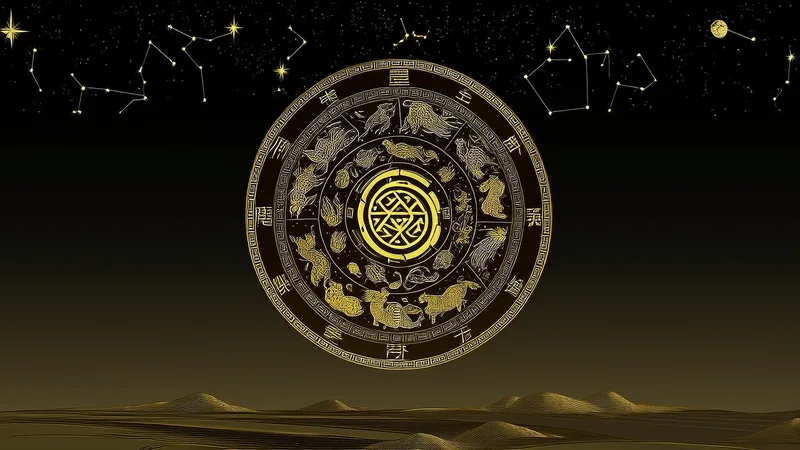
How Ancient Chinese Astronomers Shaped Feng Shui: Sky, Stars & Direction
The practice of Feng Shui is often discussed in terms of furniture placement, door alignment, and the flow of chi through a building. Yet beneath this practical surface lies a profound and sophisticated astronomical foundation. Long before the compass was used for navigation, ancient Chinese astronomers were charting the heavens with extraordinary precision, creating a cosmic framework that would eventually become the very skeleton of Feng Shui. To truly understand why a front door faces south or why a desk is positioned in the "wealth corner," we must look upward—to the stars, the moon, and the cardinal directions that have guided Chinese civilization for millennia.
The Celestial Blueprint: From Sky to Earth
The connection between the heavens and the human world is not metaphorical in traditional Chinese thought. It is a direct, energetic correspondence. Ancient astronomers observed the sky not as a distant spectacle, but as a mirror of earthly order. This astronomy feng shui connection is the key to unlocking why certain directions, structures, and landforms are considered auspicious. The early Chinese believed that the patterns of stars and planets influenced the flow of chi on Earth, and that by arranging human habitats to reflect celestial order, one could harness that cosmic energy.
The most striking evidence of this is the Chinese sky map, one of the earliest and most detailed stellar cartographies ever created. Unlike Western star maps that focused on constellations as mythological figures, the Chinese divided the sky into functional regions, each governing aspects of terrestrial life. The entire sky was seen as a celestial bureaucracy, with the north star (Polaris) as the emperor, surrounded by lesser stars representing ministers, generals, and commoners. This hierarchical view of the cosmos directly influenced the layout of Chinese cities, palaces, and even individual homes, where the most important spaces were oriented toward the north star or its terrestrial equivalent.
The Twenty-Eight Lunar Mansions: A Cosmic Coordinate System
Perhaps the most significant contribution of ancient astronomy to Feng Shui is the system of the twenty-eight lunar mansions. These are not just star clusters; they are a comprehensive coordinate system along the celestial equator, similar to the zodiac in Western astrology but far more detailed and practical. Each mansion was associated with a specific direction, season, element, animal, and even a set of human affairs like marriage, harvest, or travel. Ancient astronomers tracked the moon's daily motion through these mansions, and this celestial calendar became the basis for choosing auspicious days and directions for any important activity.
In Feng Shui practice, the twenty-eight lunar mansions are used to refine directional analysis beyond the eight cardinal points. For example, a building might face south, but the specific degree of that south orientation falls within one of the seven lunar mansions that govern the southern sky. Each mansion carries a distinct energy quality—some are nurturing, others are fierce—which modifies how that direction is interpreted. This level of precision demonstrates the profound debt Feng Shui owes to ancient astronomy. Without the meticulous observations of these star groups, the nuanced directional science we use today simply would not exist.
The Four Celestial Animals: Guardians of Space and Time
Perhaps the most recognizable astronomical contribution to Feng Shui is the system of the four celestial animals. The Azure Dragon (East), the Vermilion Bird (South), the White Tiger (West), and the Black Tortoise (North) are not mere decorative symbols. They are the names of ancient constellations that dominated the four cardinal directions in the Chinese sky. These celestial animals were mapped onto the terrestrial landscape, creating a template for ideal site selection that is still used in Feng Shui today.
When a Feng Shui practitioner assesses a property, they look for the physical manifestation of these animals in the surrounding terrain. The Black Tortoise behind a house represents the protective mountain to the north; the Azure Dragon to the east should be slightly higher than the White Tiger to the west; and the Vermilion Bird in front should be a low, open space. This is a direct translation of the sky onto the earth. The ancients noticed that the north star sat at the center of these rotating constellations, and they replicated that arrangement in human habitats, placing the principle room or the main entrance at the metaphorical "north star" position, with the four celestial animals as protective sentinels.
"The sky has its patterns, and the earth has its forms. When a sage observes the patterns of the sky, he understands the changes of the seasons. When he studies the forms of the earth, he understands the flow of energy. This is the original meaning of Feng Shui." — Adapted from ancient Chinese texts
This quote encapsulates the core of the astronomy feng shui connection. The sages did not invent arbitrary rules; they observed the laws of the cosmos and applied them to terrestrial living. The four celestial animals are not superstitions but a sophisticated memory system for orientation and energy balance.
The North Star: The Emperor of Direction
Central to all this is the north star (also known as Zi Wei or the Purple Forbidden Star). In Chinese astronomy, the north star was not only a navigational aid but the pivot around which the entire celestial sphere turned. It was the symbol of the emperor's absolute authority and the ultimate source of stability. In Feng Shui, the north star's influence is seen in the importance of the north direction, but more deeply, it governs the concept of "Tai Ji" or the center. Every building, every room, every city has a center—a metaphorical north star—around which everything else must be arranged.
The practice of using the azimuth (the horizontal angle measured from true north) in Feng Shui comes directly from ancient astronomical measurement. Early Chinese astronomers developed gnomons, water clocks, and armillary spheres to precisely calculate the azimuth of stars and the sun. These tools were later adapted by Feng Shui masters to measure the exact orientation of buildings. The luopan, the traditional Feng Shui compass, contains concentric rings that incorporate the twenty-eight lunar mansions, the four celestial animals, the north star's position, and various azimuth markings. Thus, every time a modern practitioner uses a luopan to determine a building's facing direction, they are relying on the accumulated knowledge of ancient astronomers.
From Sky Observation to Earth Arrangement
To truly appreciate the astronomy feng shui connection, consider how the Chinese sky map was used in practice. The sky was divided into three enclosures: the Purple Forbidden Enclosure (centered on the north star), the Supreme Palace Enclosure, and the Market Enclosure. Each corresponded to a different sphere of life—the emperor, the government, and the common people. These enclosures were then mapped onto the layout of cities, with the royal palace at the center (aligned with the north star), the government offices around it, and the marketplace in the southern district. This macrocosmic blueprint filtered down to individual homes, where the main hall aligned with the north star, the family rooms followed according to the four celestial animals, and even the stove and well placements were governed by the lunar mansions.
Ancient astronomy also determined the calendars that synchronized human activity with cosmic rhythms. The solstices and equinoxes, tracked through the stars, marked critical turning points in the yin-yang cycle. These became the basis for the eight directions of the Bagua, where each season and time of day is matched to a compass direction. For example, the spring equinox points east, the summer solstice points south, and so on. By aligning a building with these celestial markers, Feng Shui ensures that the chi entering the home is in harmony with the larger cosmic breath of the year.
Practical Applications for Modern Feng Shui
How does this ancient legacy help you today? Start by understanding your own "north star." Your home's center, like Polaris, is the most stable point. Arrange your main living spaces to radiate from this center, avoiding clutter that blocks the axial energy. Next, respect the four celestial animals. You do not need actual mountains or rivers, but you can create the same dynamic: have a solid wall or tall furniture behind your main chair (Black Tortoise), a lower open space in front (Vermilion Bird), and lower objects on the west side than on the east (White Tiger and Azure Dragon).
Additionally, use the twenty-eight lunar mansions to fine-tune your most critical directions, such as your front door or bed. If you know your home's exact azimuth (using a compass or a luopan), you can consult which lunar mansion governs that angle and adjust the elemental decorations accordingly—for instance, adding wood elements if your door correlates with a water mansion, or fire elements for a wood mansion. The precision of ancient astronomy ensures that no direction is treated as a generic "south" or "west" but as a specific energetic frequency derived from the stars.
Finally, remember that the north star is a reminder of constancy. In a changing world, your home should have a fixed central meridian. Do not move your main altar, dining table, or bed away from that axis without careful consideration. The ancients built their homes to echo the unfailing reliability of the celestial pole, and you can do the same by identifying your home's true center and letting all other placements support it.
The ancient Chinese astronomers did more than plot points of light; they deciphered a living, breathing order that connects the sky to the soil. Every rule of Feng Shui, from the four celestial animals to the twenty-eight lunar mansions to the sacred north star, is a memory of that celestial observation. By honoring the astronomy feng shui connection, you are not just arranging furniture—you are aligning your life with the oldest wisdom ever recorded by human hands.