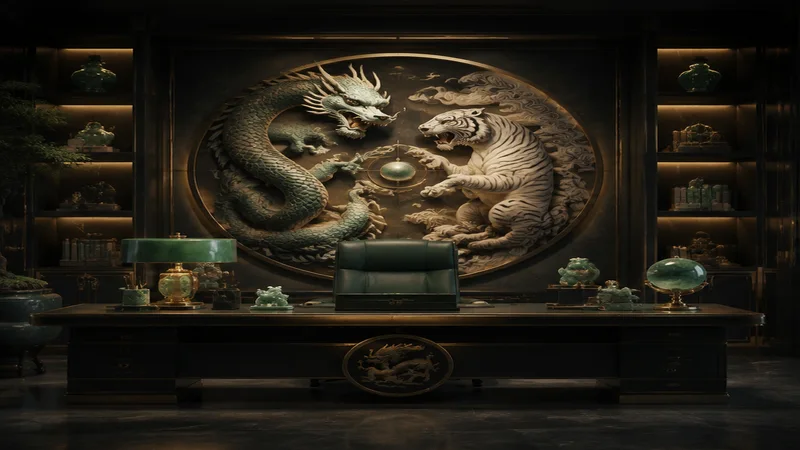
What Does "Left Azure Dragon, Right White Tiger" Mean?
One of the most famous principles in traditional Chinese Feng Shui is: Azure Dragon on the left, White Tiger on the right, Vermilion Bird in front, and Black Tortoise behind.
At first glance, this sounds like mythology. In fact, these four symbols represent an ancient framework for understanding how a building relates to its surrounding environment. The ideal environment was thought to provide:
- Protection and stability from behind (Black Tortoise)
- Active support from the left side (Azure Dragon)
- Quiet balance from the right side (White Tiger)
- Open space and opportunity from in front (Vermilion Bird)
This framework is considered a traditional belief rather than a scientifically proven principle. However, its basic logic — that a building's surroundings dramatically affect its occupants — aligns well with modern understanding of commercial real estate, workplace psychology, and urban planning.
How Can This Ancient System Apply to Modern Cities?
Modern cities rarely have mountains and rivers arranged exactly according to ancient Feng Shui diagrams. But traditional Feng Shui practitioners often reinterpret modern architecture symbolically.
For example:
- Tall buildings can represent mountains
- Roads can represent flowing water
- Parks and plazas can represent open natural spaces
- A large building behind your office can represent the Black Tortoise backing
- Open commercial space in front can represent the Vermilion Bird bright hall
This makes the ancient four-symbol framework surprisingly adaptable to evaluating modern office locations.
The Black Tortoise: Why "Backing" Matters
Traditional Feng Shui favors a building with something substantial behind it. This backing provides stability and protection.
In modern office design, this concept has obvious practical parallels. A manager's desk against a solid wall creates a sense of security and privacy. A building with a larger structure behind it feels more sheltered from wind, noise, and visual disruption.
The symbolic idea — "people work more comfortably when they feel protected from unnecessary activity behind them" — is also recognized in modern workplace psychology. Open-plan offices that leave employees exposed from behind can increase alertness and reduce focus.
The Vermilion Bird: Open Space in Front
The front of the building should ideally be relatively open. A large plaza, courtyard, park, road, or open pedestrian area creates a sense of space and accessibility.
Traditional Feng Shui calls this area the Ming Tang or bright hall. A cramped entrance may make a business feel inaccessible and unwelcoming.
Clear signage, attractive landscaping, comfortable pedestrian access, and open space in front can have obvious commercial benefits — more visibility, easier customer access, better first impressions.
The Azure Dragon: What the Left Side Represents
The Azure Dragon is traditionally associated with the left side of a building. In classical Feng Shui, the left side is expected to have stronger or more active support than the right.
In a modern interpretation, this does not mean placing a dragon statue on the left. It encourages examining whether the building's surrounding environment feels balanced. Ask:
- Is there a major road or pedestrian route on the left?
- Is there a neighboring building or structure?
- Is there a park, plaza, or open area?
- Does one side feel overwhelmingly enclosed?
These environmental details influence the experience of working in a location, regardless of one's belief in Feng Shui.
The White Tiger: Why the Right Side Should Be Quieter
The White Tiger corresponds to the right side. Traditional Feng Shui often prefers the right side to remain relatively lower or quieter compared to the left.
In practical terms, an office with aggressive construction, constant traffic, loud machinery, or heavy pedestrian congestion directly on one side may feel less comfortable than one with a calmer neighboring environment.
Balance between the two sides is the goal — neither should overwhelm the other.
Why Is Water So Important in Business Feng Shui?
Traditional Feng Shui often associates water with wealth because water moves, gathers, and circulates. In modern business terms, roads and transportation networks function metaphorically as water.
A business near a major road may benefit from high visibility, easy transportation, pedestrian traffic, delivery access, and customer convenience. But a major road can also create noise, pollution, safety concerns, and parking problems.
Good water is not simply more traffic. The quality of the movement matters — accessible, manageable flow is better than overwhelming volume that makes the location impractical.
What the Four Symbols Teach Modern Business Owners
A strong modern business location should ideally combine visibility, accessibility, stability, comfort, and appropriate customer flow. Traditional Feng Shui gives this combination symbolic language. Modern commercial real estate gives it different terminology. The two approaches are not necessarily opposed.
The ancient language may say: "The office should have support behind and openness ahead."
A modern architect might say: "Create a secure working environment with good circulation and visual openness toward customers."
The words differ. The underlying design intuition overlaps considerably.
Applying the Four Symbols: A Practical Checklist
When evaluating a commercial location, ask:
- Is there a stable, substantial structure behind the building? (Black Tortoise)
- Is there open, accessible space in front with good customer visibility? (Vermilion Bird / Ming Tang)
- Is the left side active with pedestrian flow or useful neighboring businesses? (Azure Dragon)
- Is the right side calmer and less disruptive? (White Tiger)
- Is the overall environment balanced — neither isolated nor overwhelmingly chaotic?
This checklist combines traditional Feng Shui logic with the practical considerations of any serious commercial real estate evaluation.